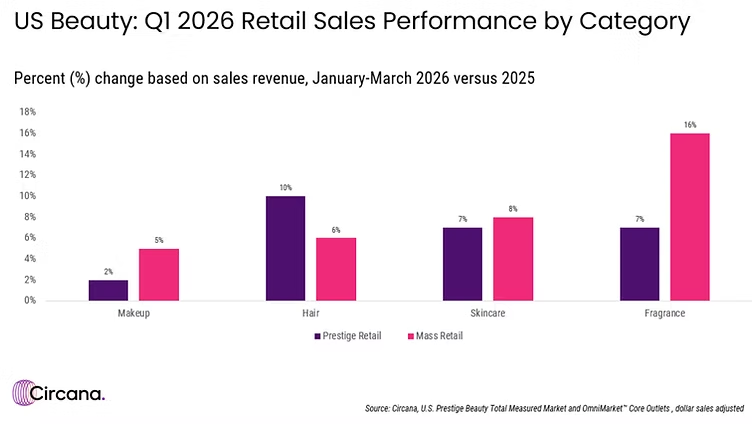
Haircare has officially overtaken fragrance as the fastest-growing category in prestige beauty after years of fragrance’s momentum dominating the industry conversation.
According to first quarter data from market research firm Circana, prestige haircare sales rose 10% versus 7% each for fragrance and skincare and 2% for makeup. Prestige haircare also ranked as one of the top unit drivers in beauty, second only to skincare. For the full year 2025, prestige haircare sales rose 8%, compared to 5% for fragrance, 3% for skincare and 4% for makeup.
“It just keeps growing,” says Larissa Jensen, SVP and global beauty industry advisor at Circana. “It’s been one of the strongest categories within prestige for several years now and it’s not showing signs of slowing down.”
Treatments are driving much of prestige haircare’s uptick as consumers increasingly shop for scalp care, bond repair and restoration products. Unlike fragrance or makeup, haircare doesn’t rely as heavily on in-store testing, and the category has registered strong online growth.
“Hair is very much like skincare in that a much larger share of sales happens in the dot-com space,” she says. “You don’t really see higher moisture in your hair immediately. So, it’s just easier to purchase it online.”
The category is being shaped by older and higher-income consumers. According to Jensen, shoppers 55 and older account for roughly 34% of prestige haircare buyers, while 66% earn more than $100,000 annually.
Hispanic consumers play an outsized role in prestige haircare growth. Jensen notes they make up 19% of prestige haircare buyers, the category’s second-largest consumer group after white non-Hispanic shoppers. “There’s a lot of diversity in terms of the different types of hair,” she explains. “There’s not one particular Latina hair type.”
Ahead, Jensen dives even deeper into what’s contributing to the category’s continued rise.
The Treatment Boom
Treatments have been the biggest growth driver in prestige haircare, and sales of scalp care treatments increased by a high double-digit percentage in the first quarter. Jensen highlights hair strength and restoration products, including bond repair formulas and in-shower masks, as among the category’s steepest gainers. Brands have caught on to the demand for treatments, and the number of new treatment launches more than doubled from last year.
Sales of haircare basics like shampoo and conditioner declined last year, but returned to growth this year. Styling product sales also increased, performing well in both mass and prestige.
Jensen believes the haircare category is in the early innings of “skinification,” and more skincare ingredients will be incorporated into haircare products. She zeroes in on the scalp microbiome, likening it to the gut microbiome from both a product development and consumer education standpoint.
Jensen says, “There’s still a lot of education the hair industry can provide consumers around hair and scalp health.”
Experts In Charge
Salon expertise remains the foundation of prestige haircare’s dominance. Salon-oriented brands account for about 70% of prestige haircare, representing the category’s largest segment, per Jensen.
She framed the salon brands’ success as part of a broader beauty trend around authority. “In hair, salon brands are the largest. In makeup, makeup artist brands are the largest. In skincare, doctor clinical brands are the largest,” she says. “The overall theme is expertise.”
Meanwhile, celebrity haircare is accelerating rapidly. Jensen shares that celebrity haircare’s sales volume has doubled, although it only makes up 3% of the market. Clean haircare brands are gaining traction, too, and clock in at 18% of the category.
The GLP-1 Opportunity
One of the biggest emerging opportunities in prestige haircare is hair thinning, particularly as GLP-1 usage grows. Jensen says haircare is a beauty category where GLP-1 users “over-index,” fueled partly by concerns around shedding related to dramatic weight loss and stress.
Products for hair thinning aren’t growing as fast as the total segment, but Jensen predicts further sales potential as GLP-1 usage expands with more accessible formats like pills and declining prices. She says, “As consumers navigate the side effects of these medications, which we believe will continue to grow, it’s something that I think is going to become a bigger piece in the future.”
Convenience Is King
Jensen points out that a misconception about prestige haircare is that most consumers engaged in it are deeply loyal to specific brands. In reality, she explains that accessibility plays a meaningful role in purchasing behavior. When Circana surveys consumers about the brands they buy most, a third of them report they buy brands that are easy to find, a sentiment more pronounced in haircare than other categories.
In other words, Jensen emphasizes that convenience is a higher-order catalyst for purchases in haircare than makeup, skincare or fragrance. Outside of haircare, she says consumers tend to be more likely to go out of their way to discover brands. That dynamic is propelling growth for brands expanding distribution at retailers like Sephora, Ulta Beauty and Amazon, and Jensen remarked that greater accessibility is benefiting the fast-growing prestige haircare segments including salon, celebrity and clean haircare brands.
High-Low Haircare Routines
Prestige haircare’s growth isn’t necessarily coming from consumers abandoning mass products altogether. Instead, many shoppers are strategically mixing prestige and mass products within the same routine.
According to Jensen, only about 20% of haircare users purchase exclusively mass-market haircare products. She says, “That means that the other 80% are potentially indulging in prestige either as that occasional treat or to purchase products that address specific needs.”
Treatments, scalp care and bond repair are benefiting in particular from the “high-low” shopping behavior as consumers prioritize efficacy-centered categories where they believe premium pricing matters most. Of the cross-shopper, Jensen says, “She may be buying her shampoo and conditioner in mass, but then buying her treatment products in prestige.”


Leave a Reply
You must be logged in to post a comment.