With aesthetics increasingly integrated into beauty, SkinSpirit is expanding its presence at Nordstrom, bringing its full suite of services, from Botox to laser hair removal, to department store floors.
The KKR-backed aesthetics chain, which operates more than 50 locations nationwide and describes itself as the country’s No. 1 provider of Botox and dermal fillers, recently opened a fourth outpost of its Nordstrom partnership at Westfield Topanga, a shopping center in Canoga Park, Calif. It joins locations at Chicago’s Oakbrook Center, Bellevue Square near Seattle and on 57th Street in New York, where its relationship with the retailer began last year. The expansion comes as aesthetics treatments are proliferating across brick-and-mortar environments, from Ject’s affiliation with high-end grocer Erewhon to Kalologie Medspa’s tie-in with Club Studio gyms.
“Beauty has always been an important consumer need, and department stores have tried to fill that need over time,” says Lynn Heublein, CEO and co-founder of SkinSpirit. “What this partnership reflects is not so much the integration of medical aesthetics into retail, but the role of medical aesthetics in beauty itself. I think the future of beauty is medical aesthetics. It’s going to become the white-hot heart of beauty.” She adds, “If beauty is important to your brand and you’re not experimenting, learning and aligning with the fastest-growing part of beauty, then you’re probably not being strategic.”
The convergence of beauty and aesthetics is certainly being recognized by prominent beauty players. Last year, L’Oréal doubled its stake in Restylane and Sculptra maker Galderma, and Waldencast acquired Novaestiq Corp. to extend Obagi into fillers.
For SkinSpirit, Nordstrom’s history of customer service and integrating services into retail was pivotal in convincing it to enter the department store arena. Nordstrom has offered brow shaping, blowouts and more. SkinSpirit strives for consistency with its services at Nordstrom. Heublein identifies the lack of consistency as a steep barrier to planting aesthetics services in environments not accustomed to them. She notes that many of the key decision-makers in beauty at Nordstrom have been clients of SkinSpirit, giving them familiarity with its experience and expectations.
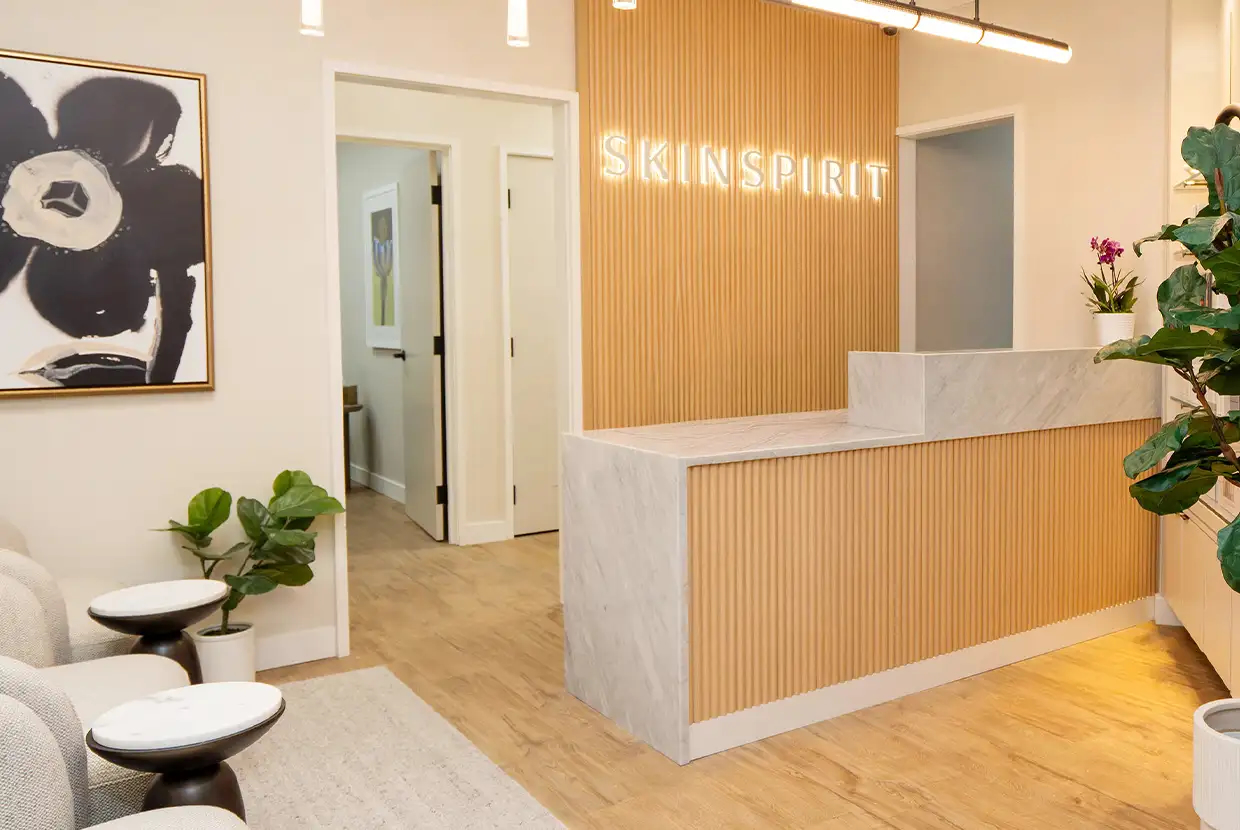
“When I started SkinSpirit, I wanted that same Nordstrom customer-service orientation. They knew the quality of service we could deliver,” says Heublein. “There’s not very many companies that can deliver services of this quality as reliably as SkinSpirit. Nordstrom’s executives need to rely on a partner that can deliver consistently high-quality service.”
Despite the in-store setting, Heublein doesn’t believe SkinSpirit’s Nordstrom clinics attract a fundamentally different clientele than its standalone locations. The demographic remains defined by interest in beauty, education and income. Treatments such as facials start at about $185, microneedling at around $400 and laser hair removal at roughly $100 for small areas, although pricing varies by location.
Heublein says, “This partnership helps us reach the demographic we want through a retail experience rather than a social media one.”
The path to discovery at Nordstrom, however, is unique. The retail environment tends to encourage exploration. Walk-in consultations and same-day conversations lower the barrier to entry, even if most treatments are still booked in advance.
“People are shopping, and they can easily ask questions. Instead of picking up the phone or driving somewhere for a special visit, it’s already part of what they’re doing,” says Heublein. “The general consumer still doesn’t really know the difference between neurotoxin and filler. It’s all a blur.”
“The future of beauty is medical aesthetics. It’s going to become the white-hot heart of beauty.”
Neurotoxins, fillers and facials are SkinSpirit’s top revenue drivers. Its service options, though, range far beyond them, and it takes a multimodality approach, enabling it to encompass regenerative treatments, energy-based devices, neurotoxins and fillers into clients’ treatment protocols. Looking ahead, Heublein is particularly energized by the shift toward regenerative medicine. She points to energy-based devices and biostimulators used for body treatments to address, for example, sagging skin on the arms or knees.
“Historically, skincare treated the symptoms of aging. With regenerative medicine, instead of filling the face to smooth lines, you can stimulate collagen and cellular renewal. It’s fundamentally different,” says Heublein, expounding, “Below the neck, regenerative medicine is a big opportunity.”
SkinSpirit remains founder-led and controlled, a structure Heublein views as both a constraint and a safeguard. The company reports client retention rates in the area of 70%, among the highest in the industry, alongside strong staff retention. The company is prioritizing systems, training and quality as it grows.
“Our North Star is whether we can deliver the experience and attract and train the staff required to do that,” says Heublein. “We’re not interested in growth for growth’s sake. We’re interested in very sustainable growth.”
Heublein, a former Procter & Gamble brand manager, launched SkinSpirit in 2003 in Palo Alto, Calif., with a $600,000 loan from the U.S. Small Business Administration. It’s part of a med-spa gold rush that has seen the number of U.S. medical spas roughly double over the past decade to more than 10,000, according to the American Med Spa Association.
In 2022, SkinSpirit received a minority investment from KKR during a wave of private equity investment in aesthetics, a highly fragmented sector with limited PE penetration. SkinSpirit has been participating in the sector’s early consolidation, including the purchases of Contempo Aesthetics in Pasadena, Calif., and Truth + Beauty in Roslyn, N.Y. The chain has grown from fewer than 40 locations two years ago to nearly 60 today.