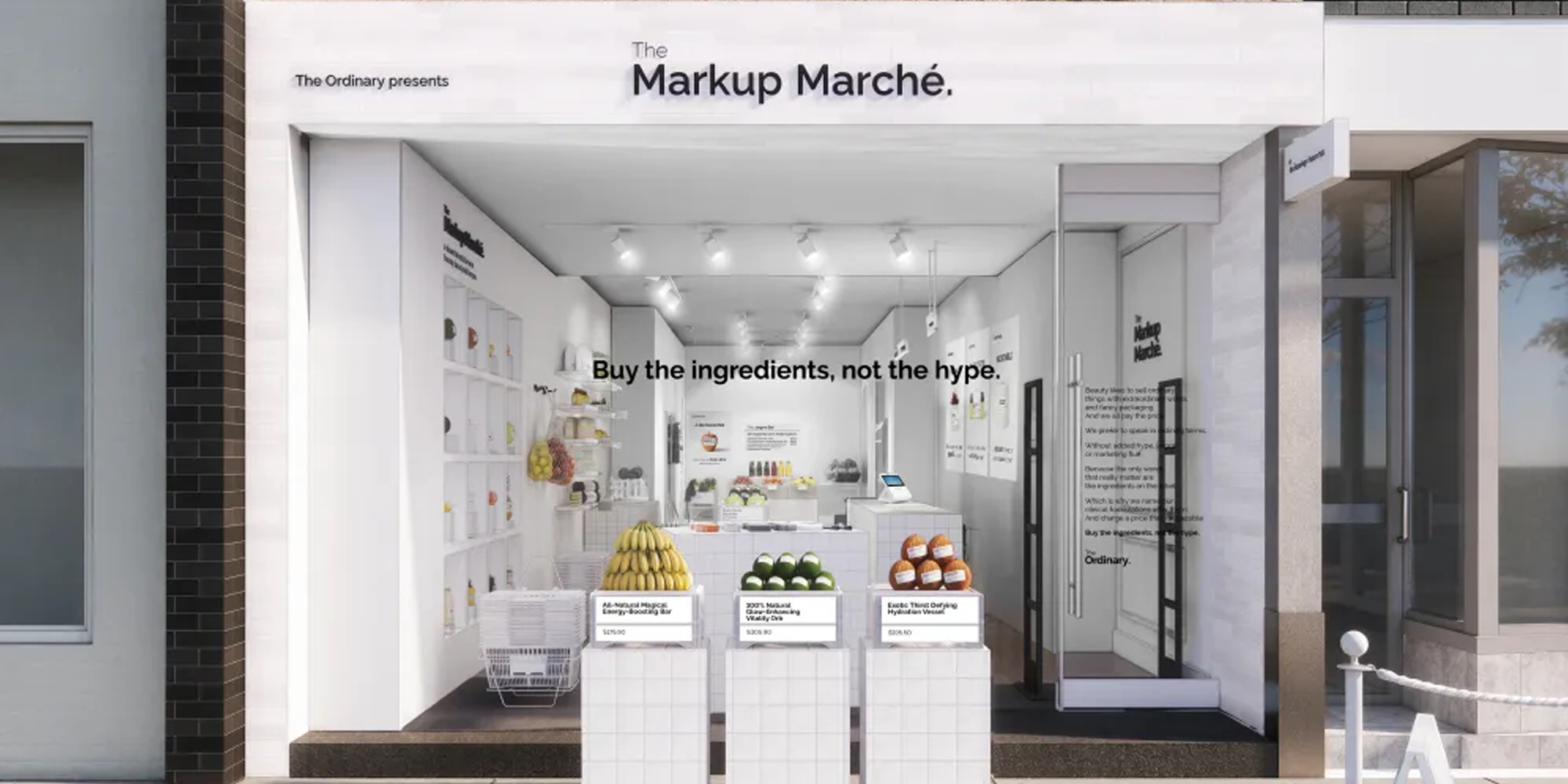

The Ordinary is turning markups into marketing with a grocery-style pop-up called The Markup Marché landing in six global cities this month to highlight the extraordinary premiums attached to luxury goods. For example, the pop-up features an “all-natural magical energy-boosting bar,” or banana, for $175.90; a “high-retention cleansing cylinder,” or toilet paper, for $96.20; and an “exotic thirst-defying hydration vessel,” or coconut, for $195.50.
Speaking to Women’s Wear Daily, Amy Bi, VP at Deciem, the Estée Lauder Companies division behind The Ordinary, said that luxury goods can carry markups as high as 700%, and the pop-up concept is meant to show that efficacy doesn’t require towering prices. But perhaps Bi should look closer to home before broadly criticizing markups.
In 2020, Business Insider cited an estimate suggesting a 3.4-oz. jar of Estée Lauder-owned La Mer’s Crème de la Mer could be recreated for about $35. Adjusted for inflation, that’s roughly $50 today. Against the product’s current $625 retail price, the implied markup would exceed 1,000%, though the estimate likely excluded packaging, marketing, retail margins and other operating costs.
The Ordinary’s anti-markup campaign comes as consumer sentiment is fragile, trust in corporations has deteriorated, dupes have proliferated, and many people are feeling financial strain. The brand has a history of taking on beauty industry practices in its marketing, including pseudoscience buzzwords in The Periodic Fable campaign last year, inflated ingredient claims and the reliance on celebrity-driven messaging over expertise.
In that context, for the latest edition of our ongoing series posing questions relevant to indie beauty, we asked 12 beauty industry consultants, product developers, cosmetic chemists and founders the following: Is anti-markup messaging an effective customer acquisition tool? What kind of markups do beauty brands need to succeed in the age of dupes and increasing price transparency? If a product performs and consumers love it, does markup criticism really matter?
-
 Jadene Taylor Founder, Cosmetic Scientist and Product Developer, Jadene Cosmetics
 I believe anti-markup messaging can absolutely be an effective acquisition tool. This is because, at its core, it’s a transparency play, and today’s consumer responds to honesty. That builds trust.
As a cosmetic scientist who has formulated products professionally, I can tell you that the markup on most luxury beauty products is not about the ingredients. It rarely is! The science, the raw materials, even the packaging are a relatively small component of what you’re paying for.
What you’re really paying for is positioning. You’re paying for the brand’s decision about where it wants to sit in the market and how it wants to be perceived. That’s not necessarily dishonest, but consumers deserve to understand that’s the transaction they’re making.
In the age of dupes and increasing price transparency, I believe the brands that will survive are the ones that are genuinely innovative. If your product does something that has never been done before, if it performs in a way that can be proven through real user results, I believe consumers will pay for it and they won’t resent the price. The problem arises when a product is ordinary, no pun intended! But the price tag is extraordinary purely for the sake of prestige.
If a product performs and consumers love it, markup criticism largely doesn’t matter. People don’t resent paying for something that genuinely works. What they resent, especially right now in this economic climate, is feeling exploited. That’s where integrity comes in.
There’s a difference between a brand that charges a premium because they’ve earned it through innovation and efficacy, and a brand that charges a premium simply because the market has historically allowed it. Consumers are definitely getting better at telling the difference. Brands that can’t tell the difference themselves are the ones who should be worried.
- Laura Badcock Cosmetic Formulator and COO, NourishUs Naturals
From my side of the industry, anti-markup is a great way to get people to stop scrolling, but it’s not a full business model. The Ordinary’s Markup Marché works because it says the quiet part out loud: yes, a lot of luxury pricing is more about theater than raw formula cost and turning that into a $175.90 banana is a pretty accurate joke. In a moment when consumers are tired, cash poor and suspicious of anything that sounds like “miracle in a jar,” calling out the game wins your attention and goodwill very quickly.
The flip side is that once you put yourself on the anti-markup pedestal, people are absolutely going to poke at your own margins. The Ordinary lives inside Deciem, which is majority-owned by Estée Lauder Cos. You don’t get to act like you’re a scrappy outsider forever. So, yes, anti-markup can pull customers in the door, but if the formulas don’t perform and your pricing ladder creeps up over time, that same message will boomerang back at you.
There’s the markup that makes for a viral tweet, and then there’s the markup that actually keeps the lights on. The La Mer example is a good illustration: Business Insider highlighted an estimate that a jar of Crème de la Mer could be replicated for roughly a few dozen dollars in ingredients versus a retail price in the hundreds, which makes for a delicious 1,000% markup headline. What that number doesn’t show you is everything unsexy that sits between a bench sample and a bottle on a shelf such as regulatory, R&D, manufacturing overhead, which includes employee wages and hopefully benefits, freight, retailer margin, sampling, counters, and now content and creators.
For indie and masstige brands, what I see work is much more grounded. You build to support 40% to 60% wholesale discounts, similar retailer margins, promos and still have enough left to reinvest. If you’re disciplined on packaging and supply chain, you can hit very fair retails without needing “La Mer math.”
In true luxury, you’re selling brand “aura” as much as emulsion (heritage, packaging, environment, service), and consumers historically accepted that. What’s changing is that younger shoppers now have enough information to separate cost of actives from cost of aura, and they’re increasingly deciding the brand “aura” isn’t always worth a four-figure percentage markup.
For a certain kind of loyalist, performance wins and everything else is noise. If cream or serum is the only thing that keeps their skin calm or makes them feel like it’s the only hero product in their routine, they will happily ignore COGS breakdowns and dupe callouts. La Mer is a perfect example as its fans aren’t sitting with spreadsheets. They’re buying the result and the ritual.
Where markup criticism really bites is with the “smart shopper” cohort. These are the people driving dupe culture and TikTok discourse. They like the feeling of hacking luxury, getting 90% of the effect at 20% to 30% of the price.
For them, it absolutely matters if your formula looks generic, but your price looks aspirational. That’s why I think the danger zone isn’t ultra-luxury or clear-value brands; it’s the muddled middle, charging BMW prices for Toyota formulas and hoping nobody reads the ingredient list.
- Loren Scott Founder, Health and Beauty Partners
The Ordinary’s Markup Marché is a smart campaign. It resonates with their audience, fits the brand’s tone and taps into a frustration consumers are genuinely feeling right now. But it’s worth being clear about what it is: a customer acquisition play, not a principled stand against industry pricing.
Estée Lauder isn’t losing sleep over this. La Mer’s buyer isn’t getting poached by a pop-up in six cities. The target here is the price-conscious consumer who’s already wondering whether a $300 moisturizer is worth it, and The Ordinary is positioning itself as the obvious answer. That’s a legitimate strategy. It just shouldn’t be confused with a transparency movement.
Which brings me to my real issue with the campaign. If The Ordinary wants to lead on transparency, let’s see their own numbers: raw material costs, CM fees, packaging margins, broker and retail splits. The same scrutiny they’re applying to luxury competitors should apply to themselves. Without that, this is theater.
On the markup question itself, context matters. Retail-facing brands generally need to hit product cost around 10% of MSRP, sometimes lower. E-commerce has more room, sometimes up to 25% of sale price.
Those aren’t arbitrary ratios. They reflect the full weight of what sits between a formula and a shelf: contract manufacturing, packaging, retail margin, broker fees, marketing. A 10X markup sounds outrageous until you account for all of it. A banana with a $175 price tag is a good visual, but it’s not a complete picture.
My bigger concern is where this kind of messaging leads to at a category level. We’re already watching price race to the bottom in e-commerce: single-ingredient oils, commoditized actives, Amazon brands undercutting everyone on margin. When price becomes the primary value proposition, brand equity goes with it, and the whole category gets cheaper and worse at the same time.
As for whether markup criticism moves consumers, it’s probably not much, especially if the brand has already earned their belief. La Mer loyalists aren’t running spreadsheets. They’re buying a ritual, and they’ll rationalize the price to fit the story they tell about themselves. That’s not irrational, it’s just how brand loyalty works.
But it does have to be earned. And the next credibility test won’t be about price transparency; it’ll be about efficacy, clinical studies, legitimate results, third-party validation. Consumers don’t have a problem paying more for something that actually works. They have a problem paying more for a story that doesn’t hold up.
The Ordinary has the storytelling side down. Whether they can back it up with proof is the more interesting question.
- Tricelle Gray Founder, Formuley
Anti-markup messaging is rarely a broad acquisition engine. The Markup Marché is sharp, but it is mostly preaching to people who already love The Ordinary. La Mer loyalists are not the easy conversion target because premium beauty is not just about function. It is also about identity, ritual, trust and habit. To me, this is a retention and reactivation play dressed up as acquisition.
The markup that works now has to do two things at once. It needs to fit the customer you are actually for, and it needs to stay defensible against the dupe sitting next to you on the shelf. If you outprice your customer, you lose them. If you charge a premium you cannot defend with substance, a dupe will eat you.
A defensible markup has a real stack underneath it, including R&D, named actives at functional concentrations, real testing, clinical work, supplier provenance and batch-level consistency. The indefensible version is what chemists call pixie dusting, building the story around a hero ingredient that appears at a level unlikely to support the claim.
Does markup criticism matter if a product works? It depends on the product and the customer. If the product delivers and the price fits the customer, criticism does not churn people. But “the product works” is itself a claim, and most consumers cannot verify it from the bottle. Business of Fashion and McKinsey’s 2025 beauty report found that 63% of consumers do not consider premium beauty higher performing than mass, which is not really a markup problem so much as an evidence problem.
The evidence problem is fixable, but most brands have not started. Real transparency means formula history, supplier documentation, testing records, batch records and the ability to retrieve all of it when the market asks, “Prove it.” Many brands cannot pull that data, and that is the real conversation we should be having.
-
The transparency play The Ordinary is making as a customer acquisition tool is something Beauty Pie brought to market a decade ago. So, while it may land fresh with a new generation of consumers, it's not a new idea. It's pretty on-brand for The Ordinary. Efficacy over pretense has always been their message.
What I'd push them to do more of is lean into who they are, not who they're not. If you spend any time on their website, it's clear the products deliver. Clinical results, before-and-afters and key ingredients are all there. They just need to leverage that at all touchpoints, paired with more emphasis on texture and the actual experience of using the products, to push back against the idea that affordable means basic.
On markups, there's a piece of context most consumers don't have. Retailers take roughly 50% of SRP just to stock a product. That doesn't make prices feel less steep, but it does change the picture a little.
The independent brands I work with typically target a 90% gross margin on wholesale, with 80% being closer to reality. Investors want strong profitability, and for prestige products, those numbers are achievable, but the math looks different once you're not selling direct. Again, not something that customers take into consideration.
As for whether markup criticism matters when a product performs and people love it, not really. That's exactly why knowing your customer is so important. You don't have to be the best value option if that's not your positioning. Not everyone shops at Zara or flies basic economy, but enough people do that it's a real market. The difference, though, is that Zara doesn't take shots at Nordstrom, and Spirit doesn't run ads comparing itself to Delta One. This approach will connect with some consumers, but it'll turn others off just as quickly.
- Alec Batis Co-Founder and Co-CEO, Sweet Chemistry
I'm sympathetic to the underlying message. Luxury markups built on storytelling rather than formulation science are a real problem, and price transparency is genuinely valuable for consumers.
But credibility requires consistency. You can't selectively apply transparency principles to your low-price brand while your other prestige product operates on the same playbook you're publicly mocking.
If it’s really a concern versus a promotional stunt, why not just have a real and straightforward conversation rather than mocking the rest of the industry? And that would start with disclosing the ingredient concentrations that warrant the retail prices.
- Laura Lam-Phaure Fractional Technical Advisor and Cosmetic Chemist, Lam Phaure Beauty Group
I believe anti-markup messaging can be somewhat misleading. From a business standpoint, every product requires a markup. Otherwise, there’s no sustainable way for a company to operate or generate profit. That said, pricing transparency can be a compelling way to build trust and attract consumers who feel products are overpriced.
In the case of brands like The Ordinary, their positioning already reflects mass-level pricing, so there’s an inherent understanding that margins are likely leaner compared to prestige brands. Markup strategies also vary significantly from brand to brand, depending on their business model, scale and overall needs. Dupes have always existed in the market. Social media has simply amplified their visibility and accelerated how quickly they’re identified and shared.
Ultimately, if a consumer loves a product, finds it effective and can afford it, markup alone shouldn’t be the primary point of criticism. The cost of goods is only one piece of the puzzle. Brands also carry substantial expenses across marketing, PR, payroll, HR, operations and more. These costs can vary widely, especially for smaller or growing brands, making a one-size-fits-all view on markup unrealistic.
- Krupa Koestline Founder and Cosmetic Chemist, KKT Labs
Anti-markup messaging works as a hook, not a strategy. It earns The Ordinary press cycles like this one, but it doesn't build loyalty, performance and feel do. The uncomfortable truth is that every brand carries a markup, and the math gets complicated fast once you account for clinical testing, stability work, regulatory, packaging that doesn't leak, and the formulator's time to actually solve a problem versus copying one.
A 700% markup on a serum that took two years and forty iterations to get right is a different number than a 700% markup on a recolored base. Consumers are getting smarter about that distinction, which is why price transparency cuts both ways. If your product performs and the story behind the price is honest, markup criticism is noise. If it doesn't, no amount of clever pop-up theater will save you.
- Joe Schrank Founder, The Cosmetic Manufacturer
Anti-markup as marketing? It works. Anti-markup as a business model? I don't see that playing out well. The Ordinary nailed the moment, and people are sick of paying $200 for a serum they think cost $4 to make, and the Markup Marché is great theater, but it's owned by Estée Lauder, who also owns La Mer, where a 3.4-oz. jar of Crème de la Mer is $625 against a COGS that Business Insider estimated at $35 a few years ago.
So, the anti-markup stance is a positioning play inside a portfolio that completely depends on those markups elsewhere. Hard to take it fully seriously. This day and age, consumers are more knowledgeable about a brand and who it's affiliated with. Don't get me wrong. Estée is no dummy. I'm sure they have a well-thought-out plan, but taking this angle while owning some of the most well-known expensive products on most shelves...I don't see the vision.
The thing most people don't realize is how little of that retail price actually goes to the brand. By the time the retailer takes their 50%, the distributor or rep takes their cut, and you back out the cost to actually make the product, you're left with very little to pay for marketing, headcount, fulfillment, returns and everything else.
That's why most brands need to price at 5X to 8X what the product cost to produce, not because they're being greedy, but because anything less and the math just doesn't work, especially with how expensive customer acquisition has gotten. Brands trying to run on tiny markups aren't being virtuous, they're usually on their way out (similar to CMs).
Does markup criticism matter if the product works? Honestly, no. People say they care about transparency, but they buy what works, what their friends use and what looks good on the shelf. What's actually changed is that the product has to back up the price. Charge $80 and the formula better deliver. The ingredient deck can't look like a $12 product in a nicer jar. The brands that get hurt by Markup Marché stuff are the ones who built everything on packaging and adjectives. The ones with real formulation are fine.
- Miriam Mandel Fractional Head of Product Development and Supply Chain
Anti-markup messaging is a luxury that most indie brands can't afford, literally. The Ordinary can run a campaign like this because they have the scale and backing to absorb it. For a founder-led brand trying to fund retail placement, hire their first employee and keep formulation quality high, markup isn't greed, it's the key to survival.
The markup conversation also ignores what actually goes into a product getting on shelf. Packaging, regulatory compliance, minimum order quantities, freight, retailer margins, in-store displays, marketing budgets, none of that is free. A consumer sees a $45 moisturizer and thinks the brand is printing money, but the reality is the brand might be making $4.
Does anti-markup messaging work as a customer acquisition tool? Maybe for a brand the size of The Ordinary with an already loyal audience.
The brands that are winning aren't necessarily the cheapest, they're the ones consumers trust. That trust gets built through performance, transparency and consistency, not by throwing shade at your own industry's economics.
- Theresa Plavoukos Founder, Plavoukos Beauty Consulting and Fat Mermaid Liquid Marine Collagen
When The Ordinary started openly deconstructing their pricing, it resonated because their product credibility was already there, so the transparency felt genuine. The risk for brands that lead with low pricing too early is that they end up attracting consumers who are primarily motivated by price versus performance. If the product doesn’t deliver, they move on to the next low-priced brand.
What I think gets lost in the markup conversation is how much goes into a product before it ever reaches a shelf: the formulation development, safety testing, evacuation and compatibility assessment, supply chain, consumer panel or clinical testing. Those costs are real, and healthy margins are what allow a brand to keep investing in quality and innovation over time.
That said, consumers are right to expect accountability. I feel that if a product truly performs, pricing criticism tends to quiet down on its own. People will invest in something that actually improves their skin, hair, mood, health, etc. What erodes trust in a brand is a premium price tag that isn’t backed up by product performance.
- Angella Sprauve Cosmetic Chemist and Clean Beauty Product Developer
I enjoy the satire in The Ordinary’s anti-markup messaging, and I understand why it resonates right now. Consumers are more price-conscious than ever, and there’s growing skepticism around luxury pricing across industries, including beauty.
That said, I think the stronger customer acquisition strategy would be less about criticizing markups and more about pulling back the curtain on what actually goes into developing and bringing a beauty product to market.
Consumers are craving transparency. This could have been an opportunity to educate people on formulation costs, testing, packaging, retailer margins, marketing and the many behind-the-scenes expenses that contribute to a product’s final price.
In the age of dupe culture and price transparency, there are still meaningful differences between an original product and a lower-cost alternative. One example that comes to mind is the Patrick Ta blushes. They’ve been heavily duplicated, but there are still nuances in texture, payoff, blendability, wear and overall sensory experience that many consumers feel justify the higher price point.
As a formulator and product developer, I think brands are more successful when they explain the value behind their pricing rather than simply defending the markup itself. Elevated packaging, proprietary technology, ingredient sourcing, stability, performance testing, artistry and brand experience all contribute to perceived value.
Luxury price points still absolutely have their customer. If a product performs, creates loyalty and delivers an experience consumers connect with, markup criticism becomes far less relevant. The Ordinary customer is not necessarily the same customer purchasing La Mer. A luxury consumer is often buying into heritage, storytelling, formulation experience, packaging and emotional connection in addition to the formula itself.
If you have a question you'd like Beauty Independent to ask consultants, product developers, cosmetic chemists and founders, send it to [email protected].