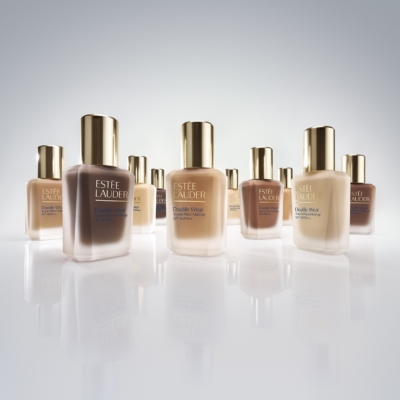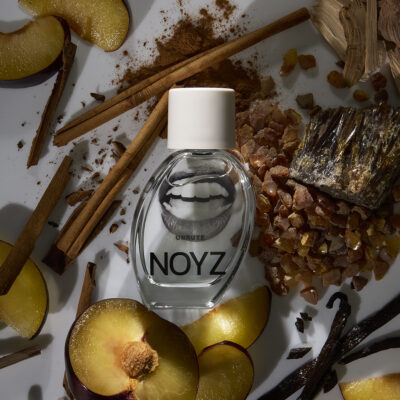

The Gap recently announced that it’s (re)entering beauty and last week it provided a sneak peek of its offering.
On one hand, the move confirms what we in the industry know: Beauty remains the most dynamic growth engine within consumer packaged goods. It validates that ours is, indeed, the vertical to be in. Having Gap enter the market could stimulate innovation, offer consumers more choice and perhaps create a new scalable point of distribution for brands unable or unwilling to enter Sephora, Ulta Beauty or Target.
An optimist will see Gap’s beauty strategy as a rational pivot: an effort to leverage the retailer’s physical footprint and sizable foot traffic to drive incremental and hopefully more profitable sales in an adjacent category. It’s a playbook used before, albeit with mixed results, by other mall-based retailers such as Victoria’s Secret and the nameplates under the Urban Outfitters group, Anthropologie and Free People among them.
On the other hand, as a beauty person, I can’t help but ask: Does the market—or the world—really need another beauty brand or another point of sale? The newly unveiled assortment (granted, it’s still version 1.0) looks good, but hardly revolutionary. I struggle to find meaningful innovation or the kind of character edge, and storytelling that founder-led brands like Vacation, Byoma or Bubble have made table stakes. And when it comes to distribution, the announced partners such as Neutrogena and Burt’s Bee are already everywhere.
A cynic might view Gap’s beauty play as a distraction by a chain challenged to find growth in its core apparel business. Despite a few successful precedents, far more fashion brands have entered beauty only to retreat, incapable of staying competitive in an unforgiving, hyper-saturated market. Just ask Kering.
Gap learned this lesson once already. It entered beauty years ago, and little suggests that today’s environment makes the company any better positioned to win. If anything, the rise of Sephora, Ulta, Amazon and TikTok has made the landscape even tougher.
So, while the move may be valid, it rests on a few assumptions worth unpacking.
Assumption 1: Beauty Is Growing, So Why Not Us?
Beauty and personal care are growing at roughly 3% to 4% annually, a tempting prospect for a company that just posted 1% year-over-year growth.
But growth in beauty isn’t evenly distributed. The category has become increasingly complex, capital-intensive and unforgiving. Expansion accrues disproportionately to what I call beauty champions or brands with distinctiveness, velocity and discipline. For every Rhode, there are a dozen J Lo Beauty that, despite tremendous promise and support, struggle to break through. From what I’ve seen, the assortment presented so far doesn’t look or feel like a future beauty champion.
Assumption 2: Fragrance and Body are Booming
Fragrance, as my friend Larissa Jensen, SVP and global beauty industry advisor at Circana, likes to say is having its moment, with robust growth across nearly every segment, including body mists, and prices. And fragrance, including home fragrance, has always been a natural adjacency for fashion brands.
Those of us who’ve lived through a few cycles know how fleeting these booms can be. A decade ago, color cosmetics were on fire. Consumers couldn’t get enough of contour, fueling sales and M&A activity. Today that same category has cooled to near stasis, with many once-hot assets shuttered or being sold at deep discounts by their acquirers.
Fragrance and body may be hot now, propelled by trends such as layering, but breaking into a category at or near its possible peak rarely yields long-term success.
Assumption 3: Beauty Will Boost Store Productivity
This argument is perhaps the most reasonable. Gap’s vast store network and foot traffic are tremendous assets. Further monetizing that footprint without adding new doors makes complete sense.
Beauty, on paper, fits the bill. It’s less space-intensive than apparel yet carries comparable or higher margins. Since the customers are there, why not sell them beauty, especially if Gap’s research suggests it’s the No. 1 category younger consumers want at its stores?
As a beauty person, I get it. Young people do love beauty. If you asked them, they’d say they’d buy it practically anywhere. A colleague joked that you could place a Sephora vending machine in a funeral home, and it would probably do brisk business with gen Zers attending their grandma’s wake. That doesn’t make beauty a sustainable long-term fit for the undertaking business.
Furthermore, having authority in apparel doesn’t necessarily translate into command in beauty. Selling jean shorts and leggings doesn’t mean that modern and aware consumers will trust you for hair and skincare recommendations. While Target can pull beauty off, it has a pharmacy and sells food. Mom and dad are in a fundamentally different headspace shopping there. Even at Target, the sunsetting of its Ulta partnership demonstrates that a retailer can push its reach in beauty only so far.
What’s the Real Play Here?
Is The Gap committing fully to beauty—creating a line so differentiated, so compelling, that it could stand on its own and possibly one day gain distribution outside its own stores? If so, why anchor the launch with brands like Neutrogena and Burt’s Bees—products available in every CVS in America?
Alternatively, if the plan is to curate an assortment of “good-enough” brands, I’d question the wisdom of opening a new front, picking a fight with Ulta, Sephora and Target while already locked in a fierce battle with Zara, H&M, Abercrombie and Shein.
And then there’s the operational questions–from stockkeeping to merchandising and loss prevention. It’s unlikely that brands will send their own field teams, which means the burden will fall on Gap’s already stretched apparel staff. Even Target—a powerhouse with one of the most compelling beauty assortments in the U.S.—has learned the hard way what happens when a retailer overextends without adequately adapting its operations to new ambitions.
In my view, only two companies have successfully built and maintained competitive fashion and beauty businesses at scale on their own: LVMH and Chanel. And as wonderful as The Gap is, it’s not playing in that league. It’s far closer to, for example, H&M, who despite entering beauty a few years ago, cites its beauty business in a literal footnote on page twelve of its recent financial report. It’s worth studying why.
So I have to ask: does The Gap truly have what it takes to win in both beauty and fashion long-term? When the next downturn hits—and it will—Gap’s core apparel business, which still drives 90% of revenue, will inevitably take priority. The company will do what it has always done: pull resources to protect apparel. And it’s that moment when it will be most vulnerable to beauty pure-players coming after its business.
The bottom line is that having the ambition and resources to enter beauty today is one thing; maintaining the stamina and capabilities to win in beauty tomorrow is another. Which is why most successful fashion houses have chosen to partner with the pros—Estée Lauder, L’Oréal, Puig.
The Real Issue Isn’t Beauty, It’s Focus
The beauty team assembled at The Gap is truly world-class and, as long as that caliber of executive is kept around, there is a good chance the front will hold. Ultimately, however, my biggest concern has little to do with beauty.
Within its portfolio, Gap remains a gem: an iconic brand with enormous latent potential. The recent viral ad campaign proved its enduring resonance in the American psyche.
In my humble opinion, Gap doesn’t need to experiment with beauty. It needs to win in apparel. Beauty should support that mission, not distract from it.
To make beauty work, Gap has to do something genuinely different—big, bold and magnetic. Something that draws new traffic because it’s inherently appealing, not because it’s opportunistic.
That means finding the right beauty partner, which is probably not a white-label developer producing private-label lines, but a kindred spirit: a brand owner, builder, community maker. Someone fast, fearless and creative.
Bridge The Gap
Conveniently, that unicorn happens to be headquartered less than 50 miles away across the Bay Bridge: E.l.f. Beauty.
Until recently, E.l.f. was one of the most underestimated champions in our industry. Even now, I don’t think it gets the respect it truly deserves, especially from prestige companies that prefer to dismiss it.
E.l.f. is already sold at Old Navy, but that’s a conventional wholesale relationship, nothing special there. Imagine something deeper.
Think of their brand DNA. Both E.l.f. and Gap are classic American disruptors. Gap didn’t invent the chino or the hoodie, but it made them iconic. E.l.f. didn’t invent half its bestsellers (at least not according to Milk Makeup, Charlotte Tilbury or Supergoop), but it democratized them.
Imagine giving E.l.f. prime space at Gap and getting out of the way. Let E.l.f. build, assort, merchandise and activate. At the prices where Gap needs to play, which are decidedly not prestige, no one would execute faster or smarter.
Let E.l.f. print cash at Gap. Give them every reason to invest, draw new traffic in and keep existing traffic longer. Make E.l.f. so happy that next time they run a Super Bowl ad, it’s with models wearing limited-edition Gap apparel made for the occasion.
E.l.f. × Gap could create a fun, high-energy, affordable beauty destination, something malls have been missing for decades. Strategically, they could place E.l.f. × Gap installs in malls that already have a Gap, but not an Ulta, expanding physical reach without upsetting E.l.f.’s existing anchor retail partner.
For The Gap, the upside is enormous: a hot, inclusive, relentlessly innovative partner with deep category coverage and lightning-fast product cycles—think Gap exclusives—without taxing SG&A with a beauty team or locking up capital in inventory.
A few years ago, e.l.f. operated its own standalone stores—a heavy lift for a company then a fraction of its current size. Closing those doors and refocusing online in 2019 arguably saved the business. But e.l.f. is no longer the vulnerable upstart it once was. Today, it could thrive on a national physical platform—one that delivers fashion-driven foot traffic and a storytelling canvas across its growing portfolio, without the burden of building its own stores.
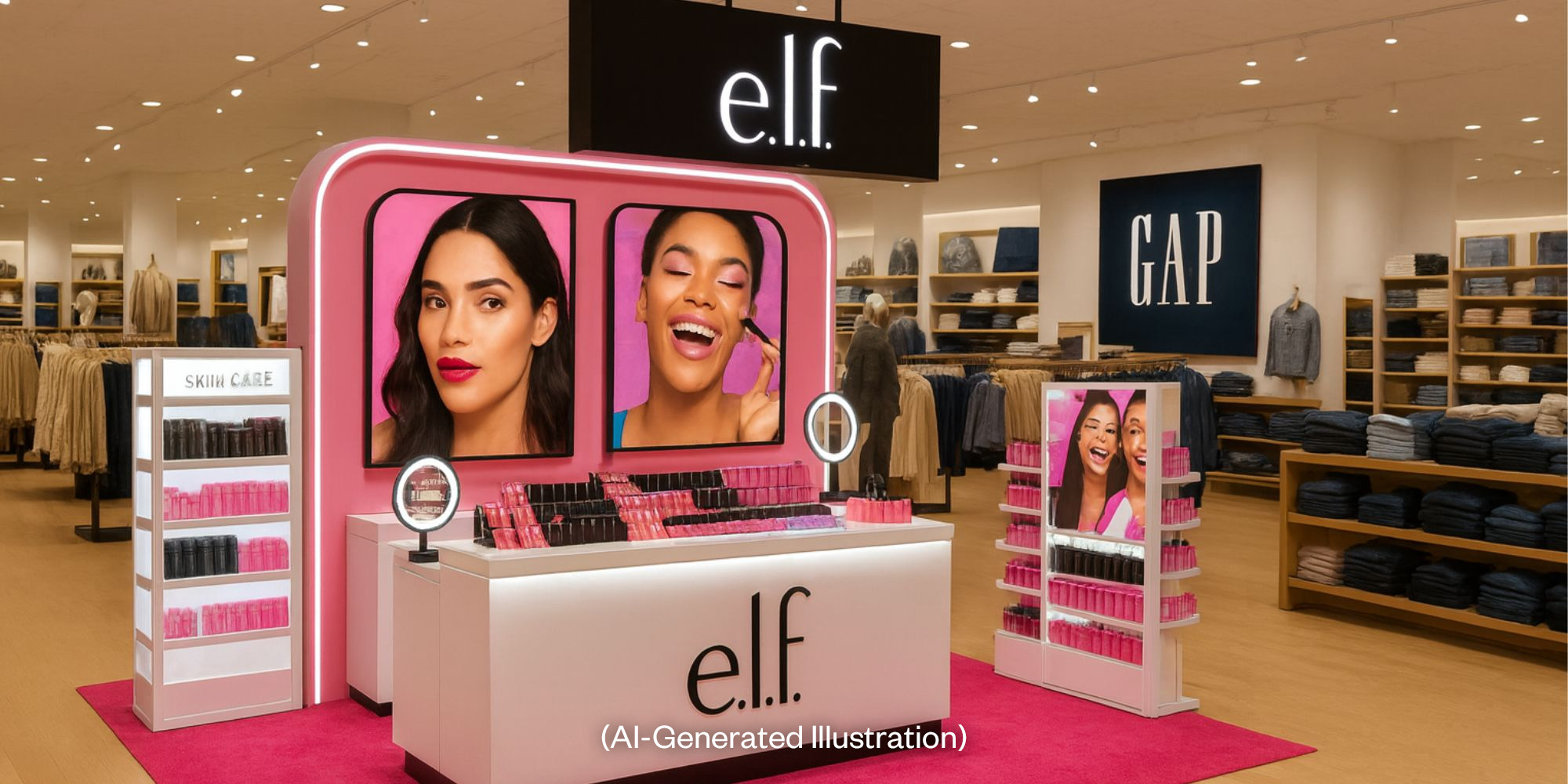
I asked Sebastian—that’s what I call my ChatGPT—to mock up E.l.f. × Gap. Tell me it doesn’t look fun! Envision what Kory Marchisotto, E.l.f.’s maverick CMO, could do with that blank canvas. Half the installs would probably have DJ consoles for influencer events you could hear from the food court.
Since both companies are roughly the same size—around $8 billion in market cap (just don’t compare the P/E ratios)—and generate over 80% of sales in the U.S., this relationship could truly be a partnership of equals. If I were a Gap shareholder, I’d sure welcome that E.l.f. multiple rubbing off on my stock.
With E.l.f. by its side, Gap wouldn’t have to worry about maintaining competitiveness in beauty. It would have the alpha of fast beauty fronting its stores, while refocusing internal resources on where it truly must win, apparel. And there’s a good chance shoppers will buy more hoodies and chinos once they’re feeling E.l.f.ing good.
Pick up The Phone
Perhaps Richard Dickson (CEO of The Gap) will pick up the phone, call Tarang Amin (CEO of e.l.f.), and say: “T, let’s crunch the numbers and see if we can put an e.l.f. in every Gap and make America happy again.”
It’s simple, strategic, and makes perfect sense—two American icons partnering to do something bold together, each focusing on what they’re great at, and doing it at scale. I think customers will love it, and, if the numbers add up, I am sure Wall Street will love it too.
Absent this, we shall all patiently await to see how Gap’s current beauty strategy unfolds.