
AI-Powered Customer Support In Beauty: From Response To Resolution


3- CAPABILITIES & FUNCTIONALITY >
6- VENDOR LANDSCAPE & DIFFERENTIATION >
Definition
AI-powered customer support refers to the use of artificial intelligence systems to manage, resolve and optimize customer service interactions across digital channels.
In beauty, these systems go far beyond answering basic questions. Powered by generative AI and agentic AI, modern support platforms can understand customer intent, retrieve order and product data, and take real operational actions such as processing refunds, initiating returns or exchanges, updating addresses, resending orders, or escalating sensitive cases to human agents.
In its most advanced form, AI-powered customer support becomes an operational layer that resolves issues end-to-end, not just a conversational interface.
Background & Context
As beauty commerce has shifted increasingly online, customer support has become a critical extension of the brand experience. While beauty generally has lower return rates than many other consumer categories, it presents unique support complexity driven by product sensitivity, shade accuracy and high customer expectations around education and trust.
Historically, customer support relied heavily on human agents and ticket-based systems. Early chatbots helped deflect simple questions, but lacked the intelligence or authority to resolve real issues. Today, AI technology has matured significantly:
-
- Generative AI allows systems to understand nuance, tone and intent, which are vital in emotionally driven beauty interactions.
- Agentic AI enables systems to act, not just respond, executing refunds, exchanges, order updates and workflow decisions.
- Deep integrations with e-commerce platforms allow AI to operate directly on real customer and order data.
The result is a shift from customer support as a cost center to customer support as an efficiency, loyalty and insight engine.
This shift is not theoretical. Gartner predicts that, by 2028, at least 70% of customers will use a conversational AI interface to begin their customer service journey and that, by 2029, agentic AI will autonomously resolve up to 80% of common customer service issues without human intervention.
For beauty brands, this signals a fundamental change in how customer support is designed and scaled, moving from human-first response models to AI-led resolution with human oversight.
Capabilities & Functionality
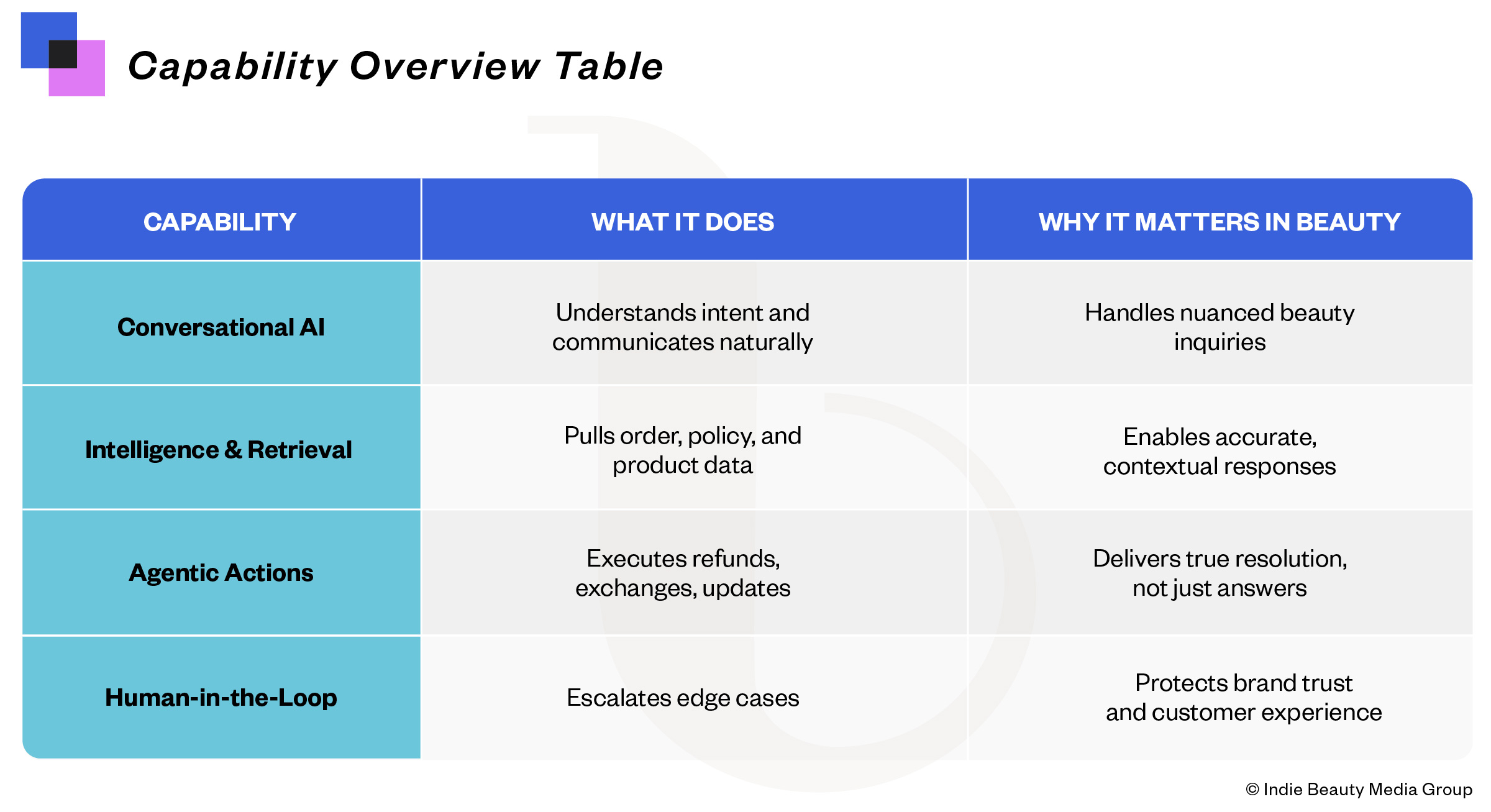
Modern AI-powered customer support systems are best understood as a coordinated set of capabilities rather than a single tool. These systems combine conversation, intelligence and action to move issues from inquiry to resolution.
The difference between responding and resolving is a critical distinction for brands. Conversational AI manages communication and understanding, while agentic AI enables the system to take action within defined guardrails. Without agentic capability, AI support remains limited to triage and deflection. With it, AI becomes operational.
Core Capability Layers:
-
- Conversational interface: The customer-facing layer that manages natural language interaction across chat, email, SMS and sometimes voice. It interprets intent, maintains brand tone and handles follow-up questions.
- Intelligence layer: The behind-the-scenes layer that retrieves and interprets data from the e-commerce platform, including order history, fulfillment status, policies and customer context, and determines the appropriate resolution path.
- Agentic action layer: The execution layer that allows AI to carry out actions such as issuing refunds, initiating returns or exchanges, updating orders or escalating exceptions to human agents.
- Human-in-the-Loop: While AI can resolve many routine issues, certain situations in beauty still require human judgment. This layer ensures that sensitive, high-impact, or unusual cases — such as adverse reactions, VIP customers, or policy exceptions — are escalated to human agents with full context. It allows brands to scale automation while protecting trust, empathy, and brand integrity.
These layers work together dynamically to resolve issues efficiently, consistently and at scale.
Implementation: How AI Customer Support Connects To Your Tech Stack
While AI-powered customer support can sound technically complex, implementation is typically far more straightforward than brands expect. These systems are designed to attach to existing commerce infrastructure rather than replace it. In practice, most beauty brands already have the foundational systems required to deploy AI support quickly and safely.
What differentiates implementations is not whether a brand can launch AI support, but how deeply it chooses to automate resolution, integrate optional systems and authorize the AI to act on its behalf. Understanding what is required versus optional allows brands to adopt AI support in a phased, low-risk way.
A. The Only Required System: An E-Commerce Platform
If brands have an e-commerce platform such as Shopify, Magento, BigCommerce, Salesforce Commerce Cloud or Wix, then they already have the core foundational data required:
-
- Product catalog
- Order history
- Customer profiles
- Inventory status
- Fulfillment and shipping data
- Payment and refund rails
These platforms expose data via APIs, allowing AI support systems to connect directly without requiring a separate CRM to launch.
B. Optional (But Highly Recommended) Integrations
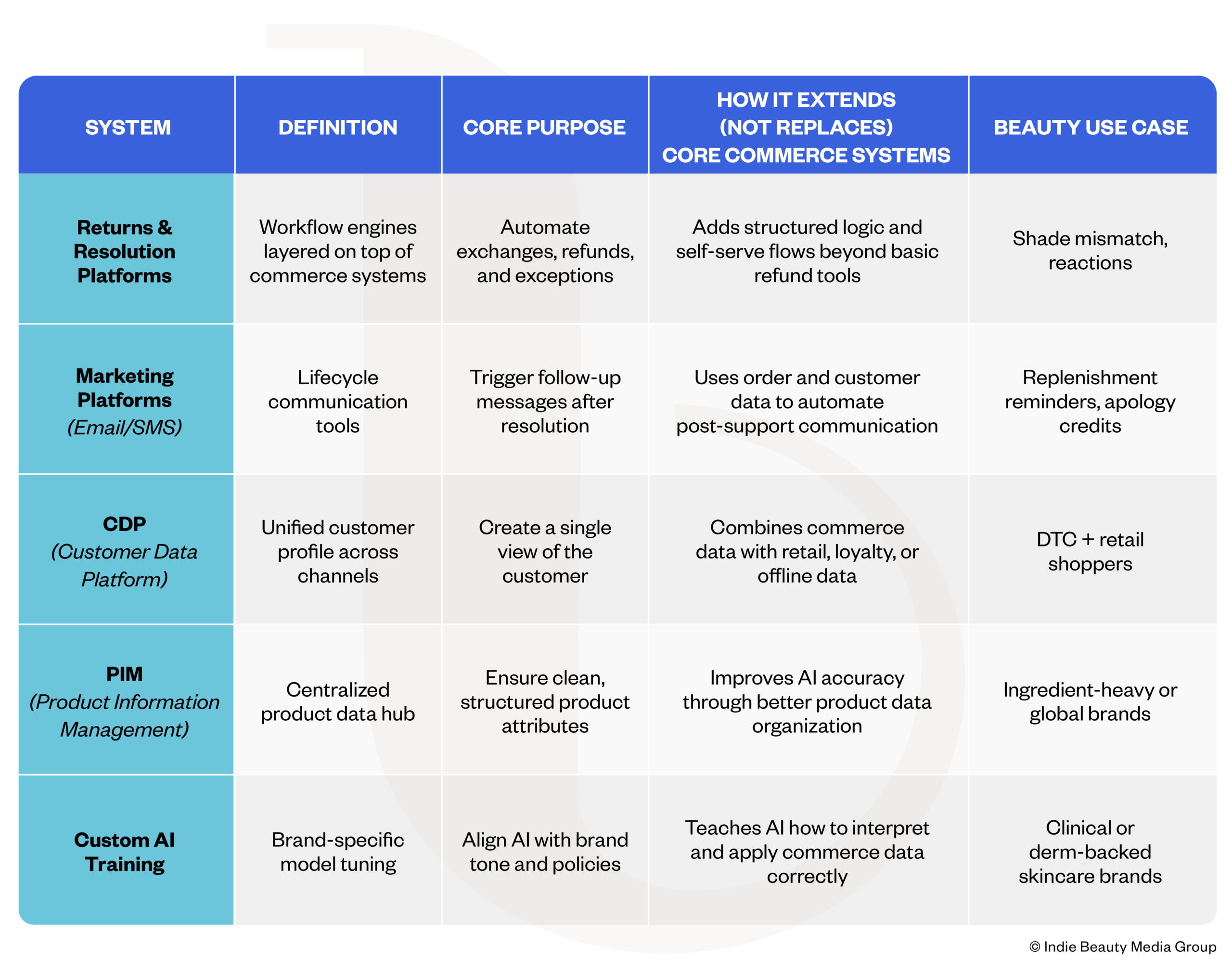
It’s important to clarify that these integrations do not replace a brand’s core e-commerce or order management system. Most commerce platforms already store essential information such as orders, customer profiles, fulfillment status and payment data, which is why they are sufficient to launch AI-powered customer support.
The recommended integrations add value in a different way. They extend automation, intelligence and scale. Rather than serving as systems of record, they help AI support platforms handle higher volumes, more complex workflows and more nuanced customer experiences. In short, the commerce platform provides the data, while these integrations help the AI apply that data more efficiently, consistently and intelligently.
Brands do not need these tools on day one. Many adopt them incrementally as support volume increases, international markets are added or resolution scenarios become more complex.
Key takeaway for brands:
Think of your e-commerce platform as the system of record, and these optional integrations as systems of optimization. They are not required for AI customer support to function, but they significantly improve scalability, accuracy and customer experience as a brand grows.
C. How The Architecture Works
At a high level, AI-powered customer support operates as a coordinated workflow rather than a single interaction. The system is designed to move an issue from inquiry to resolution in a structured, predictable way, while remaining flexible enough to handle nuance and exceptions.
When a customer reaches out via chat, email or SMS, the AI first identifies what the customer is trying to accomplish, not just the words they used. It then pulls relevant information from the brand’s commerce platform such as order history, fulfillment status and customer profile to understand context.
Next, the system applies the brand’s predefined policies and rules. These guardrails determine what the AI is allowed to do autonomously (for example, issuing a refund within a certain timeframe or value) and what requires escalation. When permitted, agentic AI executes the resolution directly, completing the task in real time rather than passing it to a human queue.
If the request falls outside approved parameters such as high-value refunds, unusual reactions or sensitive situations, the system routes the case to a human agent with full context attached. The result is a faster, more consistent customer experience that avoids fragmented ticket handoffs while preserving brand control and customer trust.
Impact
The impact of AI-powered customer support extends well beyond cost reduction. In beauty, where post-purchase experience strongly influences trust and repeat behavior, support quality is a strategic differentiator.
Over time, AI support also becomes a valuable intelligence engine, surfacing patterns in customer issues, product performance and operational friction that would be difficult to identify manually.
A. Operational Impact
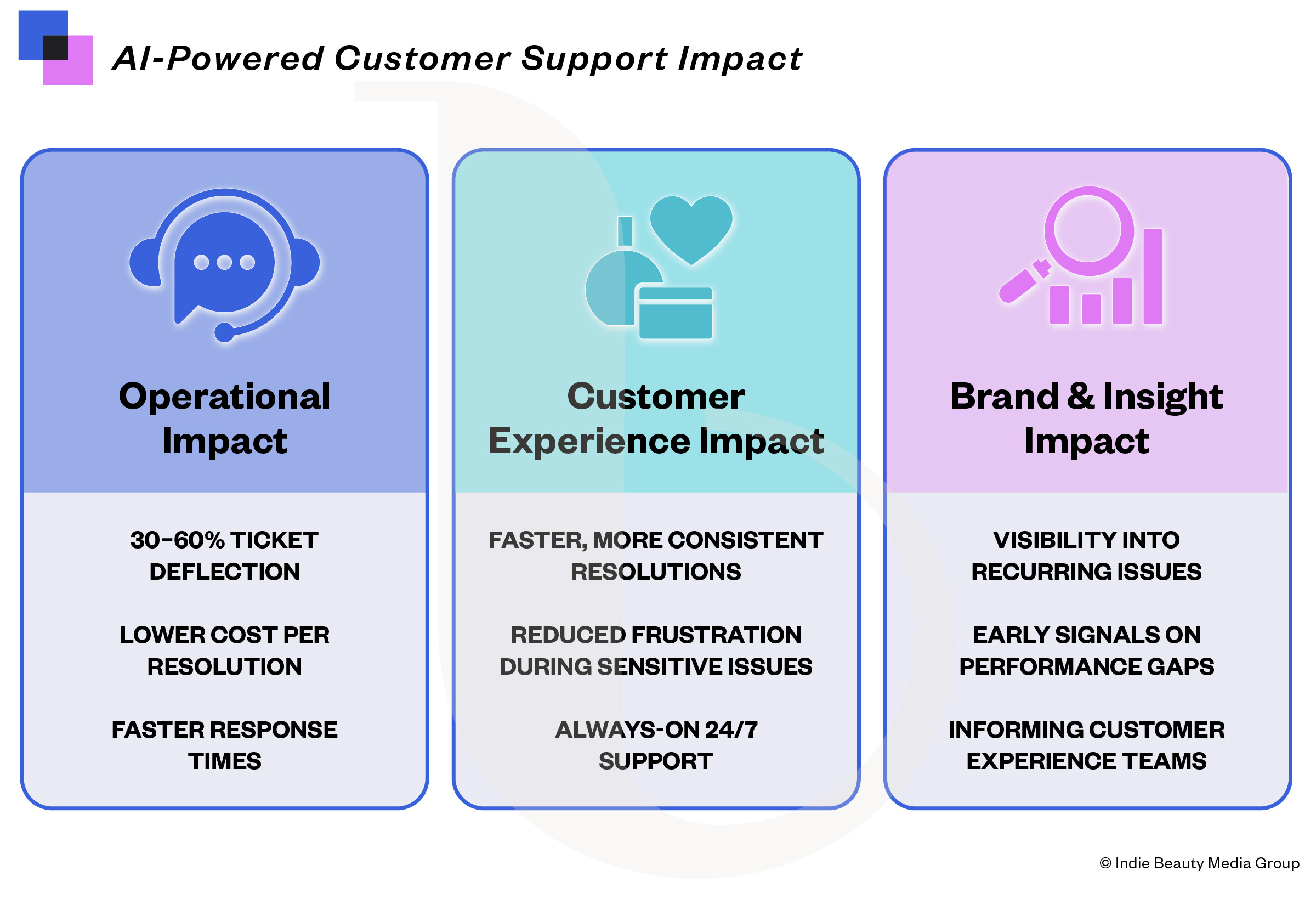
The most immediate and measurable impact of AI-powered customer support is operational efficiency. By resolving a large share of routine inquiries automatically, brands can reduce support workload while maintaining or improving service quality.
-
- 30% to 60% of support inquiries resolved without human agent involvement (ticket deflection)
- Lower cost per resolution
- Faster response times (seconds versus hours)
B. Customer Experience Impact
In beauty, how an issue is handled often matters as much as the outcome itself. AI-powered support improves consistency, speed and availability, helping brands deliver a calmer, more reliable experience, even when customers are frustrated or disappointed.
-
- Faster, more consistent resolutions
- Reduced frustration during sensitive issues (shade mismatch, skin reactions, delays)
- Always-on support across time zones
C. Brand & Insight Impact
Beyond efficiency and experience, AI support systems generate a continuous stream of structured insight. Over time, this data helps brands identify recurring issues, refine products and improve the overall customer journey.
-
- Visibility into recurring shade or sensitivity issues
- Early signals on product performance gaps
- Insight for merchandising, Customer Experience, and product teams
Vendor Landscape & Differentiation
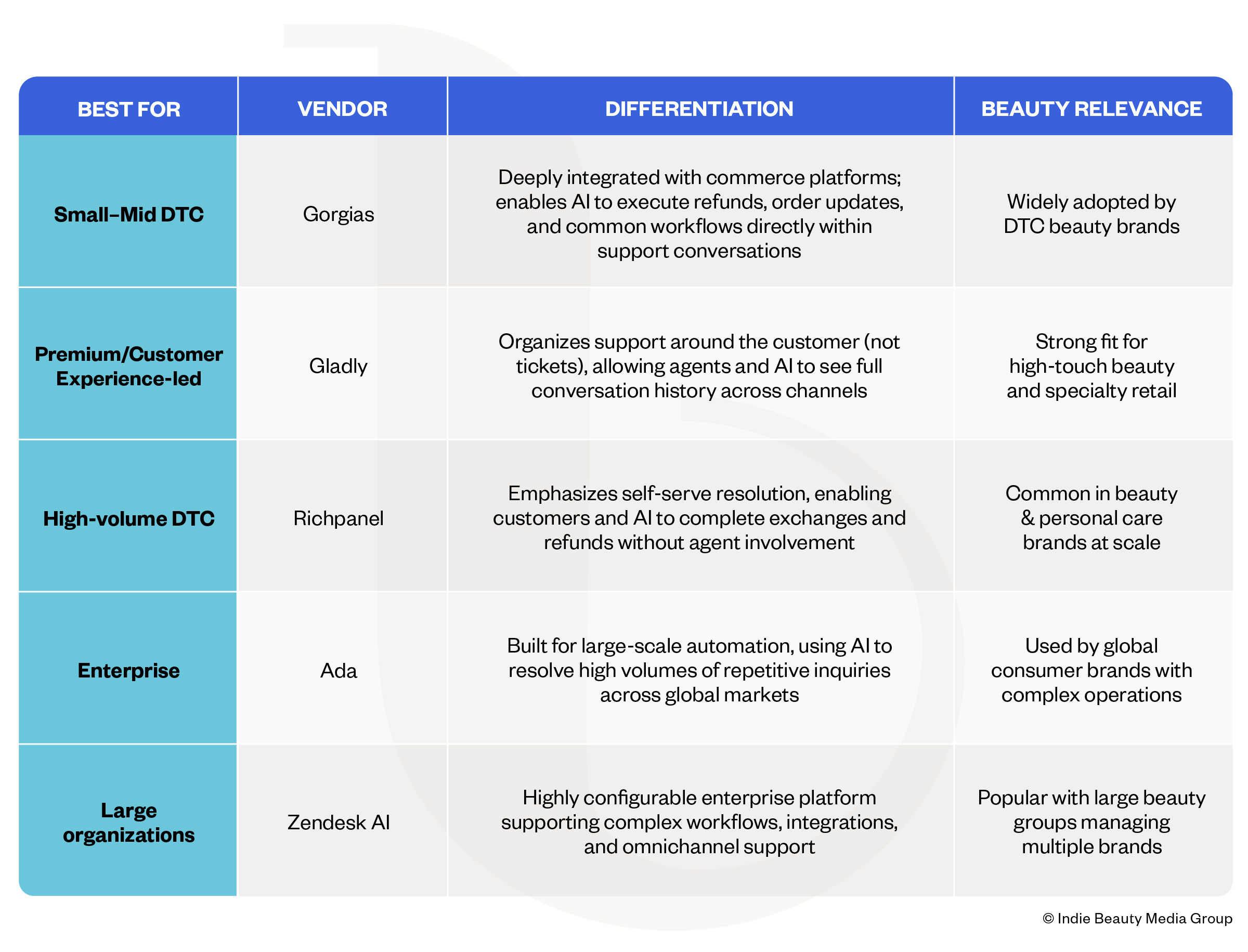
The customer support AI landscape is crowded, but platforms differ meaningfully in execution. The key differentiator is not how human the AI sounds, but how effectively it resolves real operational issues while protecting brand trust.
Cost Models
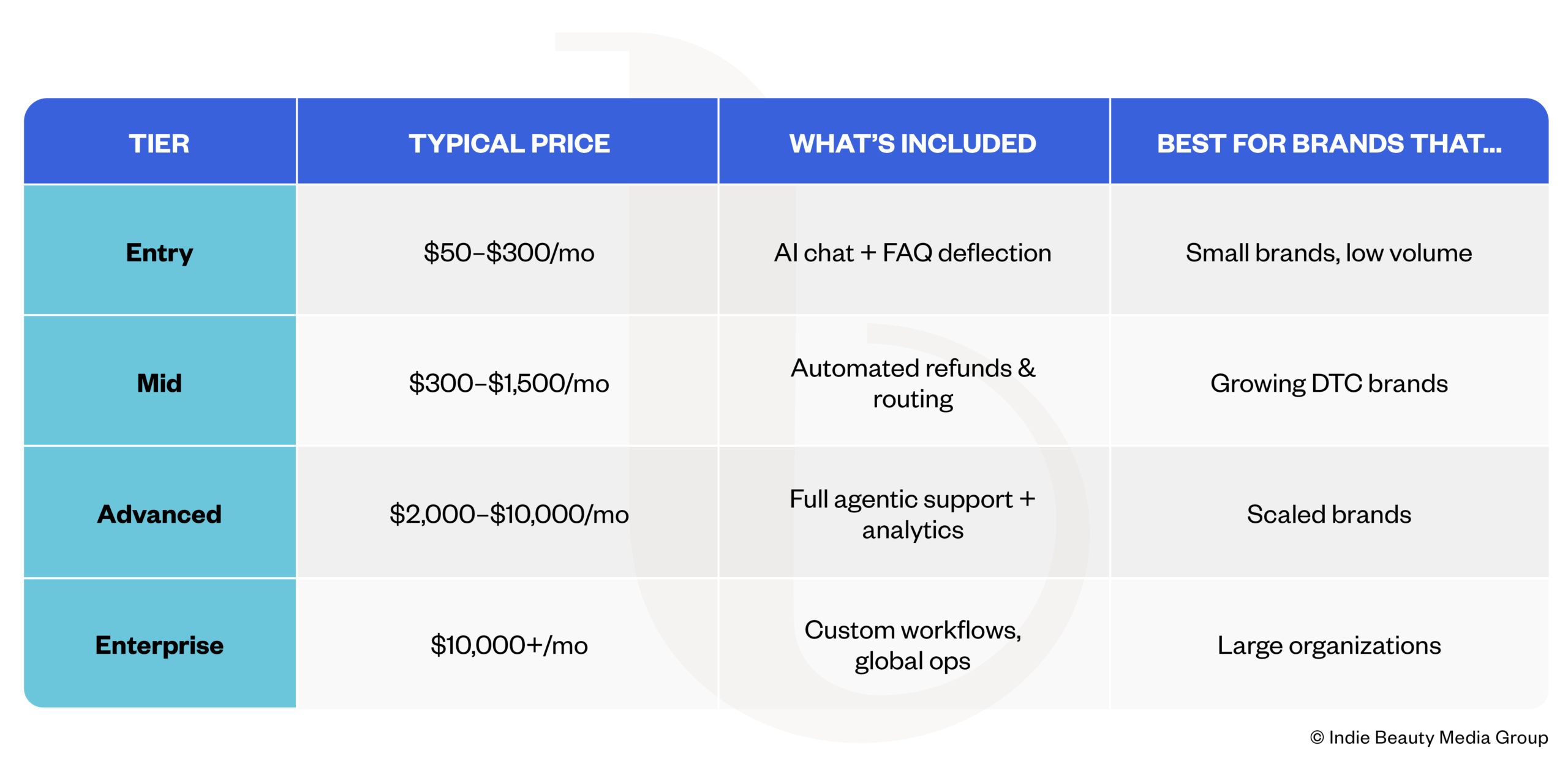
Customer support AI pricing reflects its role as an operational system rather than a marketing tool. Costs scale with ticket volume, automation depth and the range of actions the AI is authorized to perform.
Most brands start with basic automation and expand over time as volume and complexity increase.
Bottom Line
AI-powered customer support has evolved from answering questions to resolving problems, generating insights and buttressing customer loyalty.
For beauty brands, this evolution is especially powerful to protect trust, reduce the operational burden and generate continuous insight at scale.
Most brands already have the infrastructure required to adopt AI support. The strategic decision is how far and how fast to extend automation. Brands that begin building this capability now will be better positioned to scale efficiently and deliver consistent, high-quality experiences as AI becomes standard across the beauty value chain.





Leave a Reply
You must be logged in to post a comment.