From Blinc To CoverGirl, Tubing Mascara Has Become Big Business, But Education Gaps Remain, Quilt AI Finds

For mascara wearers with watery eyes, sensitive eye areas and eye shapes prone to smudging, tubing mascara was a revelation when Blinc Cosmetics brought the technology to market more than 30 years ago.
Unlike traditional mascara, which relies on pigmented wax-and-oil emulsions to coat lashes, tubing mascara largely doesn’t budge. It uses film-forming polymers to create tiny “tubes” that wrap each lash, delivering smudge-resistant wear that comes off with warm water rather than makeup remover.
Blinc Cosmetics’ Kiss Me mascara broke into Sephora during tubing mascara’s initial peak of interest in the 2000s and 2010s. In 2017, Thrive Causemetics jumped on the tubing train with its popular Liquid Lash Extensions mascara. Still, tubing at the time had largely slipped to the back burner of eye makeup.
It didn’t disappear, though. Starting about four years ago, consumer insights and search intelligence firm Spate clocked a rise in interest. In 2022 and 2023, it recorded double-digit gains in searches for “tubing mascara,” driven in part by visual demonstrations of removal.
Blinc, L’Oréal and Tarte were among the brands Spate noticed surfacing alongside the trend. Tarte released Tartelette Tubing Mascara in 2022. L’Oréal Paris launched Double Extend Beauty Tubes Mascara in 2018, while Merit and Caliray cracked the category in 2021 with Clean Lash Lengthening Tubing Mascara and Come Hell or High Water, respectively.
In its most recent year-over-year data, Spate shows 1.1% growth in popularity of “tubing mascara,” with Google search up 35.2%, Instagram up 114.4% and TikTok down 33.5%. Google accounts for 66% of the popularity share. From October 2024 to September 2025, Spate’s search data showed “tubing mascara” climbed 9.1% in tandem with growing searches for stay-put products like lip stains and cluster lashes, reflecting demand for long-wear, low-maintenance makeup.
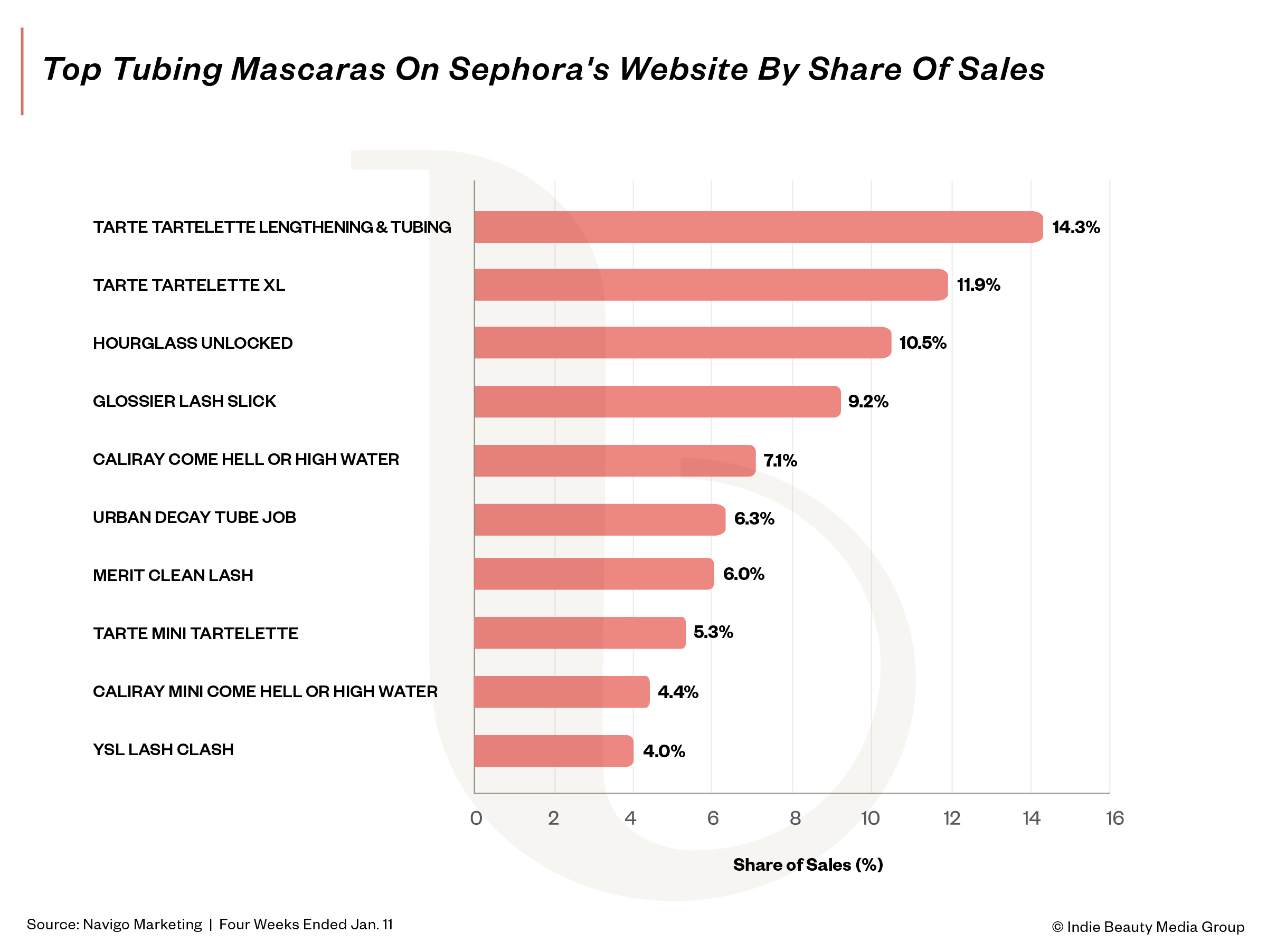
More brands are now taking up tubing. Last year, Too Faced launched Ribbon Wrapped Lash Extreme Length Tubing Mascara, and Urban Decay unveiled Tube Job Tubing Mascara, which it describes as an ultra-lightweight formula that boosts length by 34%. At Sephora, tubing mascaras are priced from roughly $14 to $34. According to e-commerce growth agency Navigo Marketing, Tarte, Glossier, Hourglass and Caliray commanded the top spots for tubing mascara on Sephora’s website for the four weeks ended Jan. 11. The data isn’t validated by Sephora.
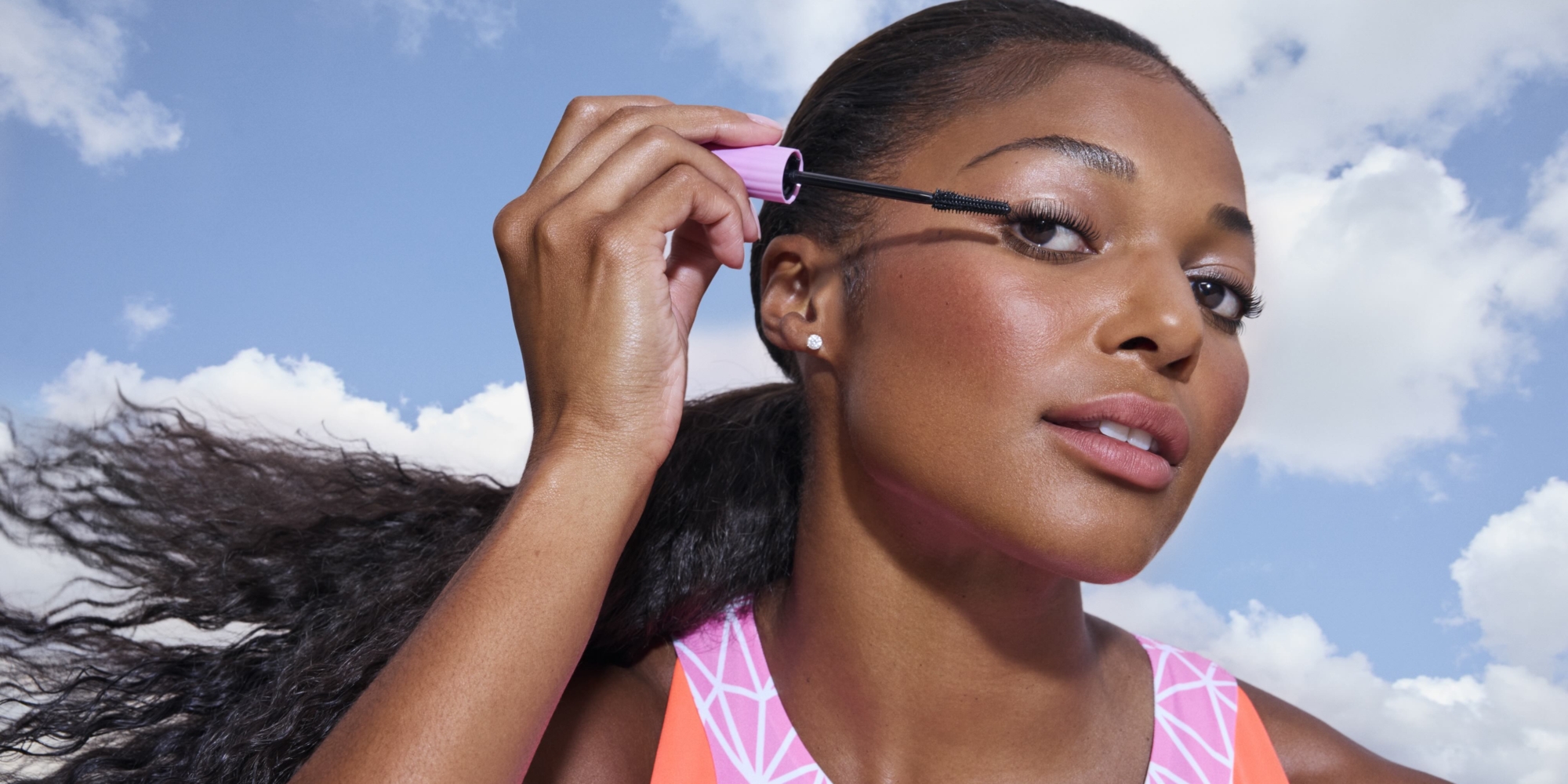
The format is also gaining traction in mass beauty. This month, CoverGirl launched its first-ever tubing formula, Eye Enhancer Wrap Tubing Mascara, with a national campaign starring American sprinter and three-time Olympic gold medalist Gabby Thomas. Titled “The Ready. Set. Wrap.,” the campaign promotes tubing technology as sweat-resistant, long-wear makeup built for high-performance use and illustrates how the category is moving beyond niche problem-solving into broader lifestyle positioning.
Not to be outdone, Blinc Cosmetics is pushing to reenter the conversation around its original tubing product. For the Golden Globes, it worked with celebrity makeup artist Brett Freedman, who brushed nominee Sarah Silverman’s lashes with the formula for the red carpet.
Kirbie Johnson, writer of the Substack newsletter Ahead of the Kirb and co-host of the podcast Gloss Angeles, has declared 2026 the year of brown tubing mascara. She highlights Dibs’ Double Standard Primer & Mascara Duo, which features a brown tubing primer, as well as brown tubing products from Tarte, Glossier, 19/99, Thrive Causemetics and Milani. Caliray has put out its Come Hell or High Water tubing mascara in a brown shade, too.
There’s a lot at stake in brands’ tussle over tubing mascara. Mascara is the No. 1 makeup product in the United States and a multibillion-dollar business globally, with an estimate from market research firm Allied Market Research pegging sales at approximately $6.4 billion in 2022 and projecting them to more than double by 2032. Within the mascara business, tubing mascara has emerged as a meaningful subsegment, with market research firm Market Intelo estimating the tubing category alone at about $1.42 billion in 2024, signaling that what was once a niche format has begun to represent a sizable slice of the market.
However, to many consumers, tubing mascaras remain novel. Across social, search and reviews, shoppers are debating what “tubing” really means, whether prestige and mass formulas perform differently and which brands can be trusted to deliver on long-wear claims. Insights company Quilt AI’s analysis of U.S. digital conversations points to a category defined by education gaps, price sensitivity and social proof. Tubing mascara, in other words, isn’t just being bought; it’s being interrogated. That scrutiny is influencing how brands position performance and value.
The analysis below from Quilt AI breaks down key themes in U.S. digital conversations about tubing mascara by share of voice, with each percentage equating to the portion of total online discussion attributed to a given theme.
Key Themes
- Language and Education: The Evolving Discourse of Tubing Technology (51%)
The tubing mascara conversation reveals significant knowledge gaps and linguistic variation, with consumers seeking basic education (“tubing mascara what is”) while using inconsistent terminology (“tubing” vs. “tubular” versus “liquid lash extensions”). This educational journey shapes how consumers understand, discuss and evaluate products in this specialized cosmetic category.
- Price-Value Recalibration: Expectations Across Price Tiers (16%)
The tubing mascara conversation reveals a fundamental recalibration of price-value expectations, with consumers seeking and expecting sophisticated technology at accessible price points. This shift challenges traditional beauty category boundaries, with drugstore and prestige products increasingly judged by the same performance standards rather than separate expectations based on price tier.
- Retail Democracy: How Distribution Channels Shape the Category (15%)
The tubing mascara conversation reveals a category that has rapidly expanded across retail channels, from prestige beauty destinations like Sephora to mass market drugstores, creating unprecedented accessibility. This retail democratization has reshaped consumer expectations, with shoppers now anticipating similar performance regardless of price point or purchase location, while still using retailer presence as a validation mechanism.
- Specialized Beauty: Addressing Unique Consumer Needs and Values (11%)
The tubing mascara conversation reveals distinct consumer segments seeking solutions for specific concerns, from sensitive eyes and contact lens wearers to mature women with thinning lashes. This specialization intersects with the clean beauty movement, creating a multidimensional market where physiological needs and ethical values converge.
- Social Proof: The Foundation of Tubing Mascara Trust (4%)
The tubing mascara conversation in the U.S. is fundamentally built on a foundation of peer validation and social proof, with consumers extensively seeking reviews, testimonials and community feedback before purchase. This review-centric behavior reveals a marketplace where consumer skepticism toward marketing claims has created an alternative trust economy based on authentic user experiences.
- Performance Paradox: The Dual Demand for Function and Aesthetics (4%)
Consumers approach tubing mascara with a dual set of expectations, simultaneously demanding superior functional performance (smudge resistance, flake-free wear, easy removal) and aspirational aesthetic outcomes (lash extension effects, dramatic length). This paradoxical demand creates a product category that must bridge pragmatic problem-solving and beauty enhancement without compromise.