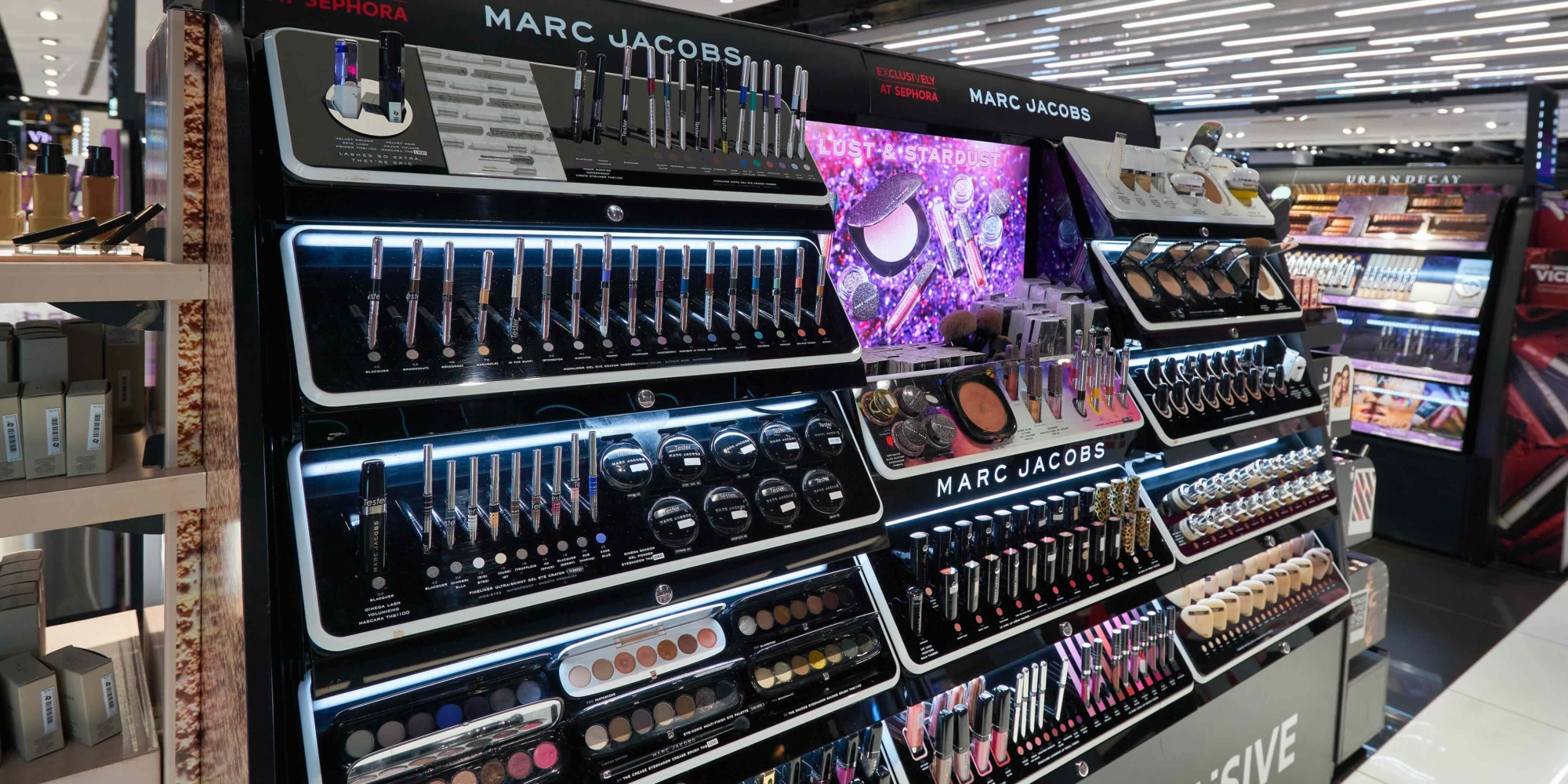

Marc Jacobs Beauty is preparing for a comeback.
After disappearing from shelves in 2021 following the end of its licensing partnership with LVMH Moët Hennessy Louis Vuitton-owned brand incubator Kendo, Coty secured the license two years later, sparking years of speculation and yearning about its return. Following his namesake fashion label’s runway show on Feb. 3, Marc Jacobs gave the yearners a sign that the makeup brand’s relaunch is approaching by crediting Marc Jacobs Beauty as the show’s makeup partner.
In line with the wave of nostalgia that’s gripped beauty and fashion, Thomas DeKluyver, the show’s key makeup artist, took a page from the grunge era, when Marc Jacobs epitomized the rebellious gen X youthquake with slip dresses, chunky combat boots and plaid shirts, delivering looks featuring smudged lower-lash eyeliner, pastel eyeshadow, dark lipstick and clean, understated skin, complemented by undone hairstyles accented with oversized scrunchies created by hairstylist Holli Smith.
The show could provide hints at Marc Jacobs Beauty’s new iteration, combining aspects of “clean girl” minimalism with expressive makeup used for effect, from pops of bright blush to washes of color over the eyelids. The concept speaks to editorial makeup rooted in attitude rather than trend cycles.
During its original run, which began in 2013, Marc Jacobs Beauty distinguished itself with fashion-forward products that became cult favorites. Diane Kendal, now the creative director of Rabanne, helped develop the products, and Adwoa Aboah, Kaia Gerber, Winona Ryder and Jessica Lange were among the faces of the brand’s campaigns. Hero products included the Highliner Gel Eye Crayon Eyeliner, Velvet Noir Major Volume Mascara, O!Mega Bronze Perfect Tan Bronzer and Eye-Conic Multi-Finish Eyeshadow Palettes.
While Marc Jacobs Beauty vanished from shelves, Marc Jacobs’ beauty business has continued to be a significant sales engine. Licensed to Coty, its fragrance portfolio generates roughly $250 million annually, according to an estimate in the publication Puck. Fragrances like Daisy and Perfect remain broadly distributed at retailers like Bloomingdale’s, Ulta Beauty, Macy’s, Sephora and Nordstrom.
As Marc Jacobs Beauty moves closer to a color cosmetics rebirth, consumers are debating what the brand’s next chapter should entail. In a recent Reddit discussion, a user with the handle u/glamb97 wrote that the relaunch could occur in the fall and that the formulas are “very very good.” Fans are hungry for the earlier products, though some commenters suggested the formulas may not be identical to them.
One commenter with the handle u/NewWeek3157 gushed, “I’m so emotionally invested in it because it was my first time falling in love with quality makeup products, and I’ve been in love with makeup [ever] since, so it’s very special to me. Had multiple holy grails for me.”
The conversation highlights the challenges facing Marc Jacobs Beauty’s comeback. The brand must evolve within today’s makeup landscape, transformed by TikTok, influencer ascendance and an onslaught of competition, while carrying the weight of its legacy.
For the latest edition of our ongoing series posing questions relevant to indie beauty, we asked 10 consultants, retailers, founders, content creators and more the following: What should Marc Jacobs Beauty 2.0 be? How can it balance commercial potential with creativity in today’s cutthroat market? How can it be relevant to contemporary consumer demands? Which specific products or categories should it prioritize?
-
 AMY KAPOLNEK Founder and Fractional CMO, The Fwrd Group
 Marc Jacobs Beauty 2.0 should come back as “editorial essentials,” a line that feels fashion-led and attitude-driven, but built around everyday staples that perform on real skin and film well on camera. The mistake would be trying to “out-clean” the clean girls or chase micro-trends. The brand’s original value was always about runway energy translated into products you’d actually use, and the fact that Marc Jacobs credited the brand as the show’s makeup partner is a clear sign they’re leaning back into that fashion authority.
Balancing commercial potential with creativity starts with a tight hero-product strategy, similar to what Coty did with the Gucci Beauty relaunch in 2019. Lead with the cult icons people still name-drop, such as the eyeliner, mascara and bronzer, then add a few statement items that feel true to the Marc Jacobs world like a lived-in liner story, a diffused matte lip, a bold blush and eyeshadow in unexpected but wearable shades.
Those hero SKUs create the commercial base while the seasonal runway drops create the creativity and press moments. And, importantly, the brand has permission to do this because its origin story is fashion-forward color, which feels very much aligned with the return of maximalist makeup.
To be relevant to consumer demands, Marc Jacobs Beauty needs to modernize without deleting what people loved. That means inclusive shade ranges for foundations and concealers, formulas that are long-wear and camera-proof and an ingredient story that is factual rather than just good marketing. Consumers today are harsher judges—TikTok is essentially a live product review panel—so performance has to be immediately legible on application through wear. The brand should also meet consumer expectations around packaging and experience without sacrificing the “object” quality that made the originals feel collectible.
For the relaunch, I would start with eyes. Bringing back the hero liner and mascara immediately reconnects the brand to what people loved while driving repeat purchases. Eye products are high-frequency categories, and they ladder directly into the undone eye story the brand just put on the runway. It’s a smart reentry point that still feels creatively aligned.
Next should be the face, specifically bronzer and blush, that read editorial but wear effortlessly every day. The brand can reintroduce a signature oversized pan moment with formulas that are more refined and upgraded in texture and wear. These are the kinds of products that become vanity staples while still having fashion credibility.
Lips should follow with one standout format rather than an overwhelming assortment. A modern matte that doesn’t feel drying or a lacquer-stain hybrid could work well, offered in a tightly edited shade range that feels distinctly Marc. Think moodier neutrals, one deep statement shade and one slightly unexpected color that gives it edge.
Complexion should come last. A stick foundation can work, but only if it’s clearly differentiated in finish, undertone range and wear. The market is saturated with foundation sticks, so there has to be a compelling reason for it to exist. If they launch one, it needs to be exceptional.
Finally, the relaunch needs to be staged like a fashion comeback: an “Archive Icons” drop (limited, highly PR-able), followed by a core line that can scale in retailers. Coty signing the expanded agreement to bring Marc Jacobs Beauty back gives them the distribution, but the creative direction has to be focused enough that the brand doesn’t become categorized as nostalgic.
- Anne Laughlin Founder, So Sloane
Marc Jacobs Beauty should celebrate an individualistic perspective on beauty and the reemergence of a creative world rather than following trends. My love runs deep for the Marc Jacobs Beauty brand, and I’m one of millions who are ecstatic for the brand’s return. My old teammates and I routinely daydream about bringing back the brand in today’s world.
The success of Marc Jacobs Beauty was rooted in merging quality formulas, nostalgia, individualism, storytelling, thoughtful packaging and an almost untouchable coolness factor. It’s a brand that’s quite challenging to compare to another beauty brand. While most brands get pigeonholed into a zone of artistry, designer, trend and so on, Marc Jacobs Beauty is a category of its own.
It didn’t just develop products to satisfy trends. Marc Jacobs Beauty crafted products that tell beautifully unraveling stories that ultimately become commercialized phenomena, even driving brands to mimic its work.
Take Marc Beauty’s Air Blush, for example. We launched Air Blush in 2016 when everyone was idolizing contoured cheekbones and heavy bronzer. Prior to the launch, my team reached out to a number of big beauty influencers pitching YouTube video partnerships to drive paid support for the Air Blush launch. To our surprise, a few creators turned down the lucrative project because they found blush to be anything but cool. They shared that blush was what your grandma wore and not what their followers wanted—or so they thought.
This is where the power of Marc comes into play and will play a strategic role today, showcasing to consumers what cool and beauty mean. Cool doesn’t mean wearing what everyone else is wearing and looking like a replica of everyone else on the streets. Cool is individualism, an appreciation for thinking outside the box, dressing for the part you want to play rather than giving in to peer pressure to conform. Marc Beauty will make a bold statement to remind consumers that taste, beauty or a cool factor is not conforming to an algorithm; it is curiosity, curation and the power of a strongly developed character.
We threw an Air Blush launch party at the Beverly Hills Hotel in July 2016. I still have the menu on my bulletin board that I crafted with the chef, including the powdered sugar French toast titled Lines and Last Night after one of the Air Blush shades, and Air Blush became a massive commercial success.
Makeup artists filled their kits with shades of blush again; influencers went wild for Marc’s nostalgic Studio 54 contour-with-blush technique; and within months, Sephora saw a sizable increase in demand for the blush category. It felt like overnight creators, brands and consumers all became obsessed with blush.
For Marc Jacobs Beauty to succeed again, it won’t lean on TikTok trends and creator demands; it will carve out its unique perspective on beauty and creativity and build a world where the word “trend” is not in its native language.
Marc Jacobs is going to place makeup on the same playing field as skincare again. We’re not going to paint our faces like in the days of 2015 to 2018 with one-hour YouTube tutorials; yet the grunge, lived-in eye makeup will open a window into one’s soul and will drive makeup’s comeback.
Marc Jacobs told us that eyes are the most unique feature of one’s face, and they’re the window into your soul. He focuses on highlighting your best features and using eyeliner, eyeshadow and mascara to tell this story. The Highliner was the No. 1 pencil eyeliner at Sephora, and this product is multifaceted, from serving as a classic eyeliner to being applied as a base for a more dramatic eyeshadow effect and beyond. I see this product morphing into a lip-and-eye combo product to bring a subtle-to-dramatic effect to the muse, almost a choose-your-own-adventure with the product.
Selfishly, I love the Velvet Noir Mascara and the story of Marc’s grandmother shaving velvet onto her eyelashes for a dramatic effect, and that story will forever captivate a crowd. Who doesn’t love the look of velvety lashes?
We’re shifting away from the strict world of “the clean girl” who goes to bed at 9 p.m., keeps a strict capsule wardrobe and maintains a small circle of friends. Marc will celebrate the power of experimentation, risks, creativity and building a bold, adventurous life. Eye makeup (Highliner, Velvet Noir, Eye-conic Eyeshadow palettes in the shape of a classic car rearview mirror) will be the vessel to spark the enthusiasm for bold looks and a bold life again.
- LILY TWELFTREE Founder, Unfiltered and Barefaced
Reimagining Marc Jacobs Beauty is tricky because the brand already means so much to so many people, and it would be easy to get it wrong. The big shift we've seen in luxury beauty since the first Marc Jacobs Beauty era is this move toward beauty as home decor (Bottega Veneta's fragrance launch, Loewe candles taking over the internet). These are visual signals of wealth and taste in a way that fashion has always been, but beauty historically hasn't. Marc Jacobs has always had a distinct visual identity and genuine fashion heritage to draw from. I'd love to see them draw on it, but I'm doubtful.
Balancing commercial potential with creativity in today’s cutthroat market is complicated. The answer to how other brands are doing this is just so different from the MJ beauty that was already so adored: smaller SKU counts, more considered hero products and little else. I would say the commercial risk for MJ is trying to compete across every category and becoming noise. But pulling back too far and losing the accessibility that made the original so beloved is also a risk. This will be hard to nail.
To be relevant to contemporary consumer demands, the product needs to be defensible, not just the marketing. MJ was always known for genuinely great products, so I don't think that's the struggle point here. It's more about making sure that quality is legible and the value is honest enough to survive scrutiny.
As for category focus, makeup! They absolutely nailed it the first time around, and luxury fashion brands moving into makeup feels genuinely underexplored right now. Everyone has gone hard on fragrance; it's been so done at this point that it almost feels like the unimaginative choice. Makeup is where MJ could actually do something unexpected and own it in a way that no one else really can.
- MARGARITA ARRIAGADA Founder, Valdé
As one of the thousands of customers devastated by the closure of the brand and very attached to some of its OG hero products, expectations are very high. That said, I absolutely think MJ Beauty continues to have potential, provided that it lives up to and actually exceeds expectations, which is entirely possible.
The industry, especially makeup, is lacking imagination, creativity and conviction. MJ has always been disruptive, and that is exactly what the category needs. What will be critical is the ability to show consistency of quality, looks and flow of innovation.
A big mistake would be attempting to replicate the past. It must disrupt and keep disrupting. In terms of category priority, I would say color. We are currently bland and boring. Therefore, complexion should not be the priority. The only way to balance commercial potential with creativity is through a strategic, disciplined approach to being and staying original.
- TARA COHEN Founder and CEO, Mixst
I’ve always admired Marc Jacobs from afar. His aesthetic was never exactly my personal style, but I’ve always been drawn to the attitude and perspective behind it, the kind of point of view a more fashion-forward, slightly irreverent customer instinctively connects with.
As Marc Jacobs Beauty returns, the biggest opportunity is anchoring the brand in a clearer, more enduring perspective. The fragrance business has remained strong because it so clearly captures the spirit of the house. The makeup, while beautifully designed and highly covetable, never fully crystallized a lasting point of view, particularly in a market now defined by founder- and artist-led brands.
The equity is there. The packaging, silhouettes and branding were always distinctive. What the next chapter needs is a sharper stance. Marc Jacobs Beauty 2.0 should be edited, opinionated and rooted in the archetypes Marc has long explored: romantic, rebellious, slightly undone. Makeup should feel like an extension of the fashion: expressive, but intentional.
In today’s landscape, the competitive frame sits alongside Victoria Beckham Beauty, Prada Beauty, Gucci Beauty and Hermès Beauty, but with a distinct edge. Where others lean polished, Marc should lean emotive and directional.
The assortment should be tightly curated, a wardrobe for the face. It should prioritize eyes and complexion accents that create mood: liners, mascara, blush and sheer, dimensional textures that feel modern and sensorial rather than heavy.
Ultimately, the brand’s relevance will come from authorship, not chasing trends, but creating a feeling—editorial yet wearable, minimal yet expressive—a beauty line that feels unmistakably Marc.
- Nicole Collins Co-Founder, 213Deli
Marc Jacobs 2.0 has to be an obvious extension of Marc, the man, and his fashion genius. He must play a lead role in the reinvention and relaunch of the brand. No one is buying a celebrity name without celebrity expertise anymore.
The cult classics from the original line have to come back to please the die-hard fans and capture new fans, and there should be surprise and delight in newness, of course. Consumers will be looking for color products that are clean and perform. Because he's a fashion legend, texture and color and performance and packaging have to be executed with extreme excellence.
Marc Jacobs has remained successful in fashion for 40 years because he has his finger on the pulse of what's cool, and that is what will make Marc Jacobs Beauty a success. That and executional excellence. A beautifully designed collection plus a marketing strategy that is executed flawlessly are what make all beauty brands successful.
It is crucial that the corporation behind the brand does not suffocate his creativity in corporate logistics. That is a sure-fire way to kill any beauty brand as we have seen time and again. For his sake, I hope the people behind the brand share his creative genius and are able to execute swiftly and with perfection. There is very little to no margin for error in the industry in 2026.
- AMANDA POND Founder and CEO, MOD Consulting
Marc Jacobs Beauty 2.0 should not attempt to be another clean, minimal, celebrity-adjacent brand competing for shelf space at Sephora. It should reclaim what made it culturally relevant in the first place: fashion-led, attitude-driven beauty with a point of view. The opportunity isn’t to chase trends. It’s to own aesthetic tension: polished but undone, minimal skin with expressive eyes, luxury with rebellion.
What should Marc Jacobs Beauty 2.0 be?
A fashion house makeup brand with editorial credibility and commercial intelligence.
The original line stood out because it felt runway adjacent. The Highliner and Velvet Noir weren’t just products. They were tools used backstage and in campaigns with strong creative direction.
Version 2.0 should:
• Lean into its gen X/grunge heritage
• Embrace the current nostalgia cycle without feeling dated
• Position itself as the antidote to algorithm-chasing TikTok brandsThere’s space in today’s market for a brand that says: We don’t follow microtrends. We define attitude.
Balancing commercial potential with creativity
The biggest risk is overcorrecting into safe, mass-prestige minimalism. Commercial viability today requires viral potential, performance-driven formulas, clear hero SKUs and strong DTC storytelling layered with retail distribution.
Creatively, the brand should:
• Lead with bold eye products (its historic strength)
• Develop campaign visuals that feel editorial, not influencer-heavy
• Use TikTok strategically, not desperatelyThe key balance: commercial in distribution, creative in identity. It should live comfortably in Sephora and Ulta, but look like it belongs in a fashion magazine.
How it can be relevant today
Today’s consumer demands clean(er) formulations or transparency around safety, inclusivity in shade range, long-wear, performance-backed claims, multifunctional products and clear value justification. But relevance doesn’t mean dilution.
Marc Jacobs Beauty should:
• Upgrade legacy formulas to modern performance standards
• Be transparent about reformulations (nostalgia is emotional: mishandling this would be risky)
• Maintain elevated packaging: weight and tactility matter in luxuryIt also needs a strong narrative bridge: from 2013 cult favorite to 2026 creative revival.
What categories should it prioritize?
Eyes (hero category and highest potential)
• Relaunch the Highliner Gel Eye Crayon immediately
• Modernize Eye-Conic palettes into curated, mood-based quads
• Lean into smudged liners, pastel washes, bold lower-lash looksEye makeup is having a resurgence after years of skin-first minimalism.
Mascara
Velvet Noir was a genuine cult product. Mascara is a high-frequency and high-repeat category, a commercially smart anchor SKU.
Selective Complexion (Not Overextended)
Instead of a full complexion range, launch one standout foundation stick or tint, a strong concealer and a modern bronzer reboot (O!Mega).
Complexion is crowded. It must be differentiated through finish and aesthetic, not SKU count.
Limited-Run Fashion Drops
This is where it can differentiate with seasonal runway capsules, color stories tied to fashion shows and collectible packaging. This builds hype without bloating the core line.
The Strategic Reality
The fragrance business (roughly $250M annually under Coty) proves the brand still has global recognition. The beauty relaunch doesn’t need to build awareness from zero. It needs to reignite emotional loyalty while attracting gen Z consumers discovering the brand for the first time.
The tension: Millennials want their holy grails back, gen Z wants bold expression and authenticity, retail wants velocity, and TikTok wants virality.
Marc Jacobs Beauty 2.0 should sit at the intersection of nostalgia + editorial credibility + high-performance formulas.
Bottom Line
The brand should not compete on price. It should compete on identity. In a market saturated with founder-led, clean-girl minimal brands, Marc Jacobs Beauty can win by owning fashion rebellion again, but with modern formulas, inclusive shade ranges and digital fluency. If done correctly, it doesn’t become another comeback. It becomes the cool girl’s makeup brand again, just evolved.
- Sonia Summers Founder and CEO, Beauty Barrage
Marc Jacobs Beauty 2.0 cannot rely on nostalgia. Nostalgia creates buzz, not longevity. What made the brand powerful wasn’t just hero products. It was attitude. It felt editorial, fashion-insider and slightly subversive. That energy is what needs to return, not just the SKUs.
The opportunity now is to sit between clean minimalism and chaotic creator brands. There’s white space for elevated, fashion-driven beauty that feels intentional, not algorithm-chasing.
If I were advising the relaunch, I’d focus on four things:
1. Own eyes again.
Highliner should come back, but with true performance innovation, long-wear, extreme pigment, expanded shades. It needs to compete with indie brands, not just trade on memory.
2. Bring back icons with proof.
Velvet Noir mascara was beloved. Relaunch it with clinical claims and visible results. Today’s consumer expects receipts.
3. Edit the complexion category.
Not 20 foundations. A few strategic, skin-enhancing products that deliver that clean base plus the statement eye contrast we’re seeing on the runway.
4. Control distribution.
Desire first. Scale second. Overexposure at launch would dilute the comeback narrative.
Relevance today requires more than aesthetics. It requires performance, transparency and cultural clarity. TikTok will test the formulas immediately. If they don’t hold up, legacy won’t save them.
Marc Jacobs Beauty shouldn’t try to be a clean brand, a derm brand or an influencer brand.
It should be fashion beauty: confident, directional and unapologetic. Comebacks don’t win because people miss you. They win because you return with conviction.
-
Marc Jacobs 2.0 is about to enter the market at the perfect moment as creativity and boldness return to color cosmetics. Expressive eye makeup is making its comeback (see BI's Feb. 26 article!), and the emphasis on vibrant eyes at Marc Jacobs' runway show underscores this bright shift.
MJB has a comeback advantage. Original loyalists are vocal and eagerly awaiting its revival. There's a wealth of testimonials and product reviews from the original line that can inform a stronger, smarter launch. For example, revamping a past hero like Dew Drops Highlighter into a more user-friendly format: moving from liquid pumps to a cream-to-powder format would improve precision and usability.
Emphasizing product customization will allow MJB to appeal to both bold and bare consumers who value efficacy and artistry. Layerable foundations, high-pigment stains and multi-use stick products are just a few examples that will help balance commercial potential with the creative artistry rooted in the brand's heritage.
The original line was extensive. A tighter SKU edit could create a bigger impact. Selective distribution and a clear focus on a hero franchise like eye or complexion will help MJB reassert itself as a category authority.
- MEHIR SETHI Founder and CEO, Luscious Group
I count myself among the loyalists of Marc Jacobs Beauty. Nostalgia for the brand is all about what the brand originally represented: professional authority, attitude and a sharp fashion-driven editorial edge. I suspect it also reflects desire for a distinct point of view and dependable quality in a market fatigued by algorithmic hype.
Its comeback should honor that identity by unapologetically bringing back all of its cult products with their original formulas intact. The brand should return undiluted and give its audience exactly what made it beloved. Authority and credibility are a rare, powerful commercial commodity.
If you have a question you'd like Beauty Independent to ask consultants, retailers, founders, content creators or others, send it to [email protected].

Leave a Reply
You must be logged in to post a comment.