
To accompany a Feb. 12 article on Merit chronicling its rise to $200 million in retail sales last year, Business of Fashion created a chart comparing the price of Merit’s foundation stick with foundation sticks from five other makeup brands—LYS Beauty, Charlotte Tilbury, Hourglass, Dior and Westman Atelier—placing Merit at the lower end of the premium spectrum, with its $38 stick sitting between LYS Beauty’s $27 offering and Charlotte Tilbury’s $48 version.
The chart drew criticism on social media for not accounting for the amount of product in each foundation stick when comparing prices. On TikTok, content creator Kere Eke, who uses the handle @kereeke, said in a video, “I hate this graph because it doesn’t normalize it based on the size or how much product you’re actually getting…I think the standard in beauty should be to report this number in addition to the number you’re actually paying.”
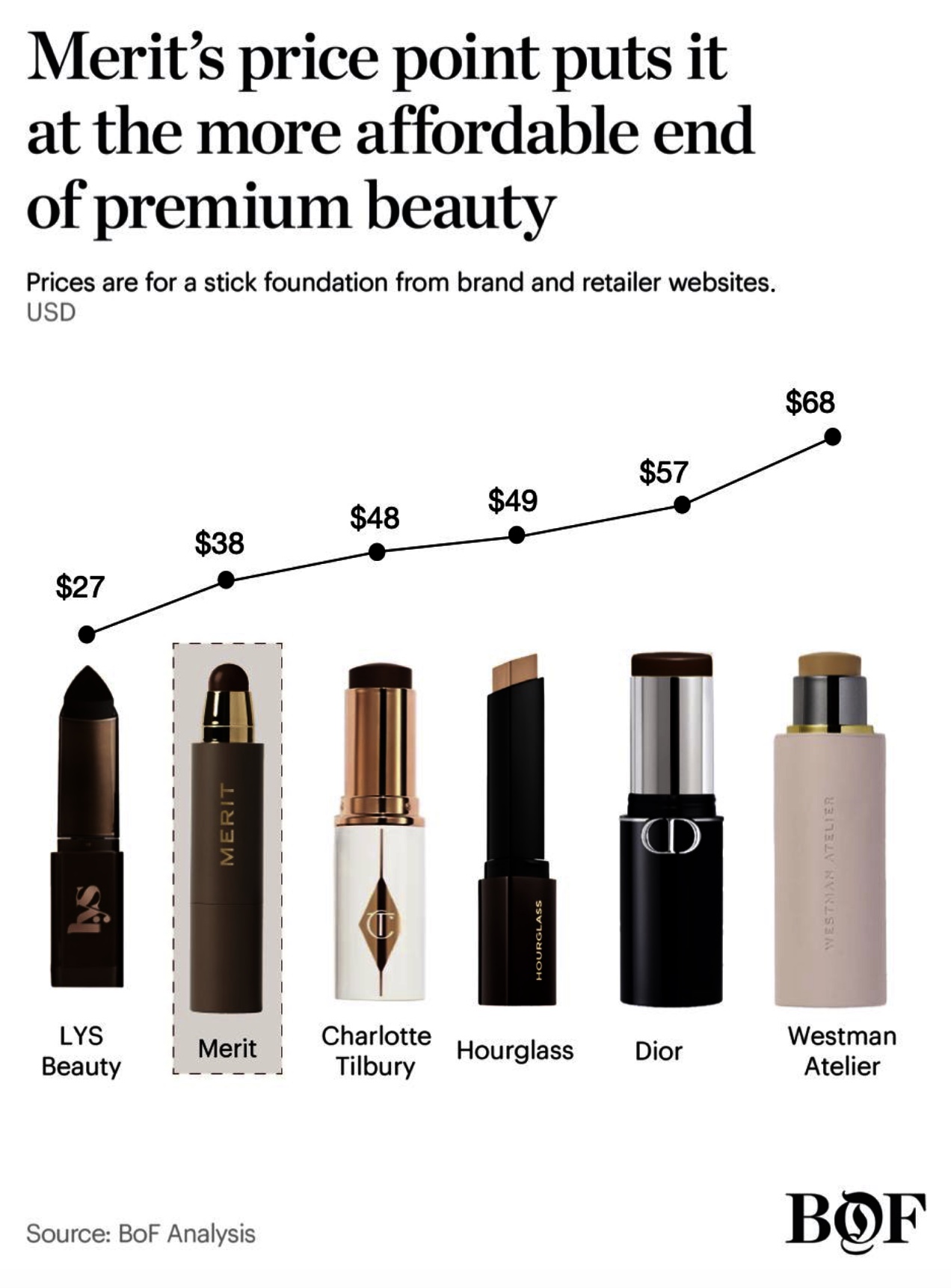
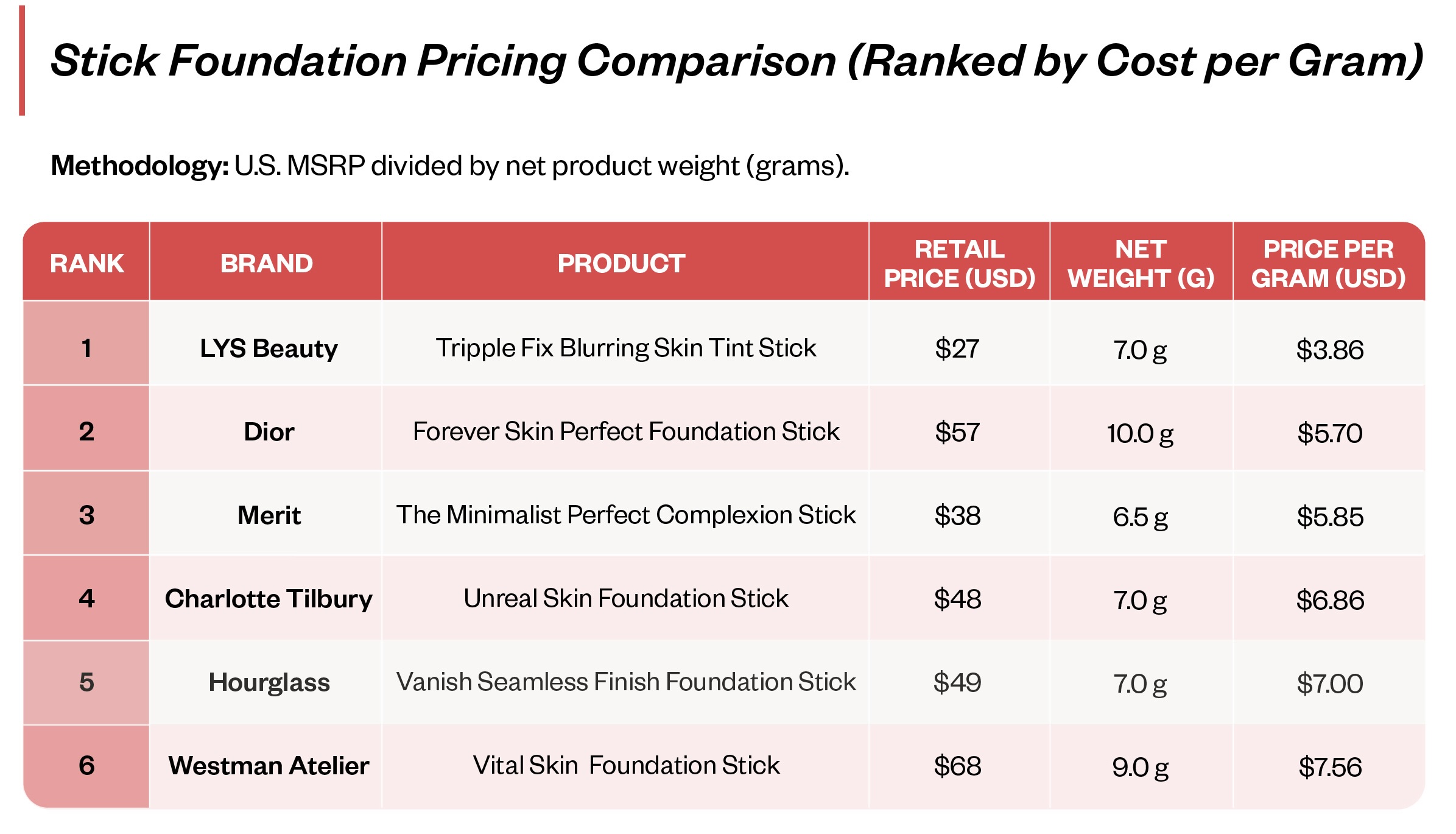
To account for product size, we created a table comparing the sticks on a price-per-gram basis. Merit’s position on the price spectrum didn’t change significantly. On a per-gram basis, its stick is priced at $5.85, compared to $6.86 for Charlotte Tilbury, $5.70 for Dior and $3.86 for LYS Beauty. The recalculation, however, underscores the relative value offered by LYS Beauty and Dior.
This exercise got us thinking about the messages prices convey and how consumers interpret value in beauty, a category where price-per-unit comparisons are rarely part of everyday shopping behavior. For this edition of our No Stupid Questions series, we asked 14 consultants, retailers, founders, content creators and more the following: Are consumers becoming more sophisticated about how they evaluate pricing today? What signals are shoppers using to judge value: price, product size, ingredients, performance or creator influence? How are perceptions of price shifting in today’s market, and how should brands respond?
-
 JENNA GOLDBERG Head of Stores, Omnichannel and Strategy, and Interim Head Of Merchandising, Bluemercury
 I think consumers are definitely savvier, especially online. Social media makes it easy to compare products, talk about price and weigh value, so shoppers are more informed than ever. That said, in our stores, those conversations look a little different. Our clients are focused less on price alone and more on understanding what a product actually does for them because how and why something works is just as important as, if not more important than, price.
The signals shoppers use to judge value really depend on the moment, but the holidays are a perfect example. That’s when shoppers are evaluating offers more closely, looking for strong value, but they still expect quality and efficacy. Sampling is a huge part of how we help clients understand value. Travel sizes and stocking stuffers, for example, let people try products or gift them before committing to the full size, which helps build confidence.
At the end of the day, value is about results. Price and product size matter, but performance, ingredients and trust in the brand are huge. Our job in store and online is to make that clear so clients can make informed decisions. Transparency really matters, especially in moments when people are thinking carefully about value.
Price is definitely part of the conversation online, and I think, currently, people are talking about it more than ever. In-store, though, it’s usually less about the number and more about fit and results. Our clients want products that actually work, and when something delivers, they stick with it.
Many of our top sellers are higher-priced items, which shows that efficacy drives perceived value. If a product solves a real problem, it’s seen as an investment rather than just a purchase. For brands, that means leading with performance, differentiation and clear benefits, and not just price. Offering a range of price points is smart, but the real driver of loyalty is consistent results. When clients trust a product, they keep coming back.
- Amanda Pond Founder and CEO, MOD Consulting
Consumers today have access to more information than ever before, and platforms like TikTok have accelerated pricing transparency. Creators now routinely break down cost-per-use, ingredient decks and dupes in real time. The fact that a viral creator immediately called out the lack of price-per-gram normalization in the BoF chart signals a meaningful shift: a segment of consumers is absolutely thinking more analytically about value.
However, sophistication is contextual. Beauty is still an emotional category. While some shoppers calculate price per gram, most are not standing in Sephora doing math. They are responding to brand perception, performance claims, packaging, creator endorsement and how a product makes them feel about themselves.
What signals are shoppers using to judge value?
Value today is multidimensional:
- Price Anchoring and Competitive Set
Consumers judge price relative to adjacent brands. Merit being positioned between LYS and Charlotte Tilbury is more psychologically powerful than its exact cost-per-gram. Placement within a “premium but accessible” tier communicates identity.
- Performance and Efficacy
If a foundation performs exceptionally, blends beautifully and photographs well, price per gram becomes secondary. In complexion especially, payoff > volume.
- Ingredient Signaling
Clean ingredients, skincare-infused formulas, clinical backing and dermatologist validation all elevate perceived value even if the raw product cost is similar.
- Aesthetic and Brand World
Packaging weight, minimalism, retail environment and founder narrative signal luxury or intentionality. Consumers often pay for positioning, not just product mass.
- Creator and Community Validation
Social proof has become a primary value indicator. A trusted creator saying “this lasts forever” can override a lower gram count.
- Cost Per Use (More Than Cost Per Gram)
Consumers are increasingly thinking about longevity. A stick that lasts six months feels like better value than one that runs out in two, even if grams are similar.
How are perceptions of price shifting?
Three key shifts are happening:
- Transparency is becoming table stakes.
Consumers expect brands to be defensible. If pricing feels arbitrary, it will be called out.
- Premium is being redefined.
“Premium” no longer automatically means expensive. Brands like LYS prove you can offer strong performance and inclusive shade ranges at lower price points, which pressures traditional prestige brands to justify their markup.
- Emotional value still outweighs mathematical value.
Even when price-per-gram comparisons show parity, consumers may still perceive Merit as “worth more” because of brand affinity, aesthetic minimalism and alignment with identity.
How should brands respond?
- Be prepared to justify pricing.
Know your cost drivers (formulation, packaging, distribution, marketing, retailer margins). If challenged, your value story must be coherent.
- Shift from price defense to value storytelling.
Instead of arguing about grams, highlight performance per swipe, skin benefits, longevity and multi-use functionality.
- Lean into strategic positioning.
Where you sit relative to competitors matters more than the absolute price.
- Consider cost-per-use messaging where it benefits you.
Especially in complexion, showing that a product lasts X months can reframe perceived value.
- Avoid competing purely on math.
Beauty purchasing remains aspirational and identity driven. Brands that reduce themselves to price-per-gram comparisons risk commoditization.
Bottom Line
Consumers are more informed, but not purely rational. Pricing in beauty is both economic and symbolic. The brands that will win are those that understand value as a layered construct: performance, positioning, emotional resonance and transparency working together.
-
The customer is absolutely becoming more sophisticated in how they evaluate pricing. What’s interesting about this evolution is that it’s not just more analytical; it’s more layered. Instead of simply asking, “How much does this cost?” they are asking, “Is this price worth it to me?” It’s subjective sophistication at its finest.
For example, cost-per-gram comparisons like the Merit example are not always apples to apples. The real value changes in how the product is actually used: coverage level, pigment intensity, how much is applied per wear. Customers are thinking beyond just size. They evaluate performance per use.
The first and most important signal is visual results. Does it work? Can I see it? Is there proof? Before-and-afters, creator demos and real wear tests all are powerful visual validations. Social proof is doing a lot of the heavy lifting in justifying price.
Ingredients are another interesting layer. Safe, efficacious formulas are table stakes now, and consumers assume that baseline. What really moves the needle is clear communication of hero ingredients. Buzzy, well-known actives like retinol listed front and center can quickly signal efficacy, even without the customer diving into the full ingredient list.
Then, there's the experiential layer. The price has to reflect the overall experience. Brand alignment, aesthetic, identity and accessibility all need to resonate with the customer's values. Transactional convenience like free shipping, easy returns, one-click checkout, shoppable user-generated content all reduce friction and become part of the perceived value based on how someone prefers to shop.
Overall, today's beauty price evaluation is sophisticated and personal. It's a combination of performance, proof, perception and practicality. Brands that can clearly demonstrate results, communicate value and remove friction are the ones that can confidently defend their price.
- Nigar Zeynalova CMO, Spark Edit
Consumers are becoming more sophisticated about pricing, but not in the spreadsheet sense the industry sometimes assumes. Most people aren’t calculating price per gram when they buy foundation. They’re evaluating whether a product earns a place in their routine.
TikTok and creator culture have dramatically accelerated pricing literacy. Consumers now understand formulation claims, dupes, wear performance and ingredient positioning in ways that didn’t exist even a few years ago. A viral side-by-side wear test can reshape perceived value overnight. That means shoppers are less influenced by absolute price and more by proof.
Performance has become the strongest signal of value. If a product lasts longer, works across skin types or simplifies someone’s routine, consumers will justify paying more regardless of size. Ingredients and formulation philosophy also carry weight, particularly as clean beauty and dermatologist-led brands have trained shoppers to look for transparency and efficacy.
What’s also shifting is the idea that “more product equals better value.” Many shoppers, especially younger consumers, prefer edited routines and smaller formats that reduce waste or allow experimentation. In prestige beauty, experience, design and emotional connection are part of the purchase equation.
The bigger change is that price now requires justification. Luxury positioning alone isn’t enough. Consumers expect brands to clearly communicate what they’re paying for - whether that’s formulation quality, performance outcomes or cultural relevance.
Brands that win today aren’t necessarily the cheapest or the biggest; they’re the clearest about their value proposition.
- Ben DuCharme VP, Insights and Strategy, The Langston Co
Consumers are becoming more sophisticated, but we see no indication that they are calculating price per gram more precisely. Instead, our research shows that consumers are more skeptical due to the continued proliferation of brands and products within the space.
Unfortunately, shoppers have learned that high price does not guarantee high quality. In fact, it is the top frustration cited by shoppers. The core question is simple: Will this work for my needs? If the answer is yes, consumers evaluate the product against others based on secondary factors like price.
Brand trust and word-of-mouth referrals remain powerful ways to convey quality. Benefit-aligned ingredients and claims act as proof points. Packaging and design shape quality perceptions. Influencers and creators provide social validation. But all of these ladder up to expected efficacy.
At the same time, price perceptions are diverging. Reflecting the broader K-shaped economy, a higher income cohort continues to spend and often drives a disproportionate share of category growth while a lower-spend cohort feels squeezed and actively seeks value.
The implication is strategic clarity. Brands must have a clearly defined target audience, understand that group’s willingness to pay, the feature/benefit requirements on their mental checklist and ensure their pricing is justified by aesthetic quality and indicators of performance.
- Sonia Summers Founder and CEO, Beauty Barrage
Consumers are smarter, but not in the way the industry sometimes assumes. They’re not standing in Sephora calculating price per gram on their phones. What they are doing is running a very fast, very sophisticated mental algorithm that blends price, performance, brand heat and social proof. Today’s beauty shopper understands positioning instinctively.
Price-per-unit comparisons are intellectually interesting, but beauty isn’t toothpaste. It’s emotional. It’s identity driven. It’s aspirational. A foundation stick isn’t just grams of pigment; it’s brand equity, packaging engineering, influencer credibility and perceived performance.
What’s changed is that consumers now expect the price to make sense. They may not normalize cost by weight every time, but they absolutely ask: Does this perform? Do I trust this founder? Is this brand culturally relevant? Does this price align with how it’s positioning itself?
And social media has made the consumer far less tolerant of pricing that feels arbitrary. TikTok has created a generation of armchair cosmetic chemists and margin detectives. If the product underdelivers, the internet will correct you quickly.
We’re also seeing a shift where “premium” is no longer synonymous with “better.” Dior pricing close to Merit on a per-gram basis actually reinforces something important: legacy prestige no longer automatically commands an irrational premium. That’s a big evolution.
The real signal today isn’t just price; it’s transparency and consistency. If you’re charging $48, you need to substantiate it through formulation, clinical validation, packaging innovation or brand authority. If you’re charging $27, you need to maintain desirability while protecting margin. Both are strategic plays.
The brands that will win are the ones that understand that value is multi-dimensional. It’s math, yes, but it’s also psychology, storytelling and trust. In this market, you can charge almost anything. You just can’t confuse people anymore.
- Amy Kapolnek Founder and Fractional CMO, The Fwrd Group
Consumers today are far more price aware than they were even five years ago. TikTok creators breaking down cost per weight is a sign of that. They’re way more comfortable interrogating value, which is why they instinctively question performance, ingredients and markups.
With that being said, it doesn’t mean price per weight is how most consumers actually shop. They don’t walk into Sephora calculating that. However, they are evaluating how a product makes them look, feel and identify. Beauty is still emotional, aspirational and performance driven. So, while they may not be “spreadsheeting” their makeup purchases, they are definitely sniffing out perceived overpricing.
Value is rarely just about price; it’s layered across performance, trust, ingredient narrative, social proof and overall brand positioning. If a foundation stick delivers higher pigment, better coverage or longer wear, consumers may use less product which can justify a higher price because it lasts longer and performs better.
Context also matters. Merit lives in “accessible luxury minimalism.” Dior signals heritage prestige. LYS stands for clean, inclusive affordability. Consumers interpret price through those lenses, too. A $38 stick from Merit feels very different from a $38 stick at the drugstore because brand story, distribution and packaging shape perceived value as much as the formula itself.
Ingredient storytelling further reinforces that perception. Actives, skincare infusions and proprietary complexes help justify premium positioning, whether or not they significantly change production costs, because innovation signals quality. Meanwhile, creator validation has become a real-time pricing auditor. When a product goes viral for outperforming its category, price resistance drops. When it’s exposed as mediocre, the same price suddenly feels inflated.
Beyond the product itself, factors like return policy, shade range, refillability and overall customer experience increasingly shape how consumers evaluate value.
We’re in a “premium fatigue” era. Consumers are still willing to spend, but they want justification. The automatic acceptance of prestige pricing is eroding. That’s why Dior’s per gram position in the recalculation is interesting. It subtly reframes a heritage brand as offering strong relative value. At the same time, accessible luxury brands like Merit thrive because they live in the psychological sweet spot: high enough to signal quality, low enough to feel rational.
- Frances Grant Strategic Advisor and Consultant
Today’s beauty consumers are increasingly sophisticated in how they assess price and value. Social media and creator commentary have demystified pricing structures, encouraging shoppers to look beyond sticker price toward metrics like ingredient quality, formulation and even price-per-gram comparisons. Still, price retains symbolic power as a proxy for quality, status and experience.
The Merit example illustrates how layered this conversation has become. Once consumers start comparing cost per gram, it’s only a short leap to deeper questions. How much product do you actually need per use, how long does it last, and how much gets wasted because of packaging design?
Each formula and component is different, meaning value can’t be reduced to a single metric. And that’s before factoring in the psychological side: how packaging, scent, texture, or creator endorsements shape perceptions, often subliminally.
But at the end of the day, whatever triggers the initial purchase, desire tends to override logic. You can tell someone that another foundation offers better value per gram, but if they love the way their favorite one feels or fits into their routine, that emotional connection wins. The product becomes “the one” because it satisfies something intangible—comfort, habit, identity. In that sense, much of beauty decision-making isn’t rational at all, but quietly guided by unspoken cues that anchor how a product makes us feel.
For brands, the takeaway is clear. Every choice, from concept to consumer, signals intent. In a world of radical transparency, where products are dissected online in real time, pricing, formulation, and positioning must be both deliberate and defensible. It’s less about reacting to scrutiny than ensuring every decision reflects what the brand stands for and can stand up to the inevitable comparison.
- Margarita Arriagada Founder, Valdé
Consumers are more sophisticated about how they evaluate pricing, but that does not mean they are mainly weighing price per ounce. In fact, in many cases, it may be the least of their criteria. The reason is that beauty products have become currency. The industry is saturated with many similar offerings, forcing the value equation to evolve. What remains constant, even as customer knowledge and sophistication increase, is quality.
That said, what I personally now see as most important is how a brand puts many of the key elements together to create its own "secret sauce" and ultimately drive the most value. For example, beyond quality and product performance, some important signals customers use to judge include ingredients. Are they clean? Do they have skincare properties? Do they multitask? Do they have ease of use?
More and more of the perception and aesthetics of the brand come into play, like packaging and branding, to finally create the emotional connection to the brand. Merit is the perfect example of a brand that does a great job of being thoughtful with its launches and telling special stories around its products, which in the end builds trust.
- Mehir Sethi Founder and CEO, Luscious Group
Premium makeup remains an emotional category rooted in identity alignment, making it impervious to math and social media sleuths. Unlike premium skincare (sometimes) or body and haircare (often), price per gram is not a significant factor. Makeup consumers consistently prioritize brand experience, luxury cues and product performance over volume.
In the prestige segment, shoppers are willing to pay more for luxury packaging, the promise of transformation, and quality. However, market saturation has raised the bar. There is now significantly less tolerance for higher-priced brands that fail to deliver results. Ultimately, premium beauty will always be measured not by quantity, but by confidence per use.
- Tara Cohen Founder and CEO, Mixst
From a market and product development perspective, we do these comparisons all the time, but I don’t think every consumer is calculating price per gram at shelf. What’s changed is that creators and reviewers are, and they’re actively educating the customer. That layer of transparency is making pricing conversations more nuanced, even if the average shopper still leads with instinct.
Are consumers more sophisticated? In pockets, yes. The enthusiast customer is far more literate about value, driven by social content and side-by-side comparisons, but broadly value is still emotional as much as rational.
When shoppers evaluate brands like Merit, LYS Beauty, Charlotte Tilbury, Hourglass, Dior or Westman Atelier, price is only one signal. Packaging, sensorial experience, brand point of view and, most importantly, performance still drive willingness to spend. If a brand knows its customer and speaks directly to her with strong design and great formulas, she’ll invest. Where the proposition feels unclear, she won’t.
Beauty is also unique in that “more product” isn’t always perceived as better. Consumers are trained to replace products regularly and don’t necessarily want oversized formats in makeup. Value lives differently here than it does in categories like body or hair. It’s about experience and trust, not volume.
We are seeing clearer price elasticity by category. Shoppers will stretch for complexion, where shade match and performance feel critical, but remain more resistant in mascara, liners and some lip segments where acceptable options exist at every tier.
Perceptions of price today sit in a tension. Consumers don’t want to feel tricked, but they also don’t equate cheap with good or expensive with superior. That puts pressure on brands to ensure quality and performance truly justify the ask.
The implication for brands is clarity: A distinct point of view, transparent value and products that deliver. When those are aligned, price becomes a reinforcement of positioning rather than a barrier.
- Lily Twelftree Founder, Unfiltered and Barefaced
I analyzed Mecca’s holiday collection to understand how their buyers were forecasting consumer interest and, as a byproduct, created a raw Google sheet breaking down the collection. The primary use for the sheet was ranking products by cost per unit, and after two TikTok videos, 2,500 people used it, generating 60,000 product-link clicks. Users came back repeatedly, well outside the holiday period, to interrogate the “objective truth” about beauty and help filter through the marketing noise. This was the first domino in me building a home for beauty research.
The average beauty consumer has become much more aware of the business of the industry. Reformulations, shrinkflation and ingredient swaps regularly cause a stir on social media. It’s an extension of the makeup artist and dermatologist creators who first built this appetite for product analysis.
Creators still play an important role, but their role is shifting. They are discovery engines more than authoritative purchase pushers. As media literacy has grown, consumers have also grown wise to the dynamics of gifting, and they automatically question whether a creator is positioned to speak objectively about a product. Instead of taking recommendations at face value, they scroll to the comments, hunting for what real people are saying. They then vet contributors for shared attributes, skin types and demographics. They’re building their own peer-review system.
I identified this behavior when I sat down with a group of 12 teenagers during customer research for Unfiltered. I watched their social media behavior and quizzed them on beauty-related behavior as they verbalized their thought process while scrolling. I found that when gen Z encounters a product, their default assumption is that the post was sponsored or the product was gifted, even when nothing suggested it. They weren’t skeptical of being sold to. They assumed they were being sold to.
Brands should stop fighting the new era of product assessment and design for it instead. Practically, this looks like optimizing branded sites for how people are actually researching now, increasingly through AI. Give engines something real to work with: actual formulation details, comparative data and the kind of information a spreadsheet-oriented consumer wants.
I hope this will force the industry to refine “transparency” from a marketing tactic into something more tangible so the best products can be rewarded over the biggest marketing spends. Practically, this looks like what Dieux Skin did when it raised prices. Rather than quietly adjusting or hiding behind vague “rising costs” language, the brand broke down exactly why.
- Nicole Collins Co-Founder, 213Deli
Beauty consumers have always been very sophisticated in how they evaluate pricing and products. This is not a new phenomenon. It was because consumers demanded it that brands removed parabens from formulas 20 years ago. Consumer demand has driven the clean beauty movement and push towards more sustainable packaging and practices as well. When the beauty sampling boom of the mid-aughts was hot (thanks to Ipsy), consumers would evaluate the value of their samples based on per size unit pricing of a sample versus a full-size item and its MSRP.
I would bet that zero beauty consumers make purchasing decisions based solely on price. Consumers will try something because it's been recommended to them by a friend, influencer or salesperson. That recommendation plus their personal preferences and values around ingredients and perception (cool factor) will determine if they make that first purchase. They will repurchase based on performance, which is totally subjective.
If pricing alone was what mattered, no one would shop beauty outside the dollar store. Beauty products make us feel our best, and that is what every beauty consumer is chasing. She wants to feel her best when she walks out the door, and she'll purchase the items she can afford that deliver that feeling for her. Brands that can evoke emotion and deliver quality formulas are the ones that win consumers hearts and dollars. That has always been true and always will be.
- Anne Laughlin Founder, So Sloane
Consumers are more sophisticated than ever, especially when it comes to product comparison and selection. While most people might view the beauty industry as overly saturated, a wide variety of needs exist across makeup, skincare, fragrance and haircare, and there is more than enough room for these brands to exist and grow.
The value of a product shouldn’t be based on weight or size. The value is the quality of the product: how it wears, the staying power, blendability and how the ingredients support versus damage one’s skin barrier. In addition, one formula might allow for less usage for optimal coverage. The value of a product isn’t the size or the weight, but rather what it is worth to its target market, how it wears and how it makes one feel.
If you have a question you'd like Beauty Independent to ask consultants, retailers, founders, content creators or others, send it to [email protected].



Leave a Reply
You must be logged in to post a comment.