When a brand’s funding round is announced, venture capitalists are happy to chime in to hype its business. But when a brand closes, a development baked into the VC business model, they’re usually nowhere to be seen. If anyone talks about closures, it’s founders—and the distraught fans of their brands.
Good Light founder David Yi has been especially candid about the circumstances surrounding his brand’s shutdown. Speaking on the Feb. 23 episode of the podcast “Gloss Angeles,” he explained that the rapid expansion of K-Beauty in American retail changed the competitive landscape and diminished his brand’s differentiation. “No longer are we the special one brand that’s K-Beauty,” he said. “We’re now a commodity. We’re now one of dozens.”
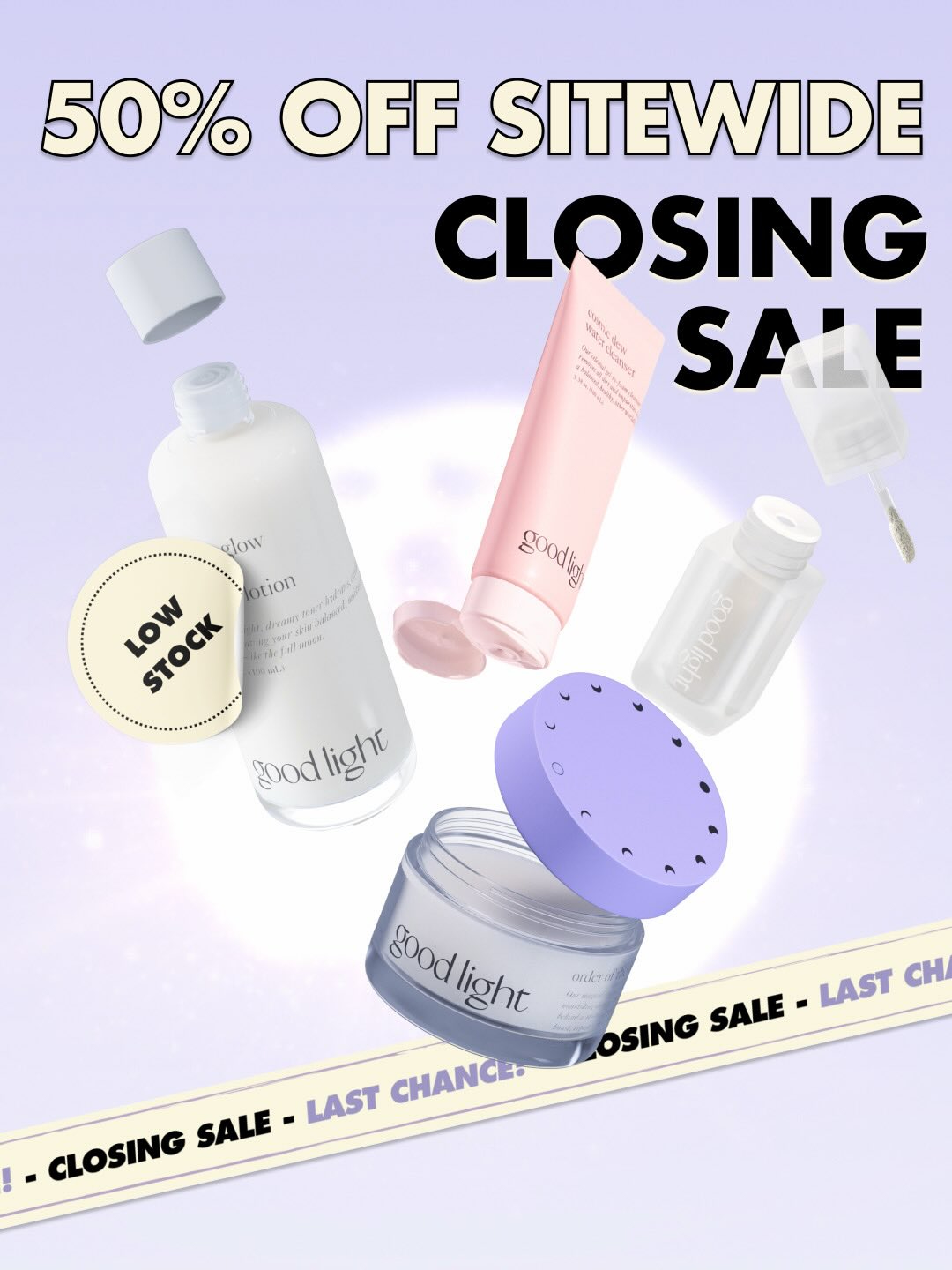
Good Light, which rolled out across Ulta Beauty stores nationwide last year, isn’t shutting down because it’s unprofitable. Yi revealed that the brand had reached profitability after cutting marketing and advertising spend for two years, but continuing to grow it would have required far more energy and resources. Good Light will shut down in April and is currently discounting products by 50% on its website.
“We’re profitable. I worked so hard in those two years, but I just didn’t see myself being able to give this more of my energy in the next two years,” he said. “Could I have 3X’d the business again? Yes, of course I could. There are other retailers that are circling us and that have reached out and that we were supposed to launch with this year, but I just didn’t feel like I had the capacity to do that.”
Yi isn’t the only one getting candid about Good Light’s closure. In a rarity for a VC investor, Odile Roujol, managing partner of Fab Co-Creation Studio Ventures and an early backer of Good Light, is also speaking openly about the brand’s shutdown and the difficult landscape indie beauty brands are navigating. In the conversation below, she provides her perspective on what went wrong for Good Light and the lessons the brand’s closure holds for early-stage brands considering big-time retail.
What’s a big lesson from Good Light’s closure?
David is a visionary, pioneer and activist. He was the first one to celebrate beauty beyond the binary. He wrote about the toxicity of Glossier because he thought it was important. He’s someone inspiring because he says things a lot of people don’t say. That’s his North Star, his vision.
Then he signed with a big retailer. When you have a big retailer and you need to deliver for many doors, it shifts how you look at your company because you want to be the best partner you can be. For Ulta, David was super exciting because he’s bold and very good at speaking. They could use him for communication.
I’ve worked in big corporations. I’m not criticizing big corporations at all, but they’re the sum of individuals with different agendas. When he needed Ulta to help him, there wasn’t any. And when you are involved with a big retailer, you have to meet expectations, and the brand wasn’t able to meet the expectations.
One of the big lessons is to partner with a big retailer step by step. For me, David’s main power was to be a beauty influencer and to have his brand be on Amazon, TikTok and DTC, where it was engaging with the community. By signing with a big retailer, he didn’t have the time to grow that.
Your vision, your North Star, you can’t execute on that the way you should have when you don’t have the time to do it.
Is there a certain level of awareness or sales you believe a brand should get to before entering a big retailer?
Let’s be super transparent. He had people taking care of his Amazon business on his cap table who were not meeting expectations. When you have that, it’s very difficult to manage because you have a contract, and when you don’t have two legs of your distribution moving forward, it’s very challenging. If he could’ve had more time and energy on DTC and Amazon, it would have helped the other part of the business.
My advice for all entrepreneurs is you should never give equity to a supplier. If these people don’t honor their commitments, you’re not in good shape.
All of the companies that are successful in my portfolio, where most of them are between $3 million and $15 million, have 20% of their business, if not more, on Amazon. When you grow on Amazon, it’s pretty healthy because it ties into your community, your social and your digital. The problem is, if you have a big retailer taking your time and energy, you can’t do that.
What were the conversations you had before the closure?
I don’t think we were informed super far in advance, and that’s normal. If you look at the cash that many entrepreneurial brands have, they could be dead in six months. We were informed when he thought it was the right time.
Brands are looking to suppliers as equity partners especially in the current tough funding environment. Are there better alternative funding sources they should look to?
When they do SAFEs, they can go to family offices or celebrities, and I’m not talking about famous musicians or actors, I’m talking about entrepreneurs who can be famous. When they source an entrepreneur, they may not be investing a large amount, but they can be healthy people to have on a cap table, whereas someone on the cap table delivering a service is not healthy for the cap table.
Do VCs deserve part of the blame for brands we’ve seen shutter?
When you look at these brands that are shuttering, you can blame VCs. From time to time, they have too much at stake. Let’s say they help twice with funding. Maybe the third time they won’t help with a follow-on because they think the founder is running out of cash and can’t find any new investors.
The VCs at the moment are facing down valuations for some of their companies because they invested at the wrong time at higher valuations. The most disciplined investors keep valuation at the early rounds around $10 million, which usually puts them in a better position. But if you invested at a higher valuation and brands struggle to find new investors, those new investors come in with preference in the next round, and you are not in good shape.
VCs have LPs and need ROI on their investment, and with some founders they can’t go further. It comes back to the question: How much cash do you need in a period when it’s tough to grow and achieve positive EBITDA, especially when you have a big retailer?
Without K-Beauty’s boom, do you think Good Light would’ve survived?
I don’t know. I don’t know if it’s the K-Beauty boom or that it just comes back to David having a tiny company with a small team. Let’s talk about Medicube, which is huge on TikTok. They have spent a lot on digital and social commerce.
At the same time, if you are at Ulta and you see the boom of K-Beauty, you have new brands coming in and appearing on the shelf. It’s frustrating when you see that. David is one of the pioneers in this generation of K-Beauty with great products and, at the same time, doesn’t survive because of lacking the cash compared to what you need. This guy is so smart and so creative and running out of cash at the wrong moment.
He did a lot of education on K-Beauty. If you look at Korean investors, they could have thought it would be smart to help a company already with a huge footprint in the U.S. and help it scale to the next stage. He didn’t find that because he’s Korean American, raised in America with Korean roots.
In Korea, he is not part of the ecosystem. They are more interested in scaling a brand in the U.S. that has already been scaled in Korea than growing and scaling a brand based in the U.S. He went to Korea many times to reconnect with his roots and the culture, but also to meet investors. That part is more complicated than people could anticipate.
On “Gloss Angeles,” Yi said it takes $10 million in funding to run a beauty business like his in 2026. Do you think that is the amount of funding needed?
There are so many different scenarios that I can’t say exactly. The minimum you need to raise in the beauty category is $700,000, and then maybe you need $2 million to $3 million from there to have a path to positive EBITDA and to grow with word of mouth and not spend too much on marketing. The most successful brands actually won’t raise $10 million.
Do you think a brand can realistically bootstrap and go the big retail route?
I’m not a big fan of going into big retailers at the seed stage because each time I have seen someone sign with a big retailer, they struggle. If they manage instead to continue growing their community and engage with their audience, including through Amazon and TikTok, they are less at risk.
In retail, you may suddenly be a hot brand they needed for a certain period, maybe when they care about inclusivity or something else, and then suddenly you are not.
What are you investing in now that you might not have been a few years ago?
When I invested in Good Light, it was very much about consumer brands building a community. Good Light did an amazing job engaging with its community around the idea of self-confidence and self-expression.
Now, to be honest, because of the cost of acquisition and the complexity of growing while maintaining positive EBITDA, I’m more interested in categories like health and longevity.
The definition of beauty is changing. If I look at my daughter-in-law, who is Korean and living in San Francisco, she’s going to the med-spa every three months even if she has perfect skin. The routine she has in skincare is simplified compared to what her mother did. The same is true for me. In menopause, you are looking at your biomarkers and thinking about your topical products in the context of everything else you are doing.
The future of beauty is about data and personalization, including devices and ingestibles. But, still, I am drawn to founders. When I chose to invest in Good Light, it was about the drive and vision of David.
There is a B2B revenue stream for some of these companies. That is one difference in the business model. Most of them also operate on a subscription model. In the past, especially in beauty, we talked about loyalty and the idea of keeping your customer for life. When you have a subscription model, you have recurring revenue if people make it part of their routine. One of the huge successes of Nutrafol was the subscription model.
What other lessons are there from the Good Light experience?
At a moment when funding is more difficult, it’s super complicated for entrepreneurs. They should choose to bootstrap and take more time to grow, but it’s tough when you have people saying they want to be on your cap table and that they can help you and provide services in addition to an investment. My advice is to do your due diligence about the people on your cap table.
On retail, from time to time, entrepreneurs underestimate the complexity of execution compared to signing a big deal. When I saw people super excited in the past to sign with Sephora, some of them now say it’s 40% of their business and that is a huge achievement. Four years ago, they might have said 80%. These retailers have many different goals. They are huge teams, and when you are a tiny company, you can’t depend on one retailer.
We’re seeing entrepreneurs like Yi and Diarrha Ndiaye, founder of Ami Colé, be proactive about their public relations strategy and taking to the press to tell the story of the brands’ closures. What do you think about that strategy?
For David, it’s totally consistent with who he is. He’s raising his voice. He’s a storyteller. He wants to say what his purpose was and why it didn’t work, and he’s self-aware about why it didn’t work. It wasn’t just him. The context didn’t help and some stakeholders didn’t help.
I don’t think he should feel bad. He did his best, and he’s a hard worker. I’m pretty confident he will find a new role or initiative that will be fabulous and consistent with who he is. He hasn’t compromised on anything, and that’s a good thing.
This interview has been edited slightly for brevity and clarity.