
Osmo Raises $70M Series B To Expand AI-Powered Fragrance Ingredient Design And Manufacturing


Osmo, which uses artificial intelligence to map molecules and generate fragrance formulas, has raised $70 million in series B funding to scale fragrance manufacturing and ingredient supply, as AI tools become increasingly central to how scents are developed.
Bringing total funding to $130 million, the series B round was led by Two Sigma Ventures, with participation from Valor, Atreides, Amplo, Alumni Ventures, Collab Fund, Lumina Partners and Stripe co-founder and CEO Patrick Collison, alongside existing investors. Osmo launched in January 2023 with a $60 million series A round led by Lux Capital and Google Ventures, with participation from Arena Holdings, Moore Strategic Ventures, Amazon’s Alexa Fund, Exor Ventures and the Bill & Melinda Gates Foundation.
The new funding will go toward scaling Osmo’s fragrance ingredient supply arm, Generation, which launched in March 2025 with proprietary, AI-designed synthetic fragrance molecules called Glossine, Fractaline and Quasarine. The molecules are engineered to deliver specific olfactive functions such as radiance, texture and diffusion rather than replicate traditional natural notes. The capital will also support the build-out of Osmo’s 60,000-square-foot manufacturing facility in Elizabeth, N.J. The company is in the process of moving its operations from its 10,000-square-foot lab in Manhattan to the new facility, slated to be fully operational by March.
By pairing AI-driven formulation with in-house manufacturing, Osmo aims to shorten fragrance development timelines and offer lower minimum order quantities than are typically available through traditional fragrance manufacturers and suppliers. The approach allows the company to serve fast-growing indie brands as well as larger consumer packaged goods companies seeking greater speed and flexibility.
Today, the industry’s “big four” fragrance ingredient supplier conglomerates—Givaudan, DSM-Firmenich, IFF and Symrise—all incorporate AI into research and development, harnessing it to analyze vast ingredient databases and explore novel scent combinations. Osmo’s model builds on that shift by coupling AI-designed ingredients with low-barrier production.
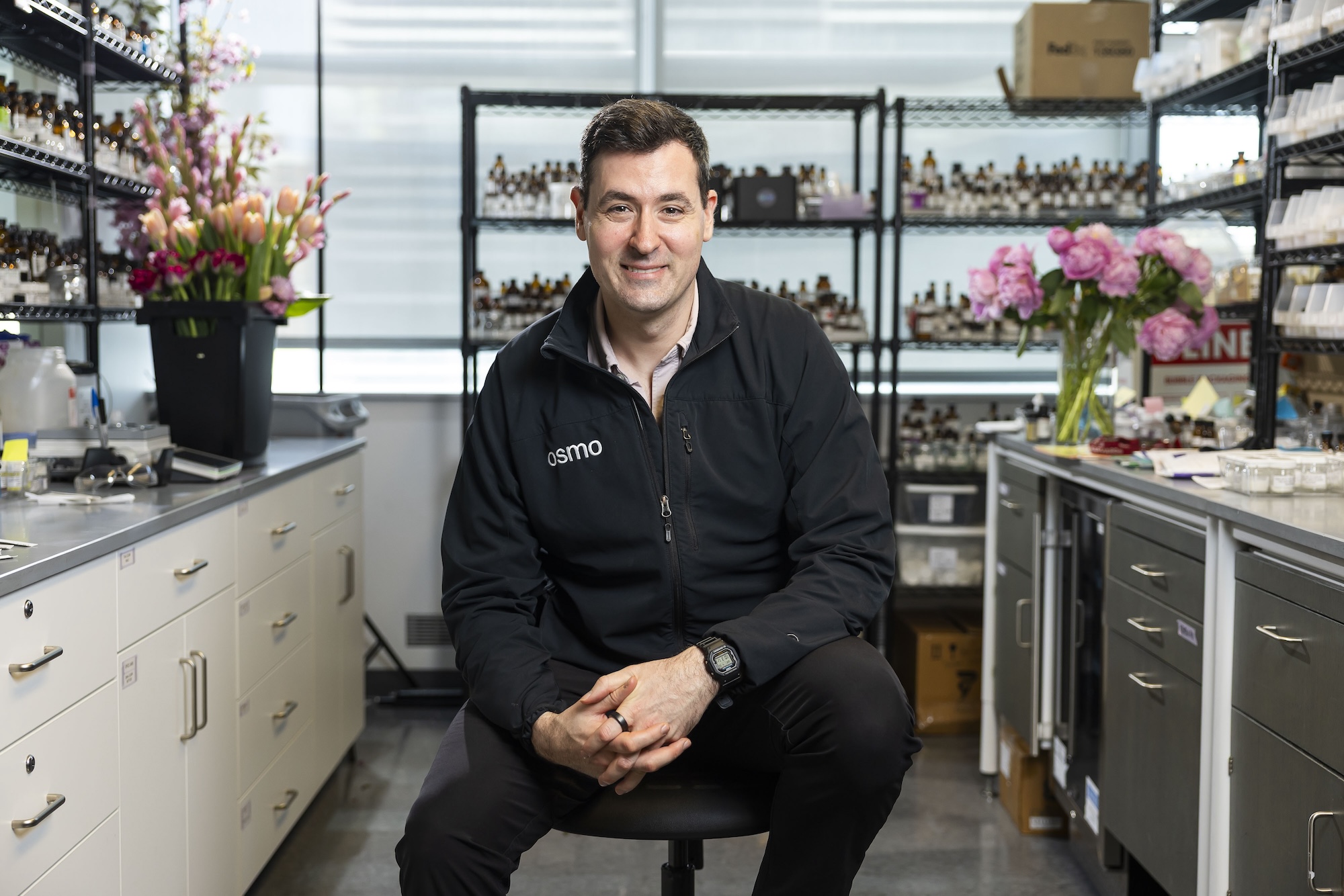
“Our business model is very simple. We don’t launch brands, we don’t market brands, we don’t distribute. We are in the background,” says Osmo CEO and founder Alex Wiltschko. “We help brands create beautiful scents at the speed of culture using data because we want our customers to win with their consumers.”
Osmo is expanding its executive team as it scales. Recent hires include CCO Mike Rytokoski, formerly of Unilever and Amyris; COO Mateusz Brzuchacz, who previously held roles at Givaudan and IFF; and CFO Nate Pearson, who has worked at Tesla and Mercedes-Benz.
With the new funding, Osmo is refining Generation, which enables brands to input information ranging from broad mood boards to highly specific parameters such as fragrance notes, texture and performance goals, to produce custom fragrance formulations that are then refined by Osmo’s in-house perfumers. Wiltschko estimates the company can turn around a fragrance in as little as 48 hours, depending on complexity.
“Brands that are startups and growing fast need to move fast, and we’ve solved that for them,” he says. “On the other end of the spectrum are multinational CPG companies. They also need speed because they’re being squeezed from both sides by white-label offerings using data to attack their market share and indie brands capturing a disproportionate share of category growth.”
Osmo’s manufacturing model emphasizes speed, smaller production runs and tighter integration between fragrance design and production. Minimum order quantities start at 500 units per SKU for turnkey fragrance projects and 10 kilograms for fragrance oil. Its formulations draw from a library of roughly 900 synthetic, natural and proprietary ingredients.
“Historically, fragrance has been incredibly inaccessible and gated,” says Wiltschko. “If you’re a brand wanting to create something truly unique, you’ve needed years of formal training, deep industry connections or millions of dollars in capital to access custom fragrance development at a large fragrance house. We’re changing that.”
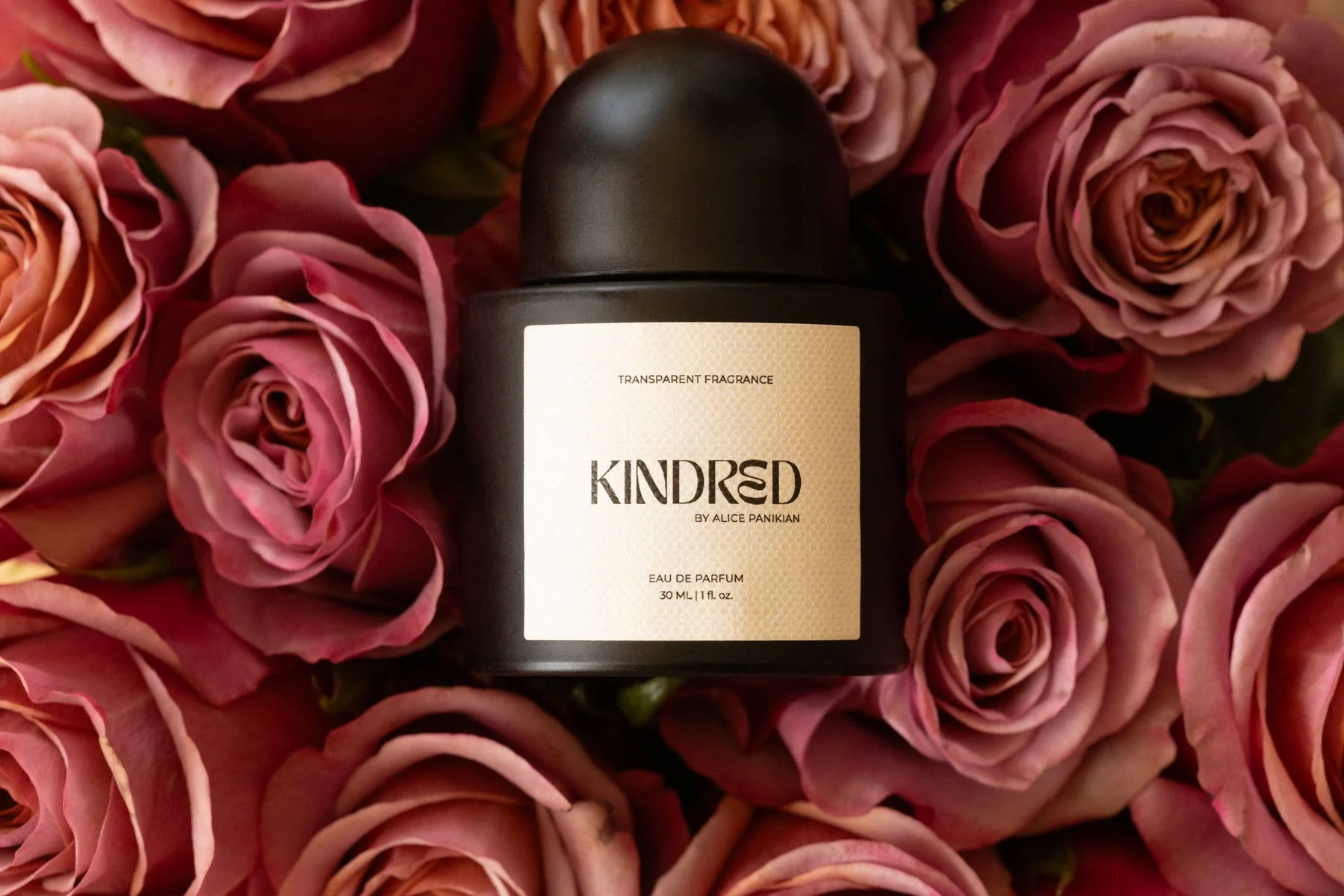
Osmo has worked with nearly 100 brands to date. Its clients include The Tilted Chair, Kindred, Loucil, the Museum of Pop Culture and the ARTE Museum. Alice Panikian, the journalist and content creator who launched Kindred in July 2025 after six months of development, was working at Osmo on its partnerships business unit when she decided to develop her own fragrance. She teamed up with Osmo’s master perfumer Christophe Laudamiel, who has created fragrances for Beyoncé and Tom Ford, on its scent.
The $65 scent features Bulgarian rose, a nod to Panikian’s heritage and her late mother. “They understood my vision and were able to translate it into a formula that felt plucked directly from my imagination,” she says. “It was the perfect balance of innovation, tradition and collaboration.”
Wiltschko received his doctorate in olfactory neuroscience at Harvard University and founded Osmo while working as a research scientist at Google Brain, which he describes as the birthplace of modern AI. In 2024, Osmo became the first company to digitize scent by “teleporting” the smell of a fresh summer plum, a demonstration showing that scent can be converted into data and used to train AI algorithms.
The company currently creates hundreds of scents per week. Wiltschko views its business as having implications beyond selling bottles of fragrance. “Dogs can smell COVID-19 and cancer, and flowers can produce scents that, from the first time you smell them, form not just a memory, but an emotion that can last a whole life,” he says. “My mission is to take that incredible power of scent and put it into people’s hands.”
Click here to learn more about Dealmaker Summit happening June 8 & 9 in New York.

Leave a Reply
You must be logged in to post a comment.