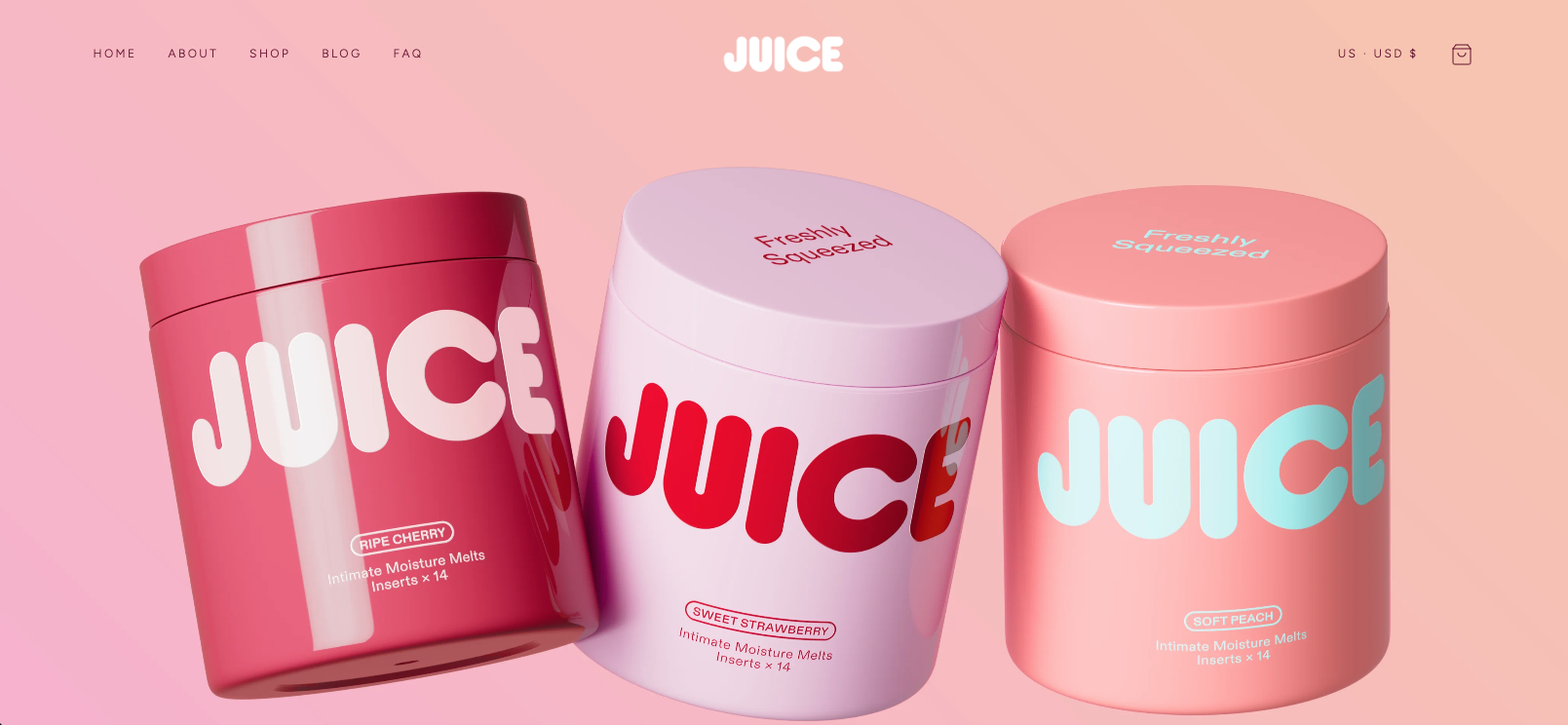

A new brand is marketing fruit-infused suppositories as “beauty products” for the vagina, promising a sweet scent. Does the vagina need a beauty product? Many women’s wellness insiders say, emphatically, no.
British intimate beauty brand Juice has launched in direct-to-consumer distribution with vegan vaginal melts in three varieties: Ripe Cherry, Soft Peach and Sweet Strawberry. The fruity-fragranced melts, inserted like tampons, are formulated with natural plant oils, fruit extracts and vitamin E. On its website, the brand describes the “little indulgence” as hydrating “from the inside out” to leave “behind a soft, subtle scent.” The brand, which describes itself as fun, bold and unapologetic, sells a jar of 14 melts for $62. It’s amassed over 15,000 followers on Instagram.
Juice is the latest venture from entrepreneur Hanushka Toni, founder and CEO of luxury goods resale platform Sellier. In a recent LinkedIn post, Toni writes that, in its first month, Juice has received more than 3,000 orders and positive feedback, “particularly from women in menopause who are tired of clinical, problem-led products and want something that feels like beauty again. Juice is about bringing that same sense of playfulness, confidence and ownership into every part of your routine.” Juice couldn’t be reached for comment.
The post elaborates, “Do we need a beauty product for our 🐱 ? No. But beauty has never been about need. It’s about choice, expression, and how you want to feel in your own body. You don’t need a hair mask. You don’t need perfume. You don’t need a bikini wax. You don’t need any of it.”
Other wellness entrepreneurs are raising concerns about applying beauty product-style marketing to an internal wellness product. Lizzie Staiano, head of marketing for period care brand Totm, criticized Juice in a post that’s garnered over 800 likes and nearly 400 comments. She decried Juice as “a very old message in pink packaging,” contending the brand recasts shame-based marketing as empowerment.
Katy Cottam, founder of intimate care brand Luna Daily, asserts that products like Juice are regressive rather than innovative. She took to LinkedIn and Instagram to share her concerns about Juice. Her Instagram video racked up over 34,000 views in less than 24 hours.
“They’re the same old feminine hygiene playbook repackaged as indulgence,” says Cottam. “Same shame, prettier jar.”
While Summer’s Eve is still around, the zeitgeist has mostly coalesced around the notion, confirmed by doctors, that vaginas are self-cleaning organs that don’t require products for freshness. Despite the consensus, products that pledge to fight vaginal odors like Lemme’s probiotic gummy Purr have become popular.
Lindsay Wynn, founder of Momotaro Apotheca, points out that moisture is important for the vaginal microbiome, but questions the safety of Juice’s formulations and marketing approach. Wynn’s brand sells $38 vaginal suppositories made with organic, plant-based ingredients including beechwood, calendula and cocoa butter as a homeopathic solution for common concerns like yeast overgrowth, bacterial vaginosis and vaginal discomfort.
“With a product that includes ingredients like fruit extracts and Stevia, you risk creating long-term, disruptive and dangerous issues,” says Wynn. “From a vulvovaginal care standpoint, this is negligent, and from a social and cultural standpoint, a brand like this is harmful. Your vagina should not taste like fruit, and we should not be telling women and young people that it should.”
The vaginal suppository format, which can be effective for therapeutic treatments, has been gaining traction in the past five years and has been a staple of indie brands for longer than that. Sexual wellness brand Foria launched bestselling Foria Relief suppositories in 2016 to alleviate menstrual cramps and pelvic pain. In recent years, modern brands like Joylux, Womaness and O Positiv have introduced hyaluronic acid-infused vaginal suppositories to support internal hydration. Women’s telehealth specialist Evvy offers probiotic vaginal suppositories to help restore pH balance and address abnormal odor and discharge.
“Same shame, prettier jar.”
Wynn argues products positioned like Juice’s melts reinforce skepticism about whether vaginal care is necessary or legitimate. “When products rely on outdated tropes masking scent or altering taste, they echo the worst of legacy ‘fem-care’ marketing,” she says. “That history has impacted consumers to associate the entire category with shame-based messaging and ineffective and even harmful ‘solutions.’”
Catherine Magee, co-founder of sexual wellness brand Playground, has a more generous take on Juice, but warns that, if a consumer is purchasing the product to treat vaginal odor, it’s important to get to the root cause of the odor. “The ingredients are rich and tissue-conditioning, meaning they topically moisturize the top layer of the vaginal walls, so that’s a positive,” she says. “If the purpose of the suppository is purely to smell better for the user, maybe this is a desired product? But I’d want to be clear that it’s not a solution or preventative against odor, and this product will not prevent odor like a deodorant.”
Vaginal suppositories exist in a regulatory gray area similar to lubricants. To use the term lubricant, a product must be classified by the United States Food and Drug Administration as a Class II medical device. To achieve the classification, it has to be extensively tested in a lengthy process that can cost tens of thousands of dollars per stockkeeping unit. Due to the cost and time involved, many independent sexual wellness brands tend to avoid the classification, instead dubbing their products “sex serums” or “intimacy oils,” staying within the cosmetics arena and stating their products are for external use.
Vaginal suppositories are for internal use, but can get around the lengthy and costly FDA process by being marketed as intended only for moisturizing, cleansing or reducing odor as “cosmetics” and not products that can treat, cure or prevent a condition, all claims reserved for drugs. A handful of vaginal suppositories are classified as Class II drugs, including PH-D’s Moisturizing Boric Acid Vaginal Suppositories and Bonafide’s Extra-strength Vaginal Dryness Relief Suppositories.
Luna Daily’s Cottam calls out the regulatory gap for instigating safety issues and opportunism. “Any product designed to be inserted into the vagina and sold with a claim of effect, therapeutic, aesthetic or otherwise should sit within a medicine or medical device framework,” she says. “It exists because that’s the only route that requires someone to prove a product is safe before it reaches inside a woman’s body. Until the industry takes that distinction seriously, we’re going to keep seeing women’s bodies treated as a category opportunity rather than an environment that deserves protection.”