“We’ll Bring What Real K-Beauty Is”: Olive Young Builds Buzz Ahead Of US Retail Expansion
When it touches down in Los Angeles with its first American store in the spring next year, South Korean retailer Olive Young is eager to open Americans’ eyes—and wallets—to the wide world of K-Beauty possibilities, from cutting-edge product formulations at affordable prices to advanced gizmos monitoring product results.
“What you know here [in the U.S.] isn’t really K-Beauty,” says Rena Kim, a senior manager at Olive Young, which is a subsidiary of food, biotechnology, entertainment and retail conglomerate CJ Group. “We’ll bring what real K-Beauty is.”
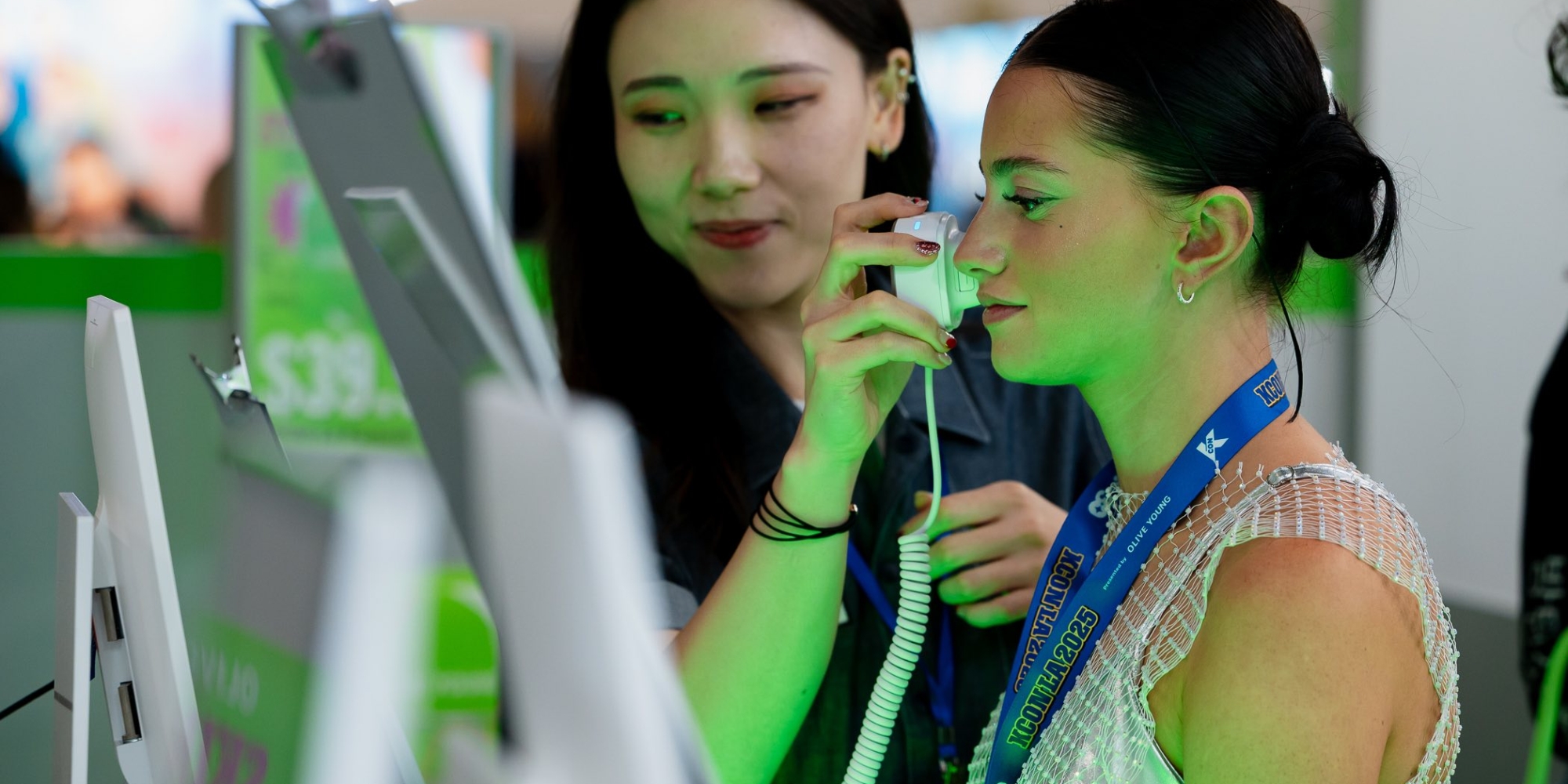
The retailer offered a preview of what its future store could offer at KCON, an annual convention celebrating Korean pop culture that ran from Aug. 1 to 3 at the Los Angeles Convention Center, where attendees checked out high-tech machines to deepen their skincare knowledge and tested products from three of Olive Young’s private labels as well as a plethora of other brands.
Sehoon Jin, EVP of Olive Young’s global platform business, says, “This is a meaningful step in bringing Olive Young’s trusted and inclusive K-Beauty experience to the U.S. market.”
Operating over 1,370 stores in its home country and sourcing from 10,000 independent brands, the K-Beauty retail giant already pulls over half of its total online revenue from the U.S., thanks to its global e-commerce platform. California alone makes up 40% of its American online sales. The 26-year-old company wants to level up the K-Beauty experience in the single largest beauty market by educating consumers and treating shopping like entertainment.
Considering that Olive Young’s name is a play on the phrase “all live young” and its core demographic comprises females between the ages of 13 and 30, “that kind of in-store experience has been really important for our strategy,” says Kim. “In the Olive Young [stores], we have the packaging and it’s affordable. It’s kind of very trendy.” With a vast database tracking customers’ purchases and reviews, the retailer is “known for changing products really fast,” she says. “You won’t see the same product in like two weeks.”
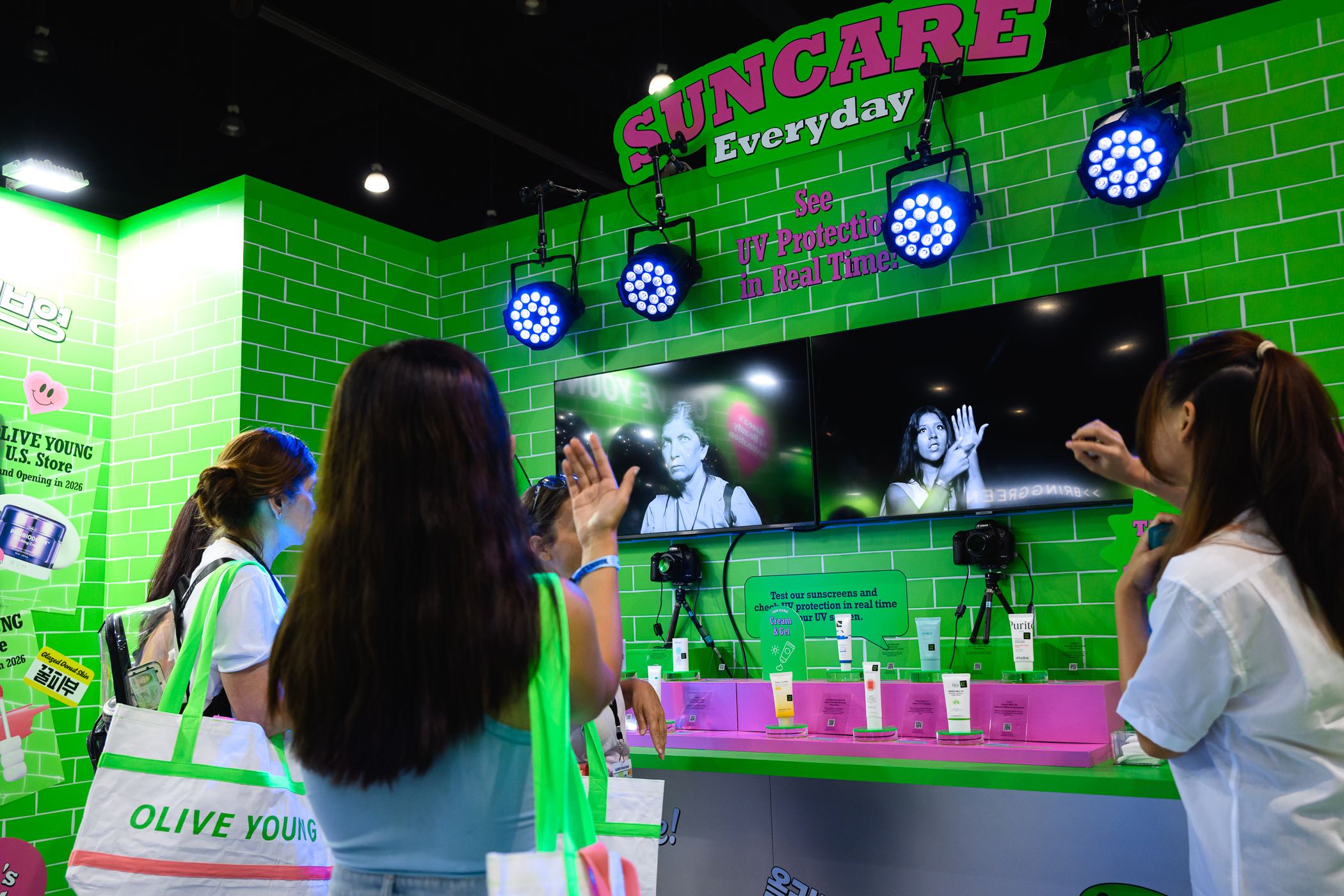
The emphasis on education and entertainment was on full display at KCON. Olive Young took over the title sponsorship this year from Samsung Galaxy and commanded a prime spot at the Convention Center with a 1,400-square-foot pink and green booth featuring 164 products from 66 brands.
In one corner of the school-themed exhibition, attendees scanned their skin to check how healthy it is, including hydration and sebum levels. Another screen used black light to display, in real time, the UV protection provided by an array of sun care cushions, sticks, creams and gels. Promising to help users “sleep like a queen, shine like a donut,” a display for creams addressed skincare concerns ranging from soothing and lifting to barrier repair and spots.
In Olive Young-logoed bags, 36,000 visitors to the booth hauled samples appealing to various ages, budgets and skin types. There was Mediheal’s sun serum blended with madecassoside that offers SPF 50 and promises to repair blemishes. It’s priced at $29 for a 50-gram size. A square wrapper from Biodance holds a pair of collagen gel toner pads priced at $27 for 60 pads.
Bringgreen, Bioheal BOH and Colorgram are among the Olive Young private-label brands slated for its forthcoming LA store. The trio of brands started selling on Amazon last year for American shoppers excited to snap up the Olive Young-approved products.
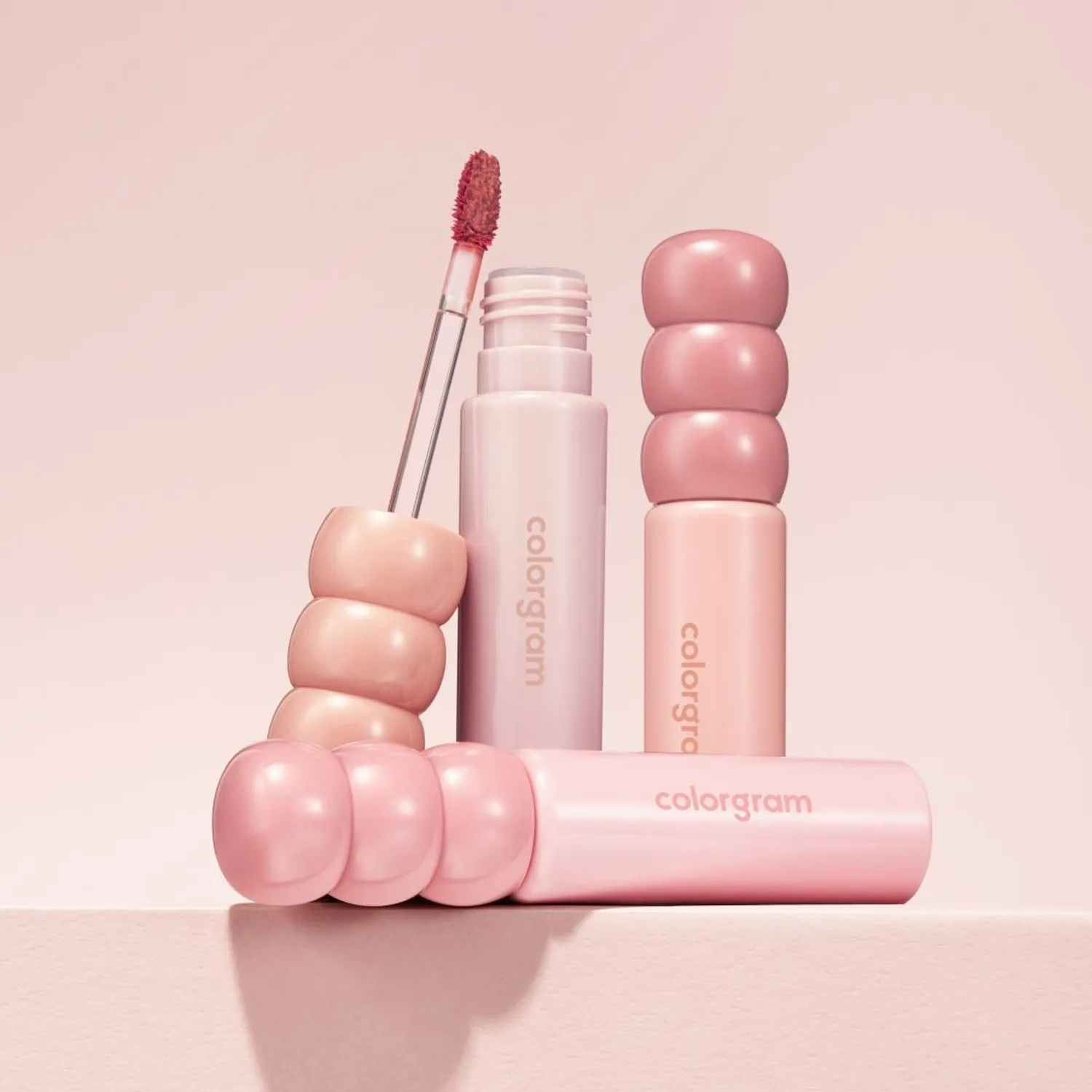
Bringgreen zaps zits with its Zinc Teca serum priced at $26 for a 25-ml. size. A 50-ml. purple jar from Bioheal BOH priced at $46 is filled with peptide-rich lifting cream. Fruity colors and glossy finishes enhance the appeal of Colorgram’s lip tints priced at $10 apiece. Indeed, beauty influencer Lily Chung recalls how Colorgram’s lip stain was her entry to K-Beauty. She says, “It wouldn’t leave my lips for two days.”
For its LA store, Olive Young plans for the staff to be a mix of people it brings from South Korea and local beauty consultants and makeup artists. While a couple of its biggest stores in South Korea span over 12,400 square feet and occupy as many as five floors, the LA location is smaller, but Kim says it still will be “a decent store.” She adds, “Each shelf and zone would be very interesting to explore. [Customers] can have fun.”
To prepare for its physical retail entrance into the U.S., Olive Young established an American subsidiary in LA in February. Its store in the city could serve as a launchpad for Olive Young to expand into other markets where interest in K-Beauty is mounting. In the first half of 2025, Olive Young global e-commerce platform sales grew 70% from a year ago. In the same period, sales surged 300% in the United Kingdom, 180% in Japan and triple-digit percentages in Malaysia, Singapore and the Philippines.
As of last December, 15.6 million people have signed up as Olive Young members, with 5 million joining in the past two years. (For scale, South Korea has a population of 52 million or roughly four times the combined population of New York City and Los Angeles.)
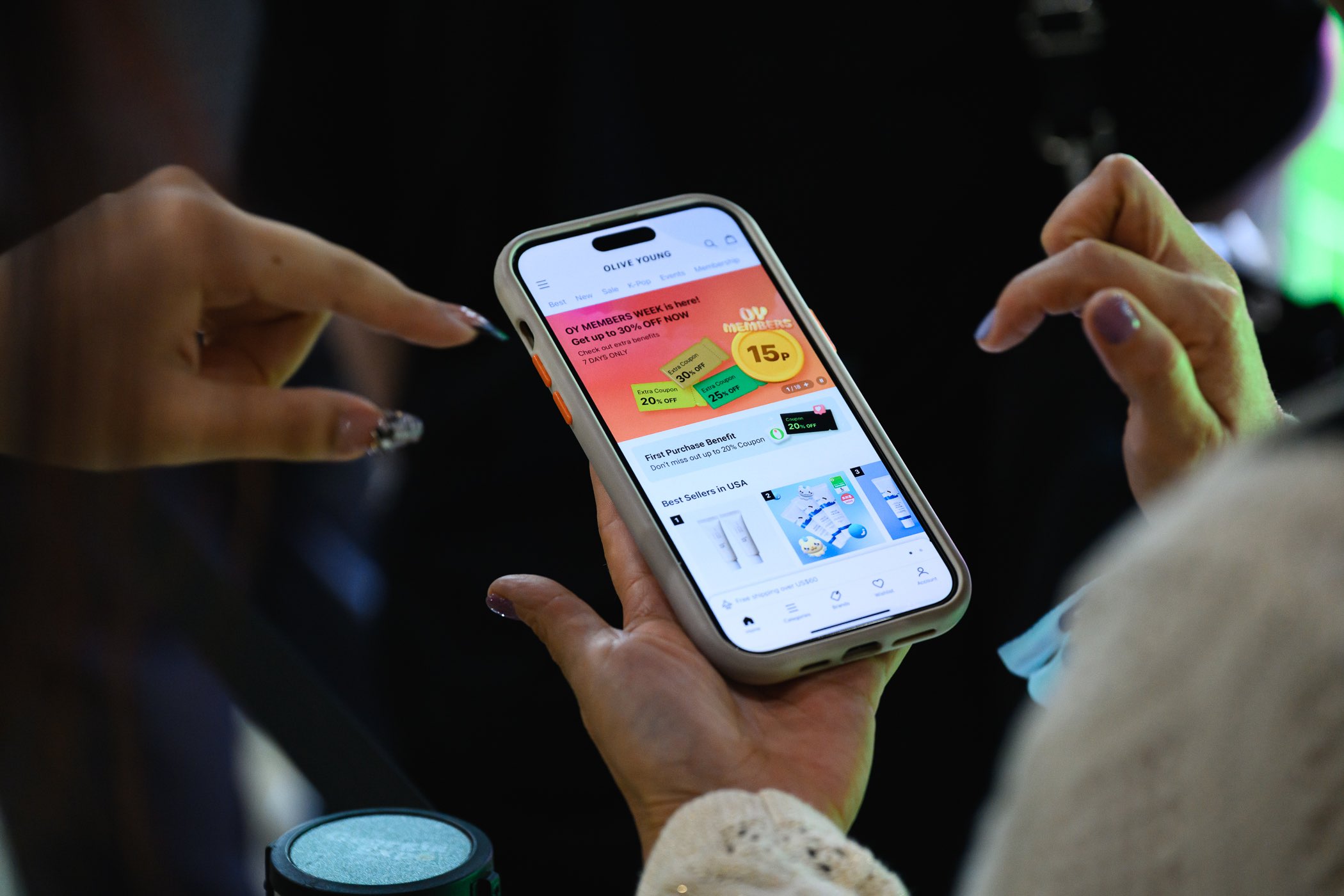
Olive Young’s revenue increased 14.4% to 1.234 trillion won or $888 million at the current exchange rate in the first quarter this year from a year ago, marking its seventh consecutive quarter above the 1 trillion won mark. In-store sales rose 15%, and online sales were up 14%. Net profit climbed 19.2% from a year ago to 126.3 billion won or roughly $91 million.
Olive Young is entering the U.S. as K-Beauty is undergoing a significant second wave. As reported by the AP, the U.S. International Trade Commission estimates the U.S. imported $1.7 billion in South Korean cosmetics in 2024, a 54% spike from the year before. South Korea trails only France and the U.S. in beauty export volume, and the U.S. recently surpassed China to become South Korea’s leading export market for beauty.
New opportunities overseas come with challenges for Olive Young, and it’s readying its model to resonate with American shoppers. For instance, Kim explains, “We have to expand more categories tailored to different races like the skin tones because in Korea we don’t have many different skin shades.”
To manage tariffs imposed by President Donald Trump, which now sit at 15% on South Korean imports, the retailer is “putting more focus on logistics and how we’re going to source in the States,” she says. “We need inventory.”
To scout American beauty brands to sell at Olive Young, the company participated for the first time in the 22nd edition of the industry trade show Cosmoprof North America last month in Las Vegas. “We are curating. If it’s a good product, they’re in,” says Kim. “It doesn’t have to be K-Beauty.”
Summarizing Olive Young’s longtime strategy for success, she says, “We’re growing all together in Korea with all those indie brands. That’s what we want to see in the States as well.”


Leave a Reply
You must be logged in to post a comment.