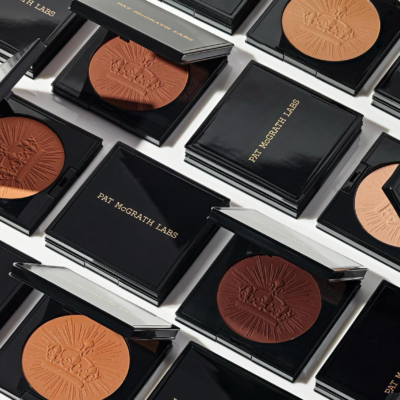

The assets of Pat McGrath Labs, the makeup brand launched by legendary makeup artist Pat McGrath in 2015, will be auctioned off on Tuesday.
The auction represents a steep fall from grace for the brand, which caused a sensation right away with its highly pigmented Gold 001 dust, packaged with gold sequins, and went on to score hits with its Mothership Palettes, Lust Gloss and MatteTrance lipsticks. McGrath has since turned her attention to Louis Vuitton, where last year she became cosmetics creative director and helped launch luxury makeup brand La Beauté Louis Vuitton.
In 2018, private equity firm Eurazeo Brands injected $60 million in funding into Pat McGrath Labs at a valuation of more than $1 billion. Eurazeo quietly exited its stake in Pat McGrath Labs in 2021, and Sienna Investment Managers later became a minority investor as the brand’s valuation declined.
According to industry sources speaking to Women’s Wear Daily, Pat McGrath Labs’ sales sank to about $50 million last year. The sales slide has fueled speculation about Pat McGrath Labs’ future, alongside McGrath’s focus on Louis Vuitton and the brand’s products showing up at T.J. Maxx.
We’re curious about whether Pat McGrath Labs could revive its fortunes. So, for the latest edition of our ongoing series posing questions related to the beauty industry, we asked six brand founders, product developers, chemists, manufacturers and consultants the following: What went wrong with the brand? Do you believe it could stage a comeback? What would a renewed Pat McGrath Labs be like?
-
 Manessa Lormejuste Chemist and Product Developer, Lorm·Co
 There were layered issues behind what went wrong at Pat McGrath Labs. A major challenge was price versus usage frequency, particularly within eyeshadow. Eyeshadow is a shelf-stable category that consumers don’t repurchase often. It’s very hard to "hit pan," even for heavy users. When paired with a premium price point (around $128), that significantly disincentivizes repeat purchase and makes long-term growth difficult to sustain without stronger replenishment categories.
While the palettes are thoughtfully curated with shades that complement each other, even strong product quality isn’t enough if consumers feel they’re buying variations of what they already own. Each palette needs to be distinct enough to avoid shade-to-shade overlap. Otherwise, it creates the perception of repeat product rather than true innovation.
Looking more closely at pricing across the portfolio, the skincare offerings were also positioned at premium levels without clear clinical backing or compelling ingredient strategies. While these products may perform well in consumer perception studies, that’s no longer sufficient for today’s savvy consumer. Shoppers are increasingly looking for science, clinical efficacy and substantiated claims even when those products come from a makeup brand.
That said, the products themselves are excellent. I’m personally a big fan of the concealer. The shade range is extremely inclusive and high-performing, particularly on melanin-rich skin. However, the brand didn’t fully capitalize on the hybrid color and skincare trend that has reshaped product development over the last two to three years.
Pat McGrath Labs remained firmly positioned as a traditional makeup brand while much of the industry was hybridizing, making it less competitive in the broader landscape. While the brand did introduce skincare products, they were not concepts that meaningfully hybridized the existing color cosmetics offering.
Lastly, there was consumer confusion at the founder level. As a namesake brand, Pat McGrath Labs is intrinsically tied to Pat McGrath herself. Her move to become cosmetics creative director at Louis Vuitton is a phenomenal opportunity, but it clearly signals that her primary creative focus is elsewhere. Even if she wasn’t directly involved in day-to-day product development, that shift creates a gap in perceived intention. This is one that can cause consumers to lose faith in a founder-led brand.
Given the broader trend of several Black-owned beauty brands struggling post the peak of DEI-driven momentum, this feels like a brand that may need to pause rather than push forward. A near-term comeback isn’t practical with the founder focused elsewhere. A more realistic path would be a resurgence years down the line as a heritage or legacy callback rather than a full relaunch in the current market.
- Summer D'on Bell Founder and CEO, D'on Cosmetics
Pat McGrath is, without question, one of the most exceptional makeup artists of our time. Her understanding of product, pigment, texture and technique is unmatched, and Pat McGrath Labs was born from that artistry. The brand’s early success was driven by true innovation and cultural moments that felt disruptive and aspirational all at once.
Where I believe momentum may have slowed is not in vision or quality, but in timing and execution. One notable example is the viral runway moment where Pat introduced the peel-off mask technique to create a hyper-glossed, glass-skin finish. The industry and consumers immediately fixated on the look, but the corresponding product took close to a year to reach the market. By the time it launched, the beauty cycle had already moved on. In today’s fast-moving beauty landscape, that gap can dilute even the most iconic innovation.
In hindsight, delaying the public-facing debut of that technique until the product was ready (or launching both simultaneously) could have significantly amplified DTC and retail performance. Aligning runway moments with immediate product access is increasingly critical, especially when virality is fleeting, but demand is instant.
That said, I do believe Pat McGrath Labs is well-positioned for a comeback. As the beauty industry recalibrates, we’re seeing consumers lean back into more detailed, expressive, 2016-era makeup, an arena where Pat has always led. A renewed Pat McGrath Labs could thrive by leaning further into experience and artistry, not just products.
I see strong potential in curated kits or systems that allow consumers to “experience Pat McGrath at home,” tools that translate her technique, not just her formulas. Simplifying the entry point without compromising quality and allowing fans to access more of Pat herself—her methods, her eye, her artistry—could be powerful.
Ultimately, I think a shift where Pat leans more visibly into her role as a makeup artist rather than a traditional founder could be pivotal. By centering the brand around her craft in an IRL, instructional and experiential way, Pat McGrath Labs could reassert its authority, not just as a luxury beauty brand, but as the gold standard for artistry-led beauty.
- Wiza Lausanne Brand and Creative Consultant
What we’re witnessing is far from a shutdown; it’s a restructuring moment. Pat McGrath Labs is built upon an almost unprecedented level of cultural reverence: Dame Pat McGrath as genius, muse and movement. That level of founder gravity can accelerate a brand rapidly, but sustaining scale, particularly post–private equity, requires rigorous operational clarity alongside creative vision.
Pat McGrath Labs has, at times, lacked clarity around who it was speaking to as beauty culture shifted toward skin-first routines, creator-led education and more value-conscious luxury purchasing. Similar inflection points have been seen with brands like Glossier, which underwent a significant restructuring and emerged leaner, clearer and more strategically focused.
Could Pat McGrath Labs return stronger? Yes. I look forward to a renewed version of the brand, one that is tighter, more intentional and deeply culturally attuned. This would mean fewer drops, more depth.
As it rebuilds, the opportunity lies in honing cultural resonance: clearer community dialogue, sharper educational storytelling and product ecosystems that reflect how consumers actually live and get ready now. Looking ahead to 2026, the brands that win will balance artistry with intimacy, serving both emotional connection and practical relevance. This is where Pat McGrath Labs still holds enormous latent power.
-
Pat McGrath Labs absolutely has the potential to stage a comeback and dominate the color space once again. With creative brand equity and a loyal consumer base, Pat McGrath Labs can capitalize on the shift from neutrals to bolder, saturated colors that she's known for.
The success of expert artistry-led brands like Danessa Myricks Beauty, Mary Phillips/M.Ph, Hung Vanngo Beauty, Makeup by Mario and Charlotte Tilbury signals that consumers now prioritize authority, technique and a clear POV, strengths that Pat McGrath Labs can leverage with an edited assortment, modernized textures and product performance.
-
Pat McGrath Labs didn’t fail creatively; it struggled operationally. From a product development standpoint, the brand built its reputation on extreme artistry and highly pigmented, technically complex formulas, but it didn’t evolve quickly enough toward everyday usability and consistent innovation cycles.
A comeback is possible, but a renewed Pat McGrath Labs would need to refocus on modernizing textures for daily wear, and balance high artistry with commercial practicality.
- Jennifer Morante-Di Marco Owner, Jem Labs
Pat McGrath Labs had lots of funding and still couldn’t sustain its position in the industry. I’m not sure what’s to come of the brand. I’m not sure what led to the fall of sales and the decision to auction off the assets. Was it poor marketing, poor financial decisions? I personally think a new marketing direction will help boost the brand.
If you have a question you'd like Beauty Independent to ask brand founders, product developers, chemists, manufacturers and consultants, send it to [email protected].