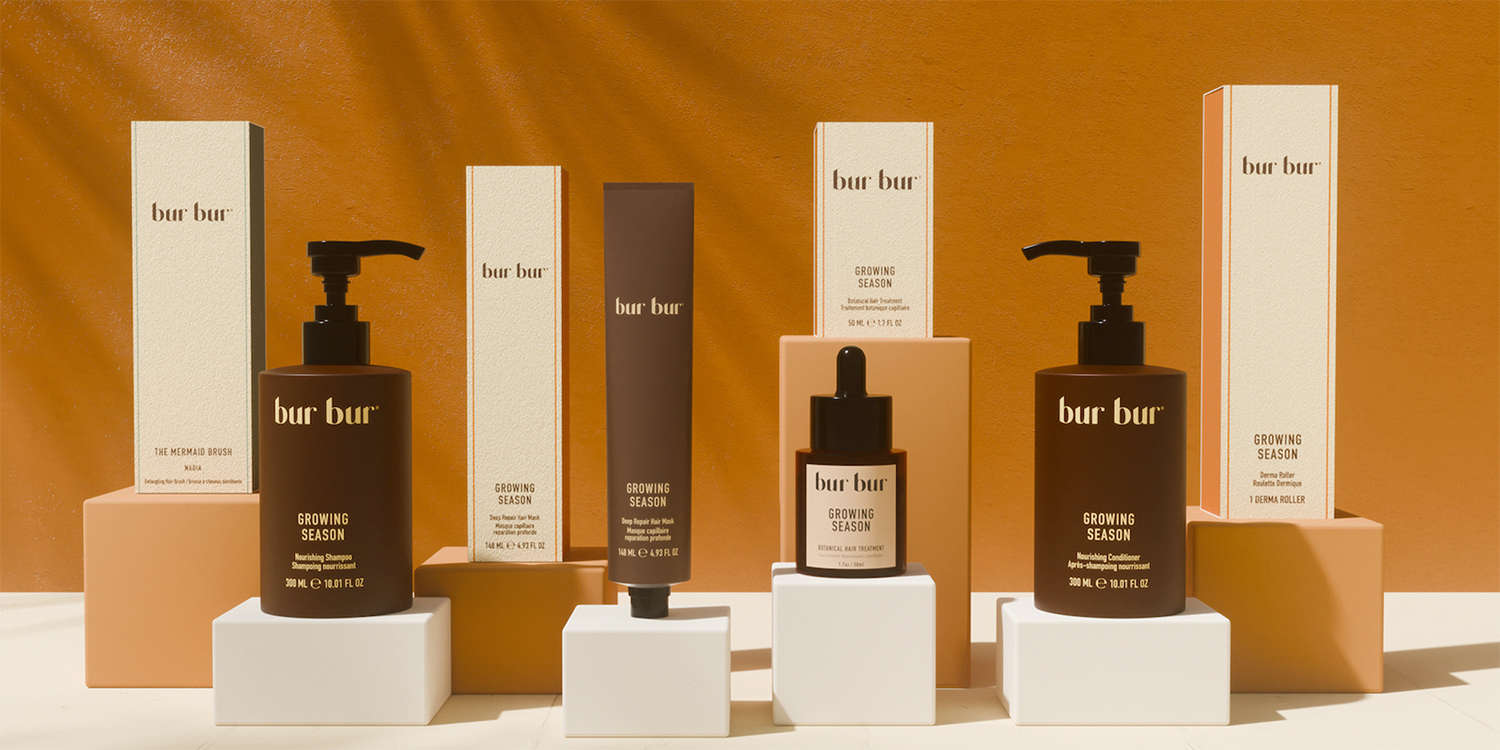

In an industry rife with celebrity-fronted brands and venture capital-fueled blitz scaling, clean scalp and strand care brand Bur Bur is proving that product performance and a slow and steady strategy might be the most disruptive model of all.
As consumers prioritize scalp health, in three short years, the Los Angeles-based brand has scaled from a $500 self-funded launch to a projected $20 million in revenue for 2026 without a single dollar of outside capital. The brand is carried by Revolve, Nordstrom, Anthropologie and Credo and is achieving sevenfold sales growth this year. According to Bur Bur, it’s profitable, with 85% of sales generated through its direct-to-consumer channel.
Its $56 Growing Season Burdock Hair Growth Oil is Bur Bur’s bestseller and has been the top-selling hair growth treatment at Revolve for six consecutive weeks. The product alone generated $1.2 million in sales in 2024.
When the pandemic hit shortly after she relocated from Russia to the United States, co-founder Anna Dzhilavyan, like untold millions worldwide, experienced rapid stress-induced hair loss. She turned to her best friend Ksenia Zaytseva, who would become her co-founder at Bur Bur, for a traditional remedy passed down from Zaytseva’s grandmother that Dzhilavyan remembered from childhood. The pair recreated a burdock oil remedy based on Zaytseva’s family recipe. Dzhilavyan saw stellar results and believed others would, too.
She recalls, “We were sitting in her kitchen and thinking, ‘Why not make a product out of it?'”

That simple question sparked what the co-founders describe as an “operational nightmare” as they balanced their day jobs with the demands of developing an emerging beauty brand. “We didn’t have any experience,” admits Zaytseva. “We had $500 and took an eight-week course on how to build an online business.”
The transition from side hustle to full-time enterprise was gradual. It wasn’t until late 2024 that the founders left their careers in graphic design and real estate. Zaytseva says, “It was so scary because we didn’t have the money to pay ourselves because all the money we generated we were putting back into the business, but it made us better entrepreneurs and better business owners.”
Early on, the founders considered raising about $200,000, but an investor friend advised against it, telling them they first needed to figure out what really worked for Bur Bur as a brand. Forced to remain lean, they concentrated on organic growth over expensive customer acquisition. Rather than relying on transactional, one-off influencer posts, they leaned into long-term customer relationships.
“People smell when it’s real,” says Zaytseva. “It’s kind of like building a family.”
That philosophy of real connection extends to Bur Bur’s products. Although scalp oil is the anchor, the brand’s handmade $72 The Mermaid Brush has become a viral sensation, selling out five times. For the co-founders, its success is a testament to the enduring power of craftsmanship in a digital world. While the brush delivers instant gratification by smoothing strands, its appeal goes beyond what plays well on social media.
“People smell when it’s real. It’s kind of like building a family.”
Zaytseva says, “It’s a handmade object. Energetically, you feel a difference from something that is handmade.”
Bur Bur is now shifting toward broader retail partnerships and international expansion. Having recently completed clinical studies showing a nearly 49% reduction in hair shedding after 50 days, the brand is also doubling down on the science behind its scalp health positioning.
Even as it expands, Bur Bur’s co-founders remain selective about outside investment. “We are very thoughtful about who we would bring in,” says Dzhilavyan. “We’re very protective of the brand.”
Bur Bur likely has no shortage of potential investors as the hair category has become a hotbed for dealmaking in 2026. Filament, Crown Affair and The Doux have closed funding rounds this year. Henkel acquired Not Your Mother’s and Olaplex.
The investment activity comes as haircare has emerged as prestige beauty’s fastest-growing category. According to first-quarter data from Circana, sales climbed 10%, compared to 7% growth in both fragrance and skincare and 2% growth in makeup. The market research firm finds consumers are gravitating toward scalp care, bond repair and restoration products.