
Showing the power of TikTok virality on Amazon purchases, Medicube took the crown last week as Prime Day’s top-selling beauty brand.
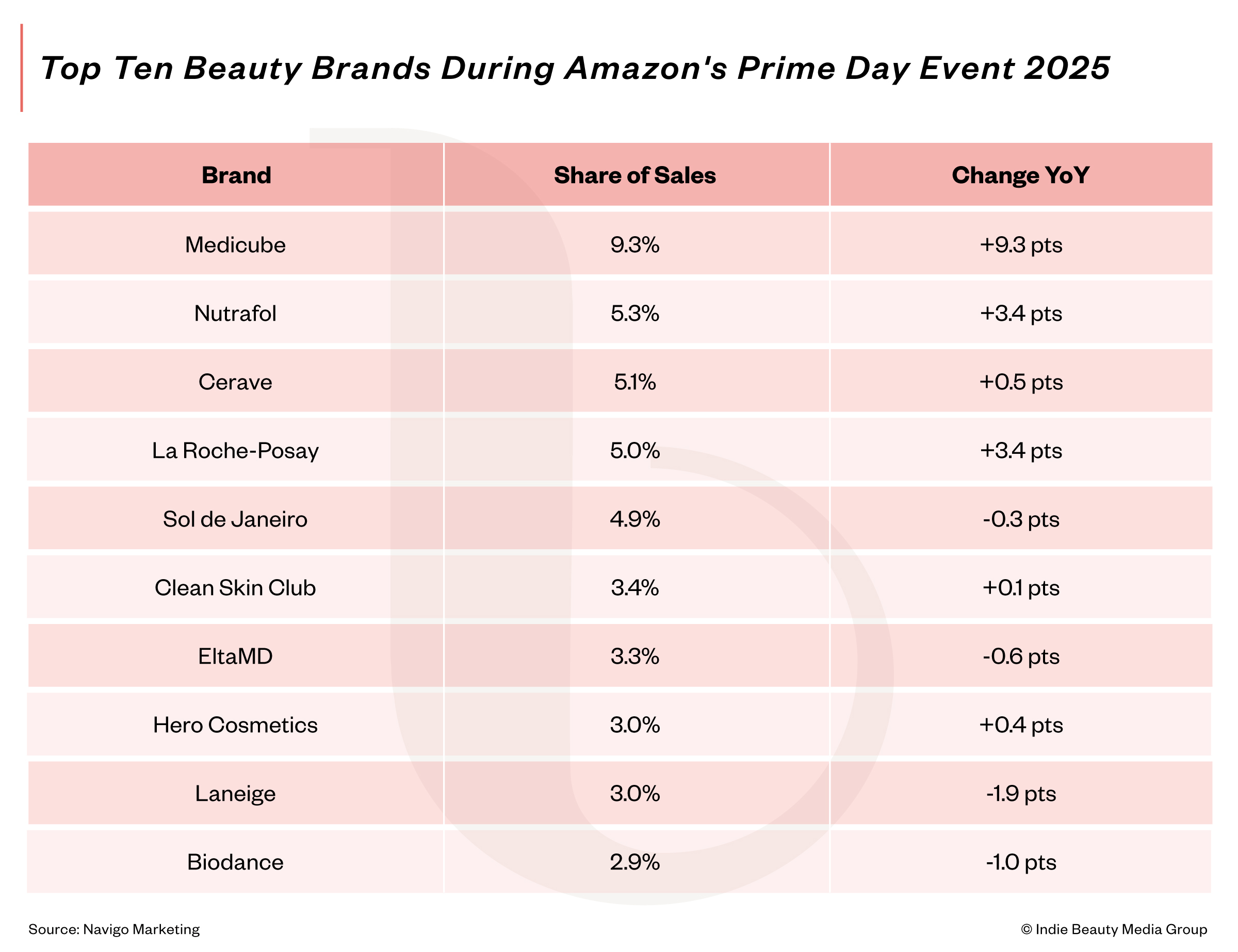
According to a report from beauty e-commerce agency Navigo Marketing, the viral K-Beauty skincare brand bagged 9.3% of total beauty share among the top 100 bestselling products during the four-day event, with its $24 Zero Pore Pads propelling growth. Medicube’s share is nearly double that of Nutrafol, the second place brand with 5.3% share. The supplement company’s $88 Balance Hair Growth Supplement was the top-selling individual beauty product on Amazon last week. CeraVe, La Roche Posay, Sol de Janeiro, Clean Skin Club, Elta MD, Hero Cosmetics, Laneige and Biodance rounded out the sale’s top 10 beauty brands.
Jacob St. John, founder and CEO of Navigo Marketing, notes that the event’s extended four-day format rewarded beauty brands that came prepared for the long-haul. Amazon Prime Day was previously held over two days. “Winners deployed deep inventory, creative rotation, and keyword orchestration across a longer sales arc,” he says. “Brands like Medicube and Sol de Janeiro also over-indexed on top-of-search share, a lever often neglected by smaller players.”
Amazon touted Prime Day as “bigger than any previous four-day period that included a Prime Day event, with record sales and more items sold during the four days.” Together with competing promotions across Walmart, Target, Best Buy, Sephora and Ulta, American retailers generated $24.1 billion in online spend during the period encompassing Prime Day, which stretched from July 8 to 11, according to Adobe Analytics. Establishing a new high-water mark for the summer shopping season, the figure represents a 30.3% jump from a year ago and is the equivalent of two Black Fridays.
Adobe identifies that kids’ apparel, home security products, refrigerators and freezers, games, computers, washers and dryers, smartphone accessories and exercise equipment were top sellers during the four-day Prime Day sprint. In beauty, securing top Prime Day status wasn’t necessarily predicated on spending the most in advertising dollars.
While Sol de Janeiro adopted an aggressive advertising strategy, with 1.2% of sponsorship activity in beauty, Medicube, which is launching at Ulta Beauty next month, leveraged organic TikTok momentum, hero products and eye-catching content to convert Amazon beauty shoppers during the event. Armani Beauty and Biodance utilized robust full-funnel paid strategies, too, during Prime Day across video, featured products and top-of-search. On the whole, beauty sponsorship activity increased 44.8% during the event, per Navigo.
“A lot of winners also did more than just the basic advertising,” says Tristan Williams, senior content strategist at Amazon growth agency Envision Horizons. “They launched affiliate marketing campaigns, updated creative assets across their Amazon pages and store to reference the sale and secured prime real estate placements from Amazon.”
According to Envision Horizons, cost-per-clicks rose 44% during Amazon Prime Day compared to June’s baseline as competition for shoppers’ dollars heated up on the platform. Last year, CPCs rose 28.5% during the same event.
Amazon Prime Day winners deployed competitive discounts to capture customers’ attention. Beauty brands that offered what Envision refers to as “loss leader” deals of 40%-plus on a handful of products to secure premium placement on the “Featured Deals” section of Amazon’s home page saw the greatest momentum during the sale. Williams says, “Success required deeper discounts plus comprehensive campaign execution across multiple channels and touchpoints.”
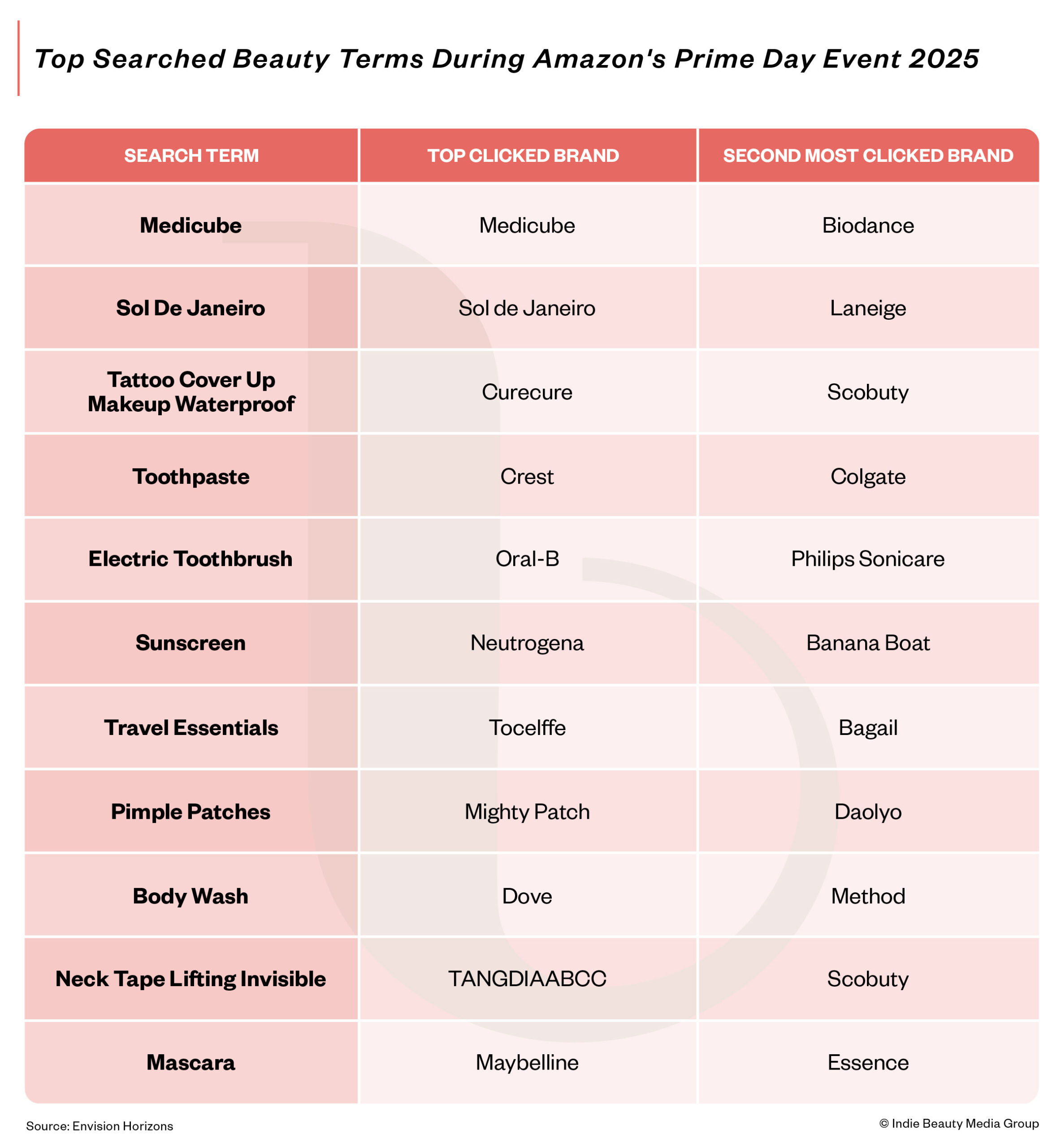
From a beauty category perspective, bath and body sprinted ahead with a 101% year-over-year increase in Prime Day sales. Skincare sales jumped 54%, while makeup saw a 45% spike over last year’s event. Haircare sales climbed 41%. The top 11 searched beauty terms on Amazon during the sale were “Medicube,” “Sol de Janeiro,” “tattoo cover up makeup waterproof,” “toothpaste,” “electric toothbrush,” “sunscreen,” “travel essentials,” “pimple patches,” “body wash,” “neck tape lifting invisible” and “mascara.”
Not everyone gained ground during Prime Day. While K-Beauty brands Medicube and Biodance saw tailwinds, Cosrx’s sales dropped dramatically, knocking the skincare brand out of the top 10 bestsellers list. According to St. John, sales share for Cosrx declined nearly 300 basis points over last year, and it represented one of the steepest declines in advertising spend across the beauty category. He says, “Performance in past Prime Days is no longer a guarantee of future relevance, especially in skincare categories where consumer experimentation and TikTok-driven cycles have accelerated.”
Dove, Grande Cosmetics and Pureology registered year-over-year declines in Prime Day sales despite investing in significant paid advertising campaigns. Meanwhile, premium beauty brands Kiehl’s, Murad and Elemis struggled to maintain visibility throughout the extended event, with their sponsorship activity falling more than 1,000 basis points over last year.
“It’s a signal that even premium brands must now compete in Amazon’s pay-to-play environment with consistent, multi-format activation,” says St. John, adding, “Paid needs to be efficient, content needs to be on point and the promotion has to match audience expectations.”
This year’s extended Prime Day format didn’t yield bigger sales for Envision Horizons’s beauty clients. Sales started strong on day one, lifting 66% over last year, but day two sales plummeted 51.2% and another 60% on day three. Sales rallied slightly on the last day but remained over 50% below day one’s high. All told, Amazon’s four-day event seems to have spread out demand rather than create incremental growth for beauty, with Envision’s client roster registering comparable performance to last year’s two-day Prime Event.
“The 4-day format appears to have redistributed rather than expanded Prime Day’s total impact, favoring large brands while creating operational complexity for others,” stated Laura Meyer, founder and CEO of Envision Horizons, in a report from the agency. “Day 1 was very exciting with exceptional performance, but Days 2 and 3 brought clear event fatigue. Day 4 recovered slightly but lacked the typical Prime Day closing surge.”