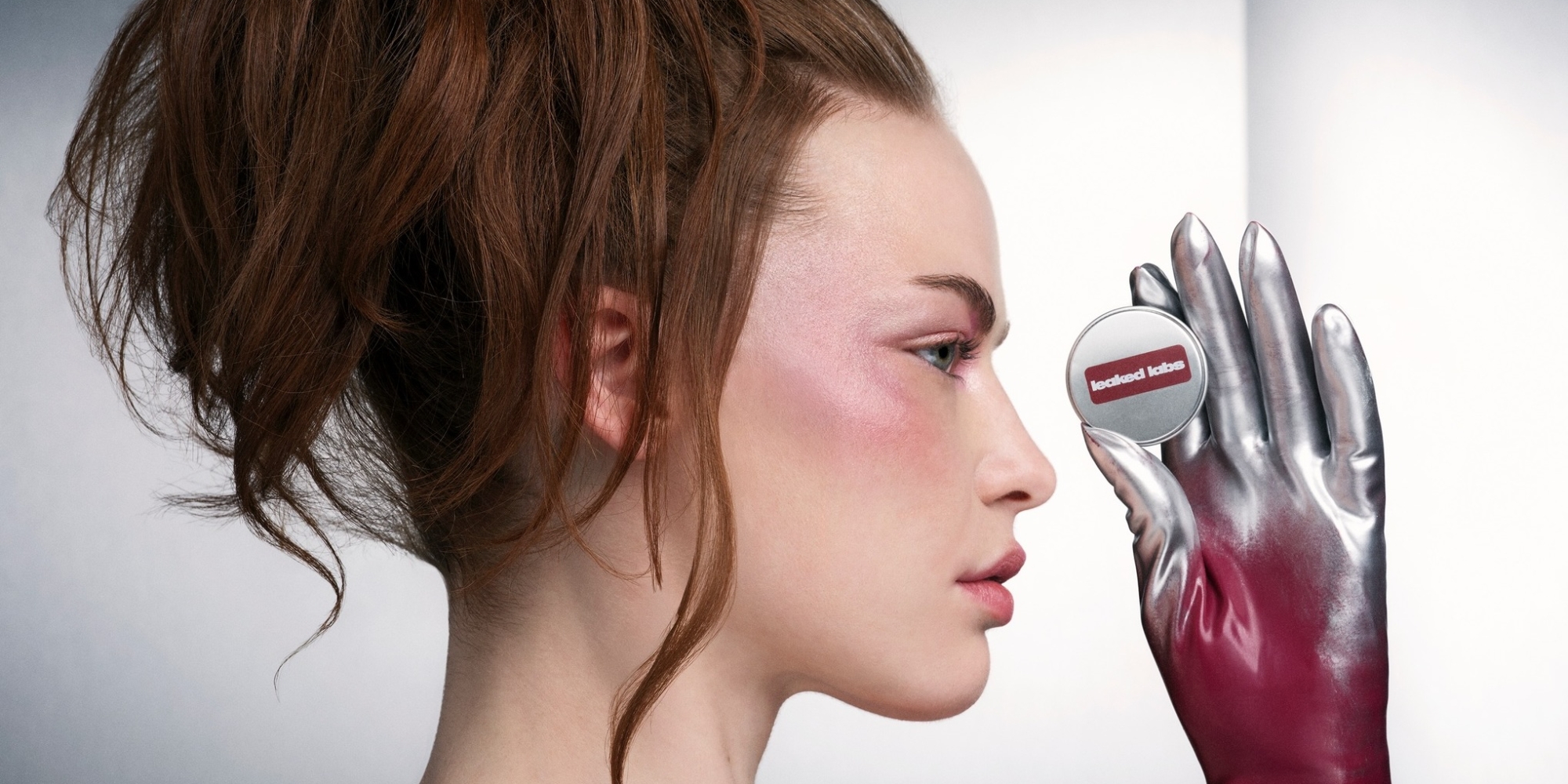

After years of demystifying beauty product development, Alexis Androulakis and Christina Basias Androulakis, the married duo and content creators behind The Lipstick Lesbians, decided to put their own spin on the process with Leaked Labs, a brand that takes experimental formulas from manufacturers and releases them to consumers in limited “leaks” every four to eight weeks, a format built for peak social media frenzy.
The Lipstick Lesbians convey the True Beauty Ventures-backed concept as effectively turning the beauty innovation pipeline inside out, exposing ideas that might otherwise remain in lab presentations or beakers and soliciting feedback from consumers on their commercial viability before moving forward with them. The concept echoes existing and past efforts such as Volition Beauty, which surfaced lab innovations in tandem with consumer-submitted ideas and influencer partnerships, Beauty Pie, which cuts out middlemen by taking products directly from labs to customers, Rephr, a makeup brush brand that receives input on forthcoming products from more than 200,000 community members and asks consumers to pay what they choose for prototypes, and From the Lab, a now-defunct subscription-driven brand from Lorraine Dahlinger and Steve Dworman that brought formulas from manufacturers working with big-name brands to customers without snazzy packaging or marketing.
For its first “leak,” Leaked Labs dropped what it calls Amplify Flexi Powder, a thin disc of pigment that appears to originate from Italian manufacturer Chromavis Fareva. The brand promotes Amplify Flexi Powder as delivering “effortless payoff when worn dry” or, with a mixing medium or setting spray, transforming into “an act of performance,” and as resistant to shattering. The product, inspired by lasagna, is priced at $34 for a pack of four and a tin to house them.
The launch has been met with a vociferous response online, sparking curiosity, skepticism, anger and confusion among beauty enthusiasts and professionals. Critics question the product’s practicality, hygiene and value. One Instagram user with the handle @breejinx writes, “Very respectfully, this seems to present more problems than it aims to solve.” Others contend the product resembles the kinds of samples manufacturers often distribute to brands during development, sometimes at no cost, raising questions about why consumers should pay for a lab sample.
At the same time, the concept isn’t without support, and a not insignificant number of commentators praise its inventiveness. Plenty of people have been intrigued enough to buy Amplify Flexi Powder, and the initial leak sold out within four days. In a TikTok video, a creator named Jalana argues much of the blowback misses the point of the brand’s model. She says, “This company is meant to give you early access to beauty prototypes, collect your feedback, and then decide, ‘Hey, is this going to actually be a product that a brand is launching, or are we going to retire it given negative feedback from people?’”
Taking the discussion off social media, we wanted to see how labs view the Leaked Labs concept. For the latest edition of our ongoing series posing questions related to indie beauty, we asked 14 manufacturers, product developers, research and development consultants and more the following: Do you have lots of innovative formulas sitting around that haven’t made it to market, or is this concept trying to commercialize ideas that were never commercially viable? How much should consumers pay for lab-originated “leaks”? Could this model change how innovation travels from lab to shelf?
-
 Joe Anthony Founder, Pensive Beauty
 There are innovative formulas sitting in labs that haven't made it to market, but the reason most of them are sitting there has nothing to do with a lack of consumer access. They're sitting there because they were never commercially viable to begin with or because the brand that commissioned them pivoted or because the performance didn't survive stability testing. A lab sample and a finished product are not the same thing, and the distance between them is where most of the actual science happens.
What concerns me about the Leaked Labs concept isn't the business model itself. Soliciting consumer feedback early is smart. What concerns me is the framing that lab-stage formulas are hidden treasures the industry has been keeping from people. In most cases, they're unfinished work.
Selling them as "leaks" implies the innovation pipeline is a vault full of finished gems that brands are too slow or too corporate to release. The reality is that most formulas in development are iterations on the same foundational chemistry, the same emulsion systems, the same delivery mechanisms that the industry has relied on for decades.
Real innovation in beauty isn't happening at the SKU level. It's happening at the platform level in how ingredients are actually delivered into the skin or hair. At Pensive Beauty, I developed NanoBase, a line of sub-195 nm nano-delivery architectures that replace the legacy emulsion systems most brands still build on. That kind of work doesn't come from rummaging through a manufacturer's back catalog. It comes from years of particle engineering, DLS validation and rethinking the science from the ground up.
As for what consumers should pay, they should pay for finished, tested, stable products with demonstrated performance, not for the novelty of seeing something early. If the industry wants to bring consumers closer to the innovation process, the answer is education and transparency about what's actually in the bottle and how it works, not repackaging development-stage samples as exclusive drops.
Could this model change how innovation moves from lab to shelf? It could change how marketing moves from lab to shelf, but marketing and innovation are not the same thing.
- Charlene Valledor President, SOS Beauty
We develop a lot of proactive innovation for clients and what we call our “blue sky” formulas, most of which don’t see the light of day. I’d say for every 10 formulas we develop, maybe one makes it to market, if you’re lucky, but that’s how R&D works. Labs and contract manufacturers make proactive marketing samples, sometimes to demonstrate a new technology they developed or a new raw material, and they present these to all of their clients.
Hundreds of brands will see the same innovation presentation. Some of the large CMs (contract manufacturers) do this twice a year, sometimes more. These concepts are raw and unfinished. Brands are not meant to launch these products as is, they’re supposed to take these concepts or technologies and adapt them for their brand, turning them into products their customers want.
What turns a formula concept into a great product is not just the formulation or the tech inside. It’s those aspects plus the brand’s unique product point of view, color perspective, packaging design and functionality and marketing and storytelling created to inspire the customer that transform a formulation into an amazing product experience and ultimately, a commercial success.
I feel as if this new model takes away some of these really crucial elements. Nevertheless, I think it’s commendable to try to do something different, and since the brand is willing to take a gamble on these raw formulas without spending the time and resources that brands typically have to invest in launching newness, then then I’m sure they’ll find an audience.
- FRED KHOURY President, Above Rinaldi Labs
Here’s how I see the Leaked Labs concept. Most labs have innovative formulas sitting on the shelf that never make it to market, but that doesn’t automatically make them consumer ready. Many are shelved for practical reasons: stability, regulatory hurdles, performance gaps or simply because they don’t fit a brand’s roadmap. That said, there are also formulas that are solid and commercially viable, but never get greenlit, and that’s exactly the space Leaked Labs seems to be exploring.
They succeed by turning the lab process into a story, letting consumers participate, get early access and influence which ideas actually move forward. Pricing isn’t about the raw materials; it’s about novelty, participation and transparency. It works if people understand these are prototypes, not finished products, and if the narrative is compelling.
There are risks: disappointed consumers if prototypes underperform, regulatory scrutiny if formulas aren’t fully vetted and the perception that labs are monetizing what used to be “free samples.” Success comes down to balancing experimentation, transparency, quality control and storytelling.
Could this model shift how innovation moves from lab to shelf? Absolutely. It can shorten feedback loops, validate concepts faster and allow smaller brands to test ideas without committing to full-scale production. At Above Rinaldi Labs, we actually offer something quite similar featuring many of the high-level near-to-market formulas from our vault that use advanced ingredients and production-ready technologies while giving consumers a say before launch.
Overall, it’s a compelling experiment in making lab innovation more accessible. Not every formula will survive the journey, but involving consumers early could help labs like ours decide which ideas truly deserve a place on the shelf, turning what was once an invisible pipeline into a participatory, market-informed process.
- Megan Cox Founder, Innacos Labs
As a contract manufacturer and formulator, we can confirm, yes, we have a wealth of innovative concepts that haven't made it to market. The majority come to us from ingredient suppliers demonstrating what their raw materials can do: gelling agents, novel textures, unique delivery systems. The technology behind something like the Flexi Powder isn't new to those of us on the lab side. It's been on trade show floors for a few years already. These concepts are exciting, and we love exploring them.
The reason most of them stay in the lab isn't a lack of imagination; it's the dual challenge of scalability and user experience. How do you mass manufacture it? And how do you package and present it in a way that's usable, hygienic and commercially viable? Those are the questions that separate a compelling lab demo from a viable consumer product.
What Leaked Labs has done is essentially sidestep both of those challenges: skip mass manufacturing, run a limited quantity at whatever the manufacturer's ceiling allows and use consumer feedback to determine whether further iteration is worthwhile. From a business strategy standpoint, that logic tracks. It's a lean, low-risk way to test market appetite for novel formats.
Where I think the execution falls short is the consumer experience. The concept of giving people access to innovation that would otherwise stay behind lab doors is genuinely compelling, but that doesn't exempt a brand from doing the work of iterating on how the product actually lives in someone's hands. A few sheets of dry pigment loosely housed in a tin, with the potential to stick together, transfer onto fingers and generally feel unfinished? That's not a prototype experience. That's an absence of product development, which is their proclaimed expertise.
One of the core challenges in R&D is bridging the gap between a cool concept and something that's aesthetically pleasing, functional and manufacturable. I respect that Leaked Labs isn't requiring the pristine finished-product aesthetic, but there's a wide middle ground between polished and neglected.
Even a simple solution—hole-punching the flexi sheets and placing them on a ring with foil separators, then housing that in a tin—would have dramatically improved usability while preserving the raw, experimental ethos. It wouldn't have added significant cost or complexity, but it would have shown consumers that someone thought through how they'd actually use the product.
The reality is that consumers are responding to what feels like a lack of effort on the user experience side, and I think that criticism is fair. The concept is strong enough to stand on its own. It didn't need to rely on novelty alone to carry a first impression.
The launch has been polarizing enough that it may complicate their path forward, which is unfortunate because the underlying idea (and its sustainability, love that) has real merit. I'd love to see them invest more in execution on future drops because the model could genuinely change how innovation reaches consumers, but only if the experience matches the ambition.
- Fatima Ramadan Founder and Principal Consultant, Vault Beauty Labs
I want to acknowledge the Lipstick Lesbians for giving product developers a voice and sharing a level of education that goes deeper than what consumers typically get from marketing alone. From an industry perspective, the Leaked Labs concept reflects a broader reality within product development.
Every product developer has touched hundreds, if not thousands, of formulas presented by third-party manufacturers. However, not every innovation is viable. Many don’t meet the standards for manufacturing, regulatory compliance, stability, or a true white-space opportunity.
Often, these submissions are meant to spark ideas rather than become finished products. That’s the nature of PD and what keeps innovation moving. Labs continuously introduce new raw materials, processing techniques and technologies, and because the beauty industry is so interconnected, there’s a lot of cross-pollination, with similar innovations appearing across multiple vendors.
At the same time, the idea that all innovation is shared across the industry isn’t entirely accurate. Some vendors offer exclusive developments to select brands, while many companies invest heavily in internal R&D and dedicated lab partnerships, creating proprietary formulas that never leave those walls and, in many cases, can surpass third-party manufacturer innovation.
Based on what is publicly visible, the Leaked Labs model appears twofold: showcasing insider-level innovation to give consumers sneak-peek into PD while also bringing forward strong formulas that brands may have passed on or have yet to launch. Over time, this could evolve into a testing ground for early-stage innovation prior to full-scale commercialization, informed by consumer feedback.
While I can’t speak to their pricing model, nothing in cosmetics is truly “free.” There are always costs tied to R&D, raw materials, componentry, production and labor. Industry insiders know this model isn’t new. Brands like MAC Cosmetics, KVD Beauty and NYX Cosmetics have done this in different ways, using limited drops, online exclusives and consumer feedback to test concepts in smaller quantities before committing to a full launch.
When a launch can cost millions, brands aren’t betting on what’s just “cool.” They’re betting on what will actually perform and scale. While initiatives like Leaked Labs may resonate with highly engaged consumers, they represent only a small portion of the global market. Successful PD goes beyond product performance; it requires scalability, shade strategy, regional relevance, pricing and a clear understanding of what will succeed in the market.
- Krupa Koestline Founder and Cosmetic Chemist, KKT Innovation Labs
Most formulation labs have a drawer or digital folder full of innovations that never make it to market. In my case, there are quite a few formula concepts and iterations sitting on the shelf that brands ultimately chose not to adopt. That usually isn’t because the idea isn’t good. More often, it simply doesn’t align with a particular brand’s DNA, positioning or launch strategy. In other cases, commercialization may require new processing equipment, specialized packaging or other manufacturing capabilities that require additional capital investment.
Many manufacturers aren’t willing to make that investment until there is proof that consumers actually want the product. What The Lipstick Lesbians are doing with Leaked Labs is interesting because it flips that sequence. Instead of labs trying to convince brands that an innovation is worth developing, the concept tests consumer interest first. If consumers respond positively, that data can give both labs and manufacturers the confidence to invest in scaling the technology.
I don’t necessarily see this as risky, assuming the product has gone through appropriate safety evaluation. In many cases, these “leaks” are not unfinished formulas so much as early-stage innovations that haven’t yet found the right commercial home.
As for pricing, consumers should pay something, but it should reflect the experimental nature of the product. The real value exchange here is not just the formula itself, but the opportunity for consumers to participate in the innovation process.
Overall, I think it’s a creative model. The beauty industry talks a lot about innovation, but the path from lab to shelf is often slow and risk averse. Concepts like this could create a new feedback loop between chemists, manufacturers and consumers that helps interesting technologies actually see the light of day.- Michael Mikhail Managing Partner, Precious Labs
We have a library of non-commercialized innovation, but it’s contextual. We are constantly developing the following:
- Texture innovations (new gels, hybrid formats)
- Shade systems or pigment dispersions
- Delivery systems (encapsulation, film formers, etc.)
A lot of these don’t go to market due to several factors:
- A brand passed on the formula (timing, cost or strategy mismatch)
- The trend window closed
- It didn’t meet a retailer’s requirements
Some concepts can be cool and seem innovative and marketable in a lab setting, but a lot of times CMs are not able to scale up and mass produce.
The pricing really hinges on what you’re asking the consumer to believe they’re buying: a product, an experience or participation in R&D. Right now, that line is blurry.
The Leaked Labs model can influence the journey, but it won’t rewrite it. The most realistic outcome is that this model becomes a front-end filter for ideas, not a replacement for the traditional development pipeline and process.
- Jamika Martin Founder, Flora Studios and Rosen
This is a super interesting model. At Flora, we don't have a ton of formulas just sitting around, especially since we work with emerging beauty brands who are only going into product development when they are 90% sure on the product launch.
I could definitely see labs working with larger brands who are throwing a lot of money at R&D potentially sitting on a lot more. Ultimately, I'm sure there are tons of products that don't make it to launch that are commercially viable. Not every beauty launch is groundbreaking. Most are just something new and interesting coupled with good marketing, and I would imagine that's the type of stuff they're bringing to life.
Now, if the product isn't fully fleshed out and is essentially a lab sample, I don't think customers should pay a full MSRP for a product like this. A lot of costs go into developing, marketing and supporting a new product, which goes into pricing. If you're cutting out a lot of those steps, you're also cutting a lot of variable costs and the MSRP should reflect that.
- Marisa Plescia Founder and Chief Cosmetic Chemist, FemChem Beauty
There are certainly many formulas developed in labs that never make it to market, but the reasons are often more business-driven than scientific and not due to viability. A formula might be technically sound and even perform beautifully yet get shelved because the cost is too high for the brand’s target price point, the marketing direction shifts, some minor stability or packaging challenges arise or just simply the brand decides not to move forward for a variety of reasons. In that sense, there are viable ideas sitting in labs.
I’m also not sure I would necessarily call them “lab-originated leaks,” but rather formulations that were simply never commercialized or marketed. However, it is essential that any formula released to consumers still undergo testing, such as stability testing and micro, to ensure it is safe and performs as intended. The model could still be interesting if it functions more like a “beta test” for beauty, where limited releases allow brands to gauge consumer interest in novel textures, ingredients or concepts before scaling up to full production.
- Corey Miles Owner, Niche Skin Labs
Many innovative products we develop with great potential never reach the market and are unfortunately discarded. It’s a loss for both the industry and consumers to waste such promising formulas that could offer real value to customers.
Provided the product undergoes sufficient testing before entering the market, I believe it should be priced similarly to products not classified as a lab-originated "leak." Just because a formula wasn’t selected as the final choice doesn’t diminish its quality. Consumer preferences vary widely and what one person loves, another may not. Therefore, the product's intrinsic value should dictate its price, rather than its commercial success.
This model has the potential to fundamentally reshape how innovation moves from lab to shelf. It creates a dynamic connection between consumers and the formulation development process, providing insights into the creativity and science behind product development.
However, if adopted too widely across the industry, it risks losing its distinctive charm. By keeping it niche, companies can sustain its unique value, increasing the chances of long-term success.
- Shannaz Schopfer Founder and CEO, The Beauty Architects
Most manufacturers have a continuous pipeline of exploratory formulas that never ultimately reach commercialization. This does not necessarily reflect a lack of performance or creativity. More often, these concepts are filtered out for strategic reasons such as brand positioning, timing, cost structure, regulatory priorities or portfolio balance. Innovation is as much about curation as it is about invention.
The idea of bringing lab concepts directly to consumers is also not entirely new. From the Lab, founded by Lorraine Dahlinger in 2016, explored a similar model. At the time, many laboratories were supportive of the initiative and consumers responded positively to the transparency and access to early-stage innovation. However, the business faced growth constraints, including the broader challenge of limited funding available to female founders, which made scaling the concept more complex.
Leaked Labs reflects how the market has evolved since then. Today’s environment is far more driven by community participation, rapid feedback and social media acceleration. The model introduces an interesting layer of consumer involvement in innovation, while also raising important questions about how clearly development stages are communicated and how expectations around performance and value are managed.
In this context, consumers are not only purchasing a formula. They are buying access to discovery, novelty and a sense of participation in the innovation journey. When that experience is clearly explained and thoughtfully delivered, there is room for meaningful perceived value.
At the same time, the beauty industry has built long-term trust through refinement, consistency and strong storytelling. Maintaining that trust will remain essential as new models emerge. Transparency around what a prototype represents and how consumer feedback will be used becomes critical.
Looking ahead, this type of approach could encourage more collaborative validation of sensorial formats and early concepts between laboratories, creators and brands. It is unlikely to replace the role of brands as curators and translators of innovation, but it may help make the development process more responsive and more connected to real consumer insight.
Ultimately, the opportunity is not to accelerate innovation at the expense of clarity, but to bring consumers closer to the journey in a way that strengthens understanding and confidence.
- Anete Vabule Co-Founder and CEO, Selfnamed
We see the “lab leak” concept as a way to capture the hype and magic that happens behind the scenes. Developing a skincare or makeup product can take years of work, involving innovations, never-before-seen ingredients and unique textures or formats. There are countless iterations that happen in the lab that the consumer usually never sees, so showing them something they were “never supposed to see” is exciting and really draws people in.
In our case, we don’t actually have many formulations just sitting around. The way we work is by defining the audience's specific problems or needs before we start development. We have a very clear idea of what we want to achieve, so the process is simply about iterating until we arrive at the best possible version. Anything else that doesn't perfectly fulfill that specific need is disregarded.
Nevertheless, we know some labs work in reverse. They start with a raw ingredient or product innovation and then work their way back to find the right market application or audience. Sometimes that fit isn't immediately clear, so “leaking” those products is a cool way to test the waters. Since all of these products still pass quality criteria and safety testing, the customer receives a functional, high-quality product, which justifies the price.
Overall, we love that this model emphasizes the work of the laboratories. It’s often a forgotten part of the story, but the people and the science happening in the labs are what make the cosmetics industry special and keep customers' skin healthy and looking amazing.
- Andrea Buratovich Strategic Account Manager, Indigo Private Label Cosmetics
The concept is intriguing from a marketing perspective, but consumers often underestimate the work required to move a product from prototype to retail. Labs do have experimental formulas—ingredient showcases, demos or proof-of-concept textures—but these are rarely market-ready. Turning them into finished products requires stability testing, scalable production, packaging and real-world validation.
For some consumers, buying experimental products could be fun and offer a behind-the-scenes look at development, but the traditional pipeline exists for a reason. Labs create experimental formulas to demonstrate possibilities, not as finished consumer products.
While compelling, it’s difficult to see a brand sustaining itself on prototypes alone. Even if select formulas are commercialized later, brand loyalty is usually built on consistency rather than novelty. There’s also the risk that early excitement fades as consumers look for products they can rely on long-term.
- Pinaki R. Majhi Founder, President and CEO, Unicus Pharmaceuticals and Mona
As we all know, a new concept or innovation is always what we look for, whether we are the end user or a product developer. We make products to address unmet needs or to solve certain problems, and we use either traditional or new approaches.
However, every product development effort, whether for a new product or the optimization of an existing product, has to go through certain steps to come up with viable prototypes while considering all important aspects, i.e., safety, efficacy, stability, user-friendliness, etc.
Involving certain volunteers (inside and/or outside) during product development is always crucial before you launch a product. However, the initial trials should also be conducted in a safe and user-friendly manner without focusing too much on commercial gain surrounding those screening steps.
If you have a question you'd like Beauty Independent to ask manufacturers, product developers, research and development consultants and more, send it to [email protected].

Leave a Reply
You must be logged in to post a comment.