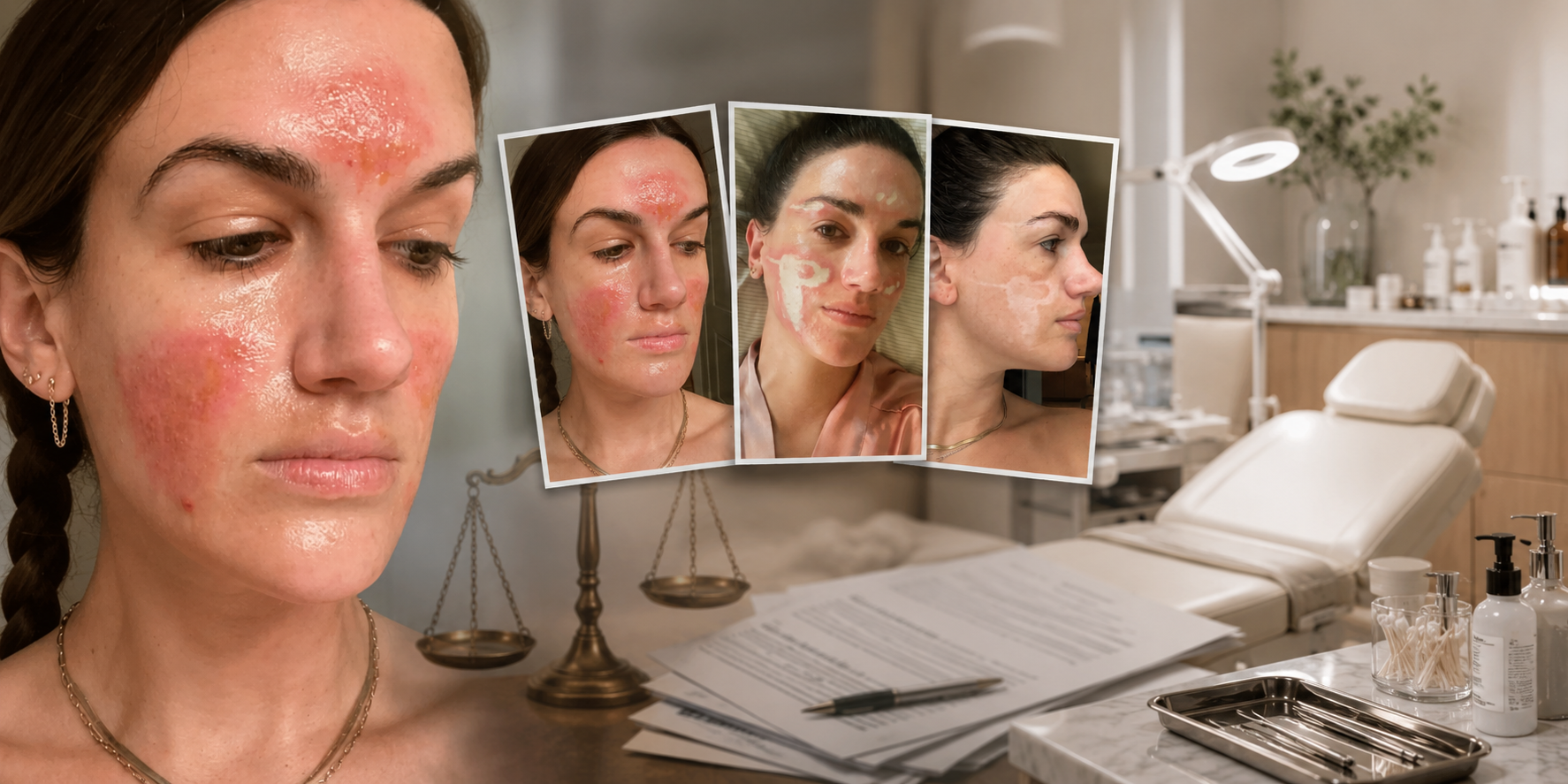
After more than four decades as one of Hollywood’s best-known aestheticians, counting Gwyneth Paltrow, Drew Barrymore, Jennifer Lopez and Jennifer Lawrence among her clients, Sonya Dakar has agreed to surrender her California aesthetician and establishment licenses as part of a settlement stemming from allegations by former client Victoria Nelson that a chemical peel treatment left her with severe burns.
The case could reverberate throughout the med-spa and aesthetics industry, where rapid growth has outpaced oversight and regulation remains largely state by state, creating a patchwork of rules across the country. It also illustrates how social media is giving clients a powerful platform to amplify their claims, influence public perception and intensify scrutiny of providers. Nelson’s more than 13-minute TikTok video detailing her experience has drawn nearly 10 million views since it was posted last August.
Dakar hasn’t publicly commented on the case. As part of the settlement, she must pay Nelson $70,000. The aesthetician previously had her license revoked in 2011 and has faced other disciplinary actions involving treatments regulators determined fell outside her legal scope of practice in California, including radiofrequency microneedling.
We wondered what aesthetics professionals made of the legal battle between Dakar and Nelson and its broader implications for the industry. For our ongoing series posing questions relevant to indie beauty, we asked seven med-spa operators, aestheticians and consultants the following: What should the industry learn from the Dakar case? Was it an isolated incident or symptomatic of broader problems? How should med-spas change as a result?
-
 Alex Thiersch Founder and Chairman, American Med Spa Association
 The Sonya Dakar case is an important cautionary tale for the public and the aesthetics industry, but it should not be viewed as representative of the medical spa industry as a whole. The issue appears to be very specific. Sonya Dakar, a self-described “facialist,” was performing treatments that were outside the scope of an aesthetician’s license in California.
That is not a gray area. California has for years been clear that medical-grade chemical peels, microneedling and energy device-based treatments are medical treatments and therefore outside the scope of practice for aestheticians. These treatments should never have been performed by an aesthetician at a day spa in the first place, which appears to have happened here.
A properly run medical spa, on the other hand, is built around medical oversight, licensed and trained providers, appropriate delegation, protocols and the ability to respond to complications when they occur. As such, this case should not, as some have claimed, be used to question the safety and professionalism of properly run medical spas.
This is not to minimize what happened to Victoria Nelson. Her experience is extremely sad and troubling, and it should never have occurred. Unfortunately, situations involving rogue actors operating outside the rules are becoming far too common. One of the biggest issues our industry faces is individuals doing things they should not be doing without fear of consequence.
But when someone without the proper license or medical training performs medical-grade treatments for years, that is not a med spa problem as much as it is a scope-of-practice and enforcement problem. It should not take a horrific experience and five years of dedicated effort by an injured patient to shut down a facility that was operating blatantly and openly against the rules.
Nevertheless, the broader lesson is that the public needs more education about what makes a medical spa safe and compliant, and why these treatments should be sought at responsible medical aesthetic practices such as medical spas, dermatology offices or plastic surgery centers. Patients should feel empowered to ask who is performing the treatment, what license they hold, who is supervising the care, what product or treatment is being used, and what happens if there is a complication.
Responsible med-spas should welcome the chance to work with regulators to ensure patients can distinguish between compliant medical aesthetics practices and actors operating outside the rules.
- Rachel Lee Lozina Founder, Blue Water Spa
As someone who has been an aesthetician for more than 23 years, I followed this case closely from the moment it first surfaced. Like many in the professional aesthetics community, I remember the images circulating among colleagues because they were so alarming. The immediate frosting visible in the photographs suggested significant tissue injury, raising serious questions about the treatment that was performed. While none of us know exactly what product or protocol was used, the outcome serves as an important reminder that even experienced practitioners are not immune to mistakes.
I don’t necessarily view this as an isolated incident. I think it’s symptomatic of a larger issue within our industry. There is constant pressure to offer the newest, strongest, most aggressive treatment, whether that’s a peel, energy-based device, or another advanced technology. Manufacturers are incentivized to sell innovation, but they are not always responsible for determining whether a treatment falls within an aesthetician’s legal scope of practice in every state. That responsibility ultimately falls on the provider.
One of my biggest concerns is that treatments have become increasingly aggressive under the assumption that stronger automatically means better. In reality, healthy skin responds best to thoughtful, evidence-based treatment plans that respect the skin barrier. More inflammation isn’t necessarily more results.
The lesson from this case isn’t simply to be more careful with chemical peels. It’s to return to the fundamentals. A deep understanding of skin physiology, patient selection, contraindications and proper application technique should always take precedence over chasing the latest technology or trend. Every treatment should begin with the question, “Is this truly in my patient’s best interest?” rather than, “Is this the newest thing on the market?”
I also believe practitioners should know their state’s scope of practice inside and out. If there’s uncertainty about whether a treatment or device is permitted, contact your state board before offering it. Staying within your legal scope isn’t just about protecting your license; it’s about protecting your patients.
Ultimately, our industry should never lose sight of the fact that our first responsibility is to do no harm. Patients trust us with their skin, and that trust should always outweigh the desire to offer the most aggressive treatment available.
- Chris Bustamante Aesthetic Nurse Practitioner and Founder, Lushful Aesthetics
The Sonya Dakar case should be a serious reminder that aesthetics is still medicine when practicing procedures like chemical peels, lasers and other treatments administered by aestheticians. Patient safety must come before reputation, ego or revenue.
Whether this is an isolated incident or part of a broader issue, it highlights several important standards the industry needs to reinforce. Providers must practice strictly within their scope of licensure, procedures that carry medical risk need appropriate medical oversight, and complications must be escalated quickly to the right specialist rather than managed beyond someone’s training. In this case, the concern is not only the alleged injury itself, but also the reported lack of timely referral and continued charging for follow-up care after a serious adverse outcome.
Med-spas should take this as a call to review their protocols around chemical peels, lasers, injectables and any higher-risk treatments, ensuring clear documentation, informed consent, complication management and direct physician or licensed medical provider involvement where required. The industry has grown quickly, but growth cannot outpace clinical accountability. Patients should be able to trust that anyone treating them understands their limits, knows when to stop and knows when to bring in a higher level of care.
- Sachin M. Shridharani Plastic Surgeon and Chief Medical Officer, SkinSpirit
The biggest takeaway for the aesthetics industry is that there is no such thing as a risk-free cosmetic procedure. While treatments like chemical peels are often perceived as routine, they still require proper patient selection, provider training and appropriate oversight. I don’t view this solely as an isolated incident, but rather a reminder of the importance of maintaining high clinical standards as demand for aesthetic treatments continues to grow.
Med-spas should use cases like this to reinforce rigorous training, transparent patient education, informed consent and a culture where safety always takes priority over trends or treatment volume. Ultimately, the practices that earn long-term patient trust will be those that consistently prioritize safety, accountability and evidence-based care.
- Jenn Mills Aesthetician and Founder, Cultskin by Jenn
Practicing aesthetics in the past was largely viewed as a working class joke. In 2011, no one knew what an aesthetician was. With the advent of social media, specifically Instagram and TikTok, practicing aesthetics (becoming an aesthetician or aesthetic nurse) became a wildly popular and sought-after profession, particularly in 2020 during the pandemic.
I noticed an immediate onslaught of folks getting licensed and immediately going into their own practice with zero experience and no foundational tools to foster a safe environment for clients and patients. Delusions of grandeur as a "celebrity" aesthetician or simply influencer famous became the milestone. Somewhere along the way, the message was lost.
The passion and integrity of being a skin specialist had reached a disgraceful zenith. Veteran aestheticians like Sonya became a mammoth, untouchable despite their terrible track records. Murmurings of racism, botched procedures, assault, scamming and lawsuits all were not enough to warrant any consequential repercussions for these god-like celebrity aestheticians.
For those of us that practice, it is imperative we work under a licensed and seasoned professional (in good standing) for a few years before venturing on our own. Knowing when to refer out when the condition or procedure is not within your scope of practice is vital to the integrity of the industry and the patients' well-being.
For clients, please read all reviews, seek someone through word-of-mouth, look for before-and-afters, look for an extensive biography of credentialing that isn't simply, "celebrity esthetician with 400k followers." And as always, if a mistake happens, immediately send your client or patient to your medical director, urgent care or the ER.
I have seen mistakes in the treatment room, but none before quite as extensive and ongoing as this. It was shocking to witness. It should serve as a reminder that no one is above consequence. No matter how famous or litigious.
I believe having a qualified medical director is critical to any med-spa that is performing any service that cannot be remedied in the immediacy of an adverse event. Traditionally, this would be something ablative such as a deep chemical peel or laser as well as any injectables of course. All of the leading aestheticians and aesthetic nurses I know are compulsory with their education, rules of government and client/patient informed consent.
- Michael Kennis Founder, Physician and Chief Medical Officer, Velour Medical
What cases like this reveal is a gap that's been widening for years between consumer demand and the standards governing who actually performs these procedures. Chemical peels have become so normalized that patients often don't realize they're making a medical decision. Some practitioners operate the same way.
The approach I've always taken is that every patient deserves more than what they're asking for. Someone comes in requesting a peel. The first job is understanding what they actually want, whether that's clarity, evenness, confidence, and then determining what's going to get them there safely, which may not be the most aggressive option or even that treatment at all. That shouldn't be a differentiator. It should be a baseline.
My background in emergency and urgent care medicine informs everything about how I practice: precise, conservative, deeply attentive. Enhancement should look like you, just better. No trends, no overcorrection. When you operate from that foundation, you're not guessing and you're not chasing the request. You're delivering something better than what the patient came in for.
If this case pushes the industry toward stricter standards around training, supervision, and which procedures require a licensed medical professional, that conversation is long overdue.
- Tag Ceder CEO, The Well Labs
While I do feel this awful, detrimental incident was a fluke thing, it is a reminder that it is of the utmost importance that aestheticians adhere to state laws and stay within their scope of practice. Carrying their own insurance is always a good idea.
No one plans on getting divorced or in a car accident or injured, but unfortunate occurrences do happen. However, bear in mind, state regulations vary and in some states, an aesthetician can legally perform microneedling and stronger peels.
If you have a question you'd like Beauty Independent to ask med-spa operators, aestheticians and consultants, send it to [email protected].




Leave a Reply
You must be logged in to post a comment.