Why Your Ads Aren’t Converting—And How Connected Commerce Fixes It


Despite social media’s ability to bridge people and places across platforms, the advertising ecosystem remains highly fragmented, inhibiting consumer brands’ ability to find and convert customers.
But connected commerce has quickly risen to the forefront of branded social strategies, turning ad experiences into unified narratives. In fact, the path from discovery to recommendation, checkout and community sharing has become far more integrated, leading eMarketer to project that social commerce sales in the United States will surpass $100 billion in 2026.
While connected commerce initially required strategic shifts, internal realignments and heavy technology investments, it’s becoming more attainable for small- and medium-sized businesses, making its potential impossible to ignore. Brands like Esker, Fur and Patchology regularly lean into connected commerce to fuel sales growth.
Understanding Connected Commerce
At its core, connected commerce is a cohesive brand ecosystem that improves conversion rates and customer satisfaction. Connected commerce encompasses different aspects of the consumer journey, from initial awareness to purchase and beyond.
Specifically, it blends online and offline channels throughout the consumer journey to ensure consistency from discovery through purchase. It connects consumer touchpoints, including influencers, e-commerce, in-store experiences and social and retail media advertising for a cohesive shopping experience.
“Part of [connected commerce] is working holistically together,” says Meredith Matthes, account director at Navigo Marketing. “We can see what’s working or not on social and if we can recapture that or retarget those same people within the Amazon landscape, for example.”
Matthes explains that purchase demand isn’t generated through sales channels like Amazon, Ulta Beauty, Sephora or even Google. Search engines are primarily used for branded research rather than generic beauty terms. Meanwhile, influencers, TikTok and Meta ads are better bets for generating interest and purchase intent. However, customers are fickle, so even when demand for a product is created, a brand can’t always direct customers to a specific place or on a specific timeline.
According to a Winterberry Group survey of 214 enterprise and middle-market leaders, roughly nine in 10 plan to boost connected commerce spending in 2025 after increasing it in 2024. Yet 39.3% of marketers surveyed admit their organizations still lack a clear, unified view of consumers across retailers.
The ads of yesteryear focused on benefit claims to drive customer interest and conversion, but today they are increasingly shifting toward storytelling such as founder-led narratives and values-based messaging. This storytelling can only go so far along the customer funnel toward purchase, and connected commerce can help brands understand when and where it makes sense to adjust messaging for potential customers.
“Many brands generally are trying to utilize social as much as possible,” says Matthes. “If you’re a brand, and you’re looking at [the changing social landscape] and you’re feeling left behind on your social strategy or not growing on Amazon, it’s worth having a conversation [about connected commerce].”
Esker Case Study: Before and after working with Navigo
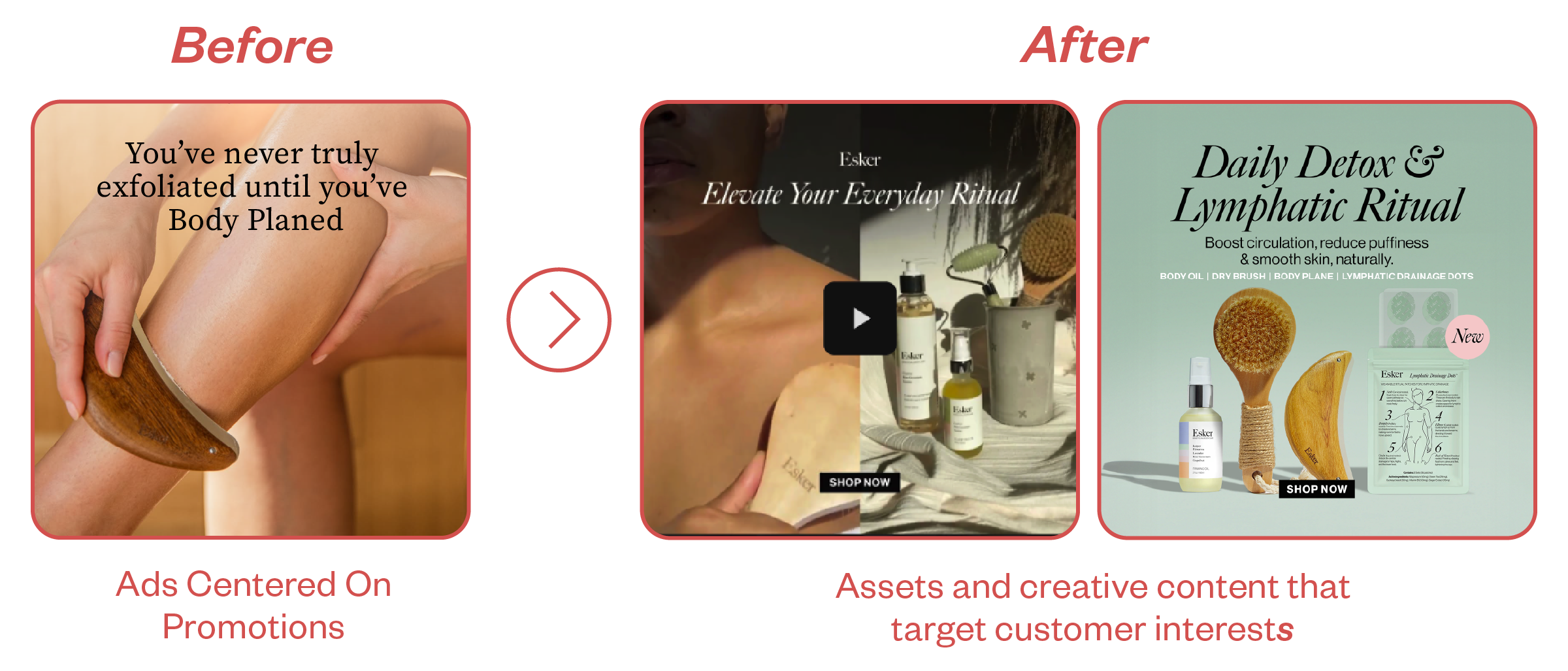
Esker Case Study
Esker, the prestige personal care brand, saw sales plateau despite its presence on Amazon and a 2025 launch at Ulta. By the fourth quarter, the brand knew it needed more than maintenance. It needed to stabilize the business, acquire new customers and prove its sales engine could scale.
Esker tapped Navigo’s connected commerce platform to assess ad strategies, sales growth and customer acquisition against expectations and diagnose misalignments. Navigo has done that assessment for other brands like Fur. Navigo’s platform can show ad spend within a sales channel such as Amazon and determine whether it would be better allocated to a different channel based on expected return on investment.
Following its analysis, Esker reduced ad spend by 31% to improve ROI. Ads were cut across Meta and Google, particularly those that retargeted the same audiences too aggressively, targeted existing customers or were deployed in areas where new customer growth had stalled. Return on ad spend improved by 40% in less than 60 days.
Common Reasons Your Meta Ads Aren’t Performing
- The frequency of ads is not optimized.
- Ad content isn’t speaking to the right audiences.
- Retargeting existing customers too aggressively.
- Leading too heavily with benefits at the top of the funnel.
When Esker began with Navigo, its ads centered on promotions. Navigo identified gifting as a more effective path to acquiring new customers. Because Esker’s portfolio includes several small gift sets and kits alongside larger individual stockkeeping units, Navigo created ad assets and creative content targeting consumers interested in gifting. The pivot was impactful in reducing Esker’s cost per customer acquisition by 38% year over year and increasing its on-site conversion rate by 43% in less than 60 days.
One Team Thinking
In the face of connected commerce, consumer packaged goods marketers are transforming their teams to better align ad spend with real consumer behavior. Often, brands have multiple teams handling growth marketing and sales or use third-party agencies to manage platforms such as Amazon. The structure can create friction and information silos because information isn’t being shared or received quickly enough, and team goals can splinter.
“[Navigo] can unify the entire content side of it, so that when a customer is seeing these multiple touch points, they are going to have an inherent connection because the messaging is consistent,” says Matthes. “[Otherwise,] when you have multiple different people creating creative [assets], the direction they go can be vastly different.”
She points out that the biggest hurdle brands face is internal pushback on connected commerce due to concerns about job security or diminished responsibility. Each sales channel in connected commerce reinforces the others and momentum builds over time.
Connected Commerce Measurement
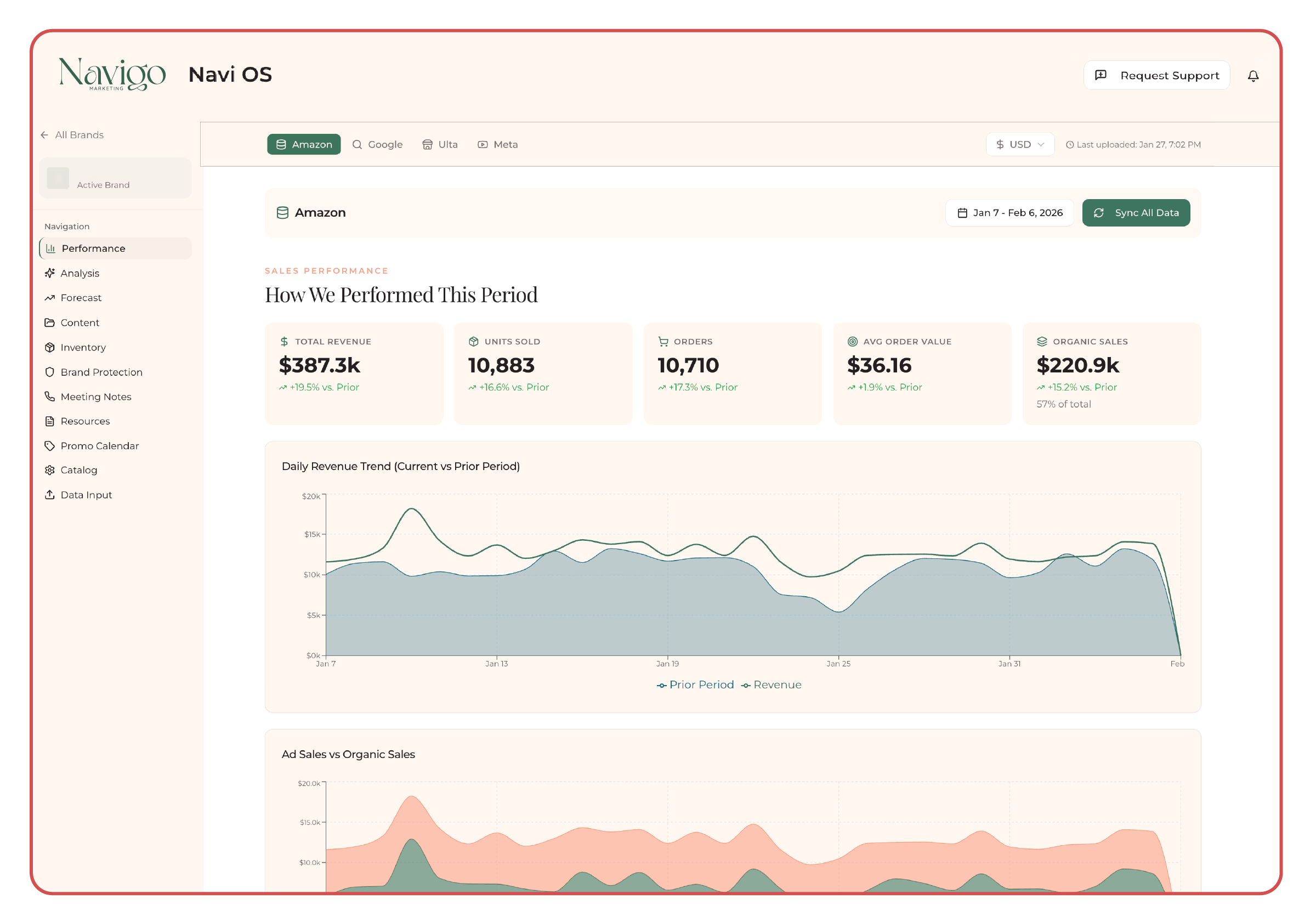
Navigo recently launched a proprietary tool native to its dashboard, giving brands greater visibility into how advertising investment in one channel is driving sales in another. Rather than looking at each channel in isolation, it surfaces the cross-channel connections that are often invisible, including how today’s spend can show up as sales in a completely different marketplace weeks or months later.
Second Case Study
A skincare brand with $15 million in annual sales engaged Navigo to reconfigure its advertising and content strategy. Despite distribution across Amazon, Ulta, TikTok, Meta and Google, it had failed to scale, and its connected commerce execution collapsed in the fourth quarter of 2024.
Navigo identified that the brand was overinvesting in Google and wasn’t driving new customer demand. One branded Google term alone was burning $50,000 a month with no incremental return. Ads were scaled back on Google and reallocated primarily to Meta and TikTok for upper-funnel ads as well as Amazon and Ulta for bottom-funnel conversions, with Google reserved for final-stage intent support. Additionally, ads were focused on prospective customers and featured more high-conversion SKUs.
“When you’re overspending on branded content, a lot of times it looks like it is performing well, because of high ROAs, but unfortunately you’re just retargeting the [existing customers] who were going to repurchase anyway,” says Matthes. “People are consistently willing to try new products. So, if you’re not continuing to build new customer bases and instead relying heavily on branded, you’re going to see sales drop.”
Ultimately, the brand reduced total ad spend by 60%, and its customer acquisition costs for new customers dropped by 66% year over year in less than 180 days. Profit jumped 520% year over year in the fourth quarter of 2025, creating room for reinvestment.
KEY TAKEAWAYS
- A connected commerce strategy is easier to develop than ever before, spurring a race among brands to adopt it.
- Connected commerce is viable for any brand that feels like it isn't unlocking sales growth in social media ads and is seeing other sales channels suffer.
- Connected commerce doesn't deliver automatic results. Patience is required.
- If a brand isn't acquiring new customers, it’s time to make a change.
Navigo Marketing is a full-funnel growth agency specializing in beauty brands across Amazon, Ulta, Sephora, TikTok and Meta. Navigo operates on a Connected Commerce model building integrated strategies that drive brand awareness and revenue across every channel where modern beauty consumers shop. Working closely with brand founders and marketing teams, Navigo combines data-driven performance marketing with high-quality content to accelerate growth without sacrificing brand integrity. With a track record of long-term client partnerships and measurable results, Navigo is a trusted growth partner for beauty brands looking to scale.
Learn More >