
Artificial intelligence is disrupting how beauty shoppers search and purchase products, but Amazon and Walmart still dominate online beauty shopping, according to a new report from marketing company Tinuiti.
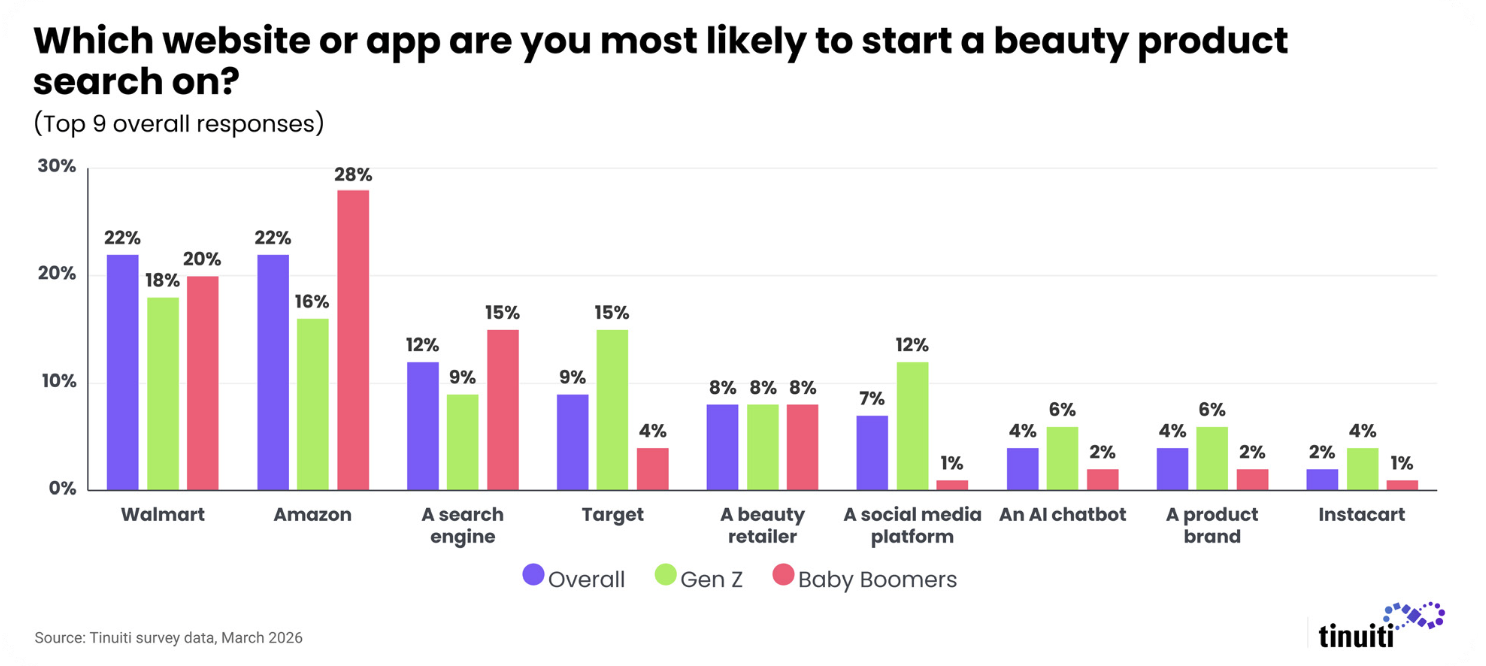
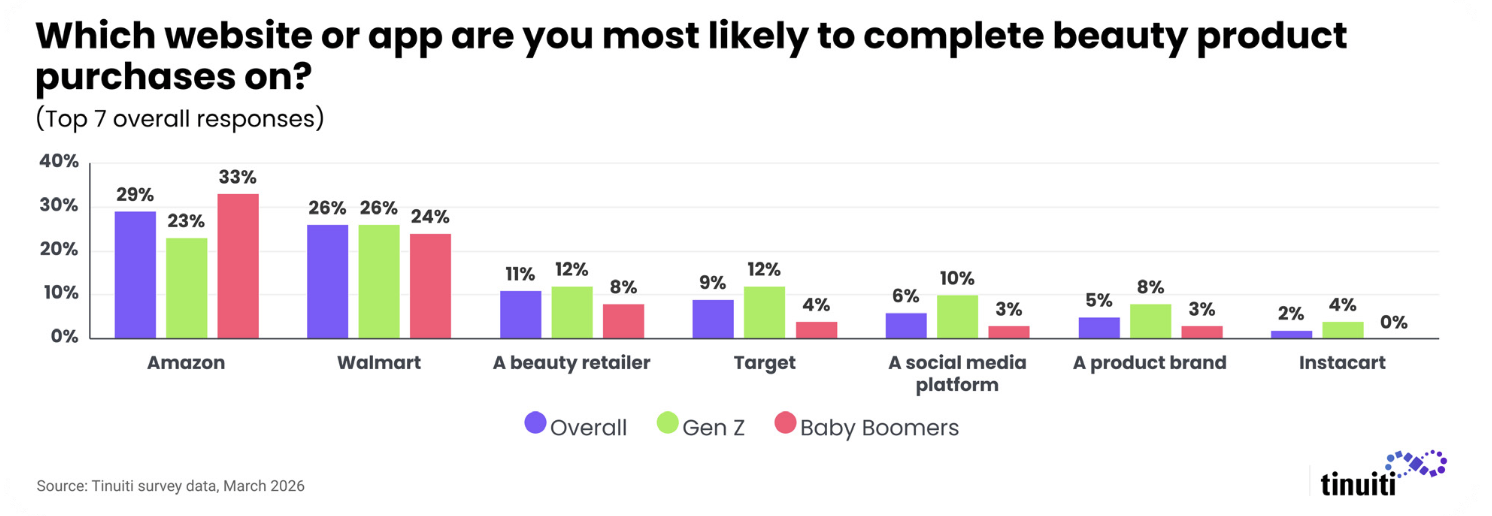
A March survey of 1,000-plus beauty shoppers in the United States found that Walmart and Amazon were the top two spots for where beauty product searches start online, claiming 22% of participants each. Search engines, Target and beauty retailers came in third, fourth and fifth. Asked where they are likely to complete a beauty purchase, 29% of participants said Amazon, 26% said Walmart, while 11%, 9% and 6% said beauty retailers, Target and social media platforms, respectively.
Half of shoppers polled discovered beauty products that they later purchased through social media, followed by in-store displays or signage and linear television advertising. Facebook was the top social platform for discovery, followed by YouTube and TikTok Shop, which ranked identically in Tinuiti’s 2025 beauty survey. About 30% of the shoppers surveyed buy products through TikTok Shop.
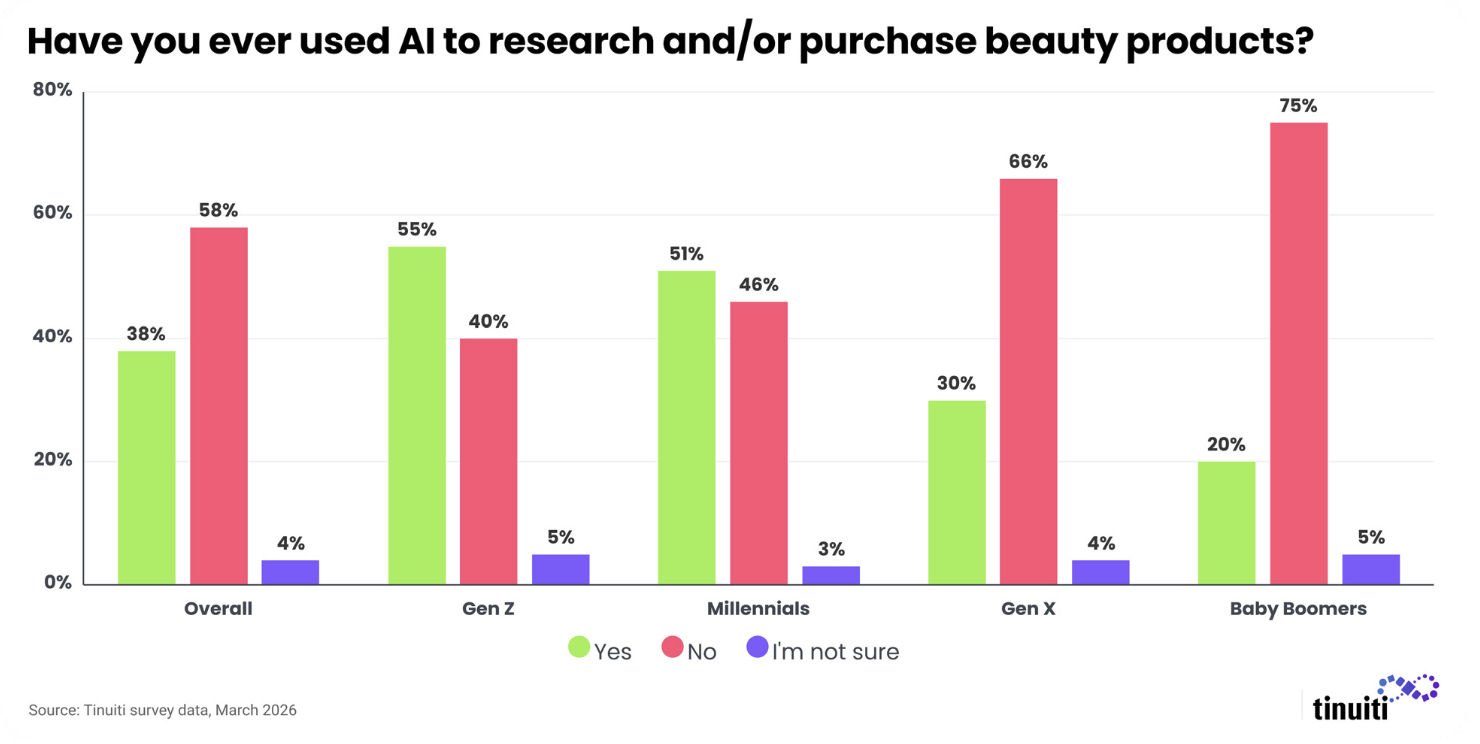
AI is hardly inconsequential, and the survey found that more than one in four shoppers have turned to AI-powered platforms like ChatGPT, Claude, Perplexity and Gemini for personalized beauty product recommendations. The rate is particularly high among younger, digitally savvy shoppers. Fifty-five percent of gen Z shoppers and 51% of millennial shoppers surveyed use AI to research and purchase beauty products. The rates for gen X and baby boomers were 30% and 20%, respectively. About 21% of the survey participants used AI to research beauty products in-store.
As AI adoption rates accelerate, Giselle Ebrat, founder and CEO of beauty recommendation website Searchbeaute.ai, argues that the power in beauty discovery is shifting from retailers that own inventory and logistics to those parties that master intelligence and recommendation. She says, “If AI becomes the primary interface for how consumers decide what to buy, then the entity that controls that recommendation logic, whether it’s OpenAI, a retailer or a verticalized beauty discovery platform, holds the most leverage.”
Hosting hundreds of millions of product listings online, Amazon and Walmart aren’t about to be dethroned as the industry’s leading conversion platforms soon. However, they’re having to play defense as AI platforms steadily siphon off discovery. Amazon launched its AI-powered shopping assistant Rufus in 2024 to provide shoppers on the platform with personalized recommendations. By the end of 2025, more than 250 million shoppers had used the tool, with monthly users up 140% year-over-year and interactions up 210%. The e-commerce giant claims the technology is on track to deliver over $10 billion in incremental annualized sales.
Walmart has moved aggressively to embed AI directly into the shopping journey. It launched shopping assistant technology Sparky directly into ChatGPT and Google’s Gemini earlier this month, allowing the retailer to tap into external discovery channels and maintain control over customer data, recommendations and checkout. The move comes after a partnership with OpenAI on its Instant Checkout feature last October failed to gain traction with shoppers. OpenAI is pivoting away from Instant Checkout entirely.
“Nobody wants to be just the shopping cart,” says Jonathan Cohen, CMO of skincare device brand Pure Daily Care and oral care brand AquaSonic. “The retailers who figure out how to make AI-powered discovery feel native inside their own platform will be fine. The ones who treat it like a bolt-on feature are going to wake up one day and realize they’ve lost the customer before the customer even starts shopping.”
Other beauty retailers are taking action, too. Last week, Sephora announced the integration of its app into ChatGPT, enabling shoppers to link to Beauty Insider accounts to get individualized recommendations using their profile preferences, purchase history and loyalty information. Eventually, shoppers will be able to make payments and check out directly within ChatGPT. Cohen says, “If Sephora’s catalog and review data are baked into the tool, that’s a massive advantage for brands in their ecosystem.”
In February, Target announced a partnership with OpenAI to test in-app advertising on ChatGPT based on keywords used during user conversations. Rina Yashayeva, SVP of brand strategy at e-commerce and marketing agency Front Row, explains partnering with AI companies underscores retailers’ need to stay as close as possible to the point where discovery and purchase merge. She says, “At the end of the day, it should always come back to the consumer.”
AI may be becoming an integral part of the beauty shopping journey, but it isn’t simplifying it, at least not yet. According to the Tinuiti survey, 48% of gen Z shoppers, 43% of millennials and the majority of gen X and baby boomers are using more sites and apps to discover beauty products than before they started using AI tools. Kelsie Johnston, founder of agentic commerce advisory firm KJT Ventures, reasons the use of a multiplicity of sites and apps is due to the nascency of AI tools, with no preeminent tool yet commanding creativity, guidance and purchasing activity.
“It makes sense that people aren’t clicking through if they’re looking for a quick answer to a question like, ‘What moisturizer is good for winter?’ That’s low risk, accessible pricing, low friction, easy switching,” she says. “The stakes of the purchase dictate the depth of the journey, and for most beauty purchases, we’re still in quick-answer territory where AI supplements, but doesn’t replace the broader discovery ecosystem.”
Ebrat agrees that beauty consumers are stitching together purchasing pathways as social media drives discovery, retailers capture transactions and AI tools insert themselves somewhere in the middle. She figures shopper behavior will eventually consolidate into fewer, more integrated platforms over time. She says, “No single destination fully solves beauty discovery yet.”