

Artificial intelligence is beauty’s newest gatekeeper, and it’s not easily impressed.
More than half of consumers report abandoning a purchase after an AI assistant surfaced concerns about a product due to incomplete, inconsistent or poorly documented information, according to a new report from Amazon agency Envision Horizons titled “The New Blind Spot: Why AI Is Sending Your Customers to Competitors.” Nearly 40% say they’ve abandoned a purchase once or twice as a result of AI, while 12.1% report it happens often in their shopping journey.
“AI has become the new trust layer in commerce,” says Laura Meyer, founder and CEO of Envision Horizons. “Consumers are discovering products on social media, validating their purchase decisions with AI and completing transactions on Amazon. The findings in this report confirm that this emerging consumer journey is already taking shape.”
The report is based on a survey of 1,035 U.S. consumers. Questions about AI’s impact on the shopping process, including where AI-researched purchases are completed, brand switching, trust rankings and whether AI has stopped a purchase, were asked only of the 744 respondents who reported using AI for shopping.
Shoppers don’t appear to resent AI’s role in the purchasing process. According to the survey, 40.7% of consumers who use AI for shopping say AI-generated recommendations are “often” or “always” well-suited to their needs. Consumers have long relied on reviews, influencers and marketing to guide purchasing decisions, but they’re increasingly outsourcing part of the vetting process to AI systems capable of summarizing reviews, evaluating ingredients, comparing products and identifying alternatives.
Consumer trust in AI, however, isn’t equal across categories. Only 23% of consumers surveyed are comfortable purchasing health and wellness products based primarily on an AI recommendation, compared to 25% for apparel, 33% for electronics and gadgets and 36.7% for household items. Beauty’s position in the middle indicates consumers are willing to consult AI, but remain hesitant to hand over purchasing decisions entirely.
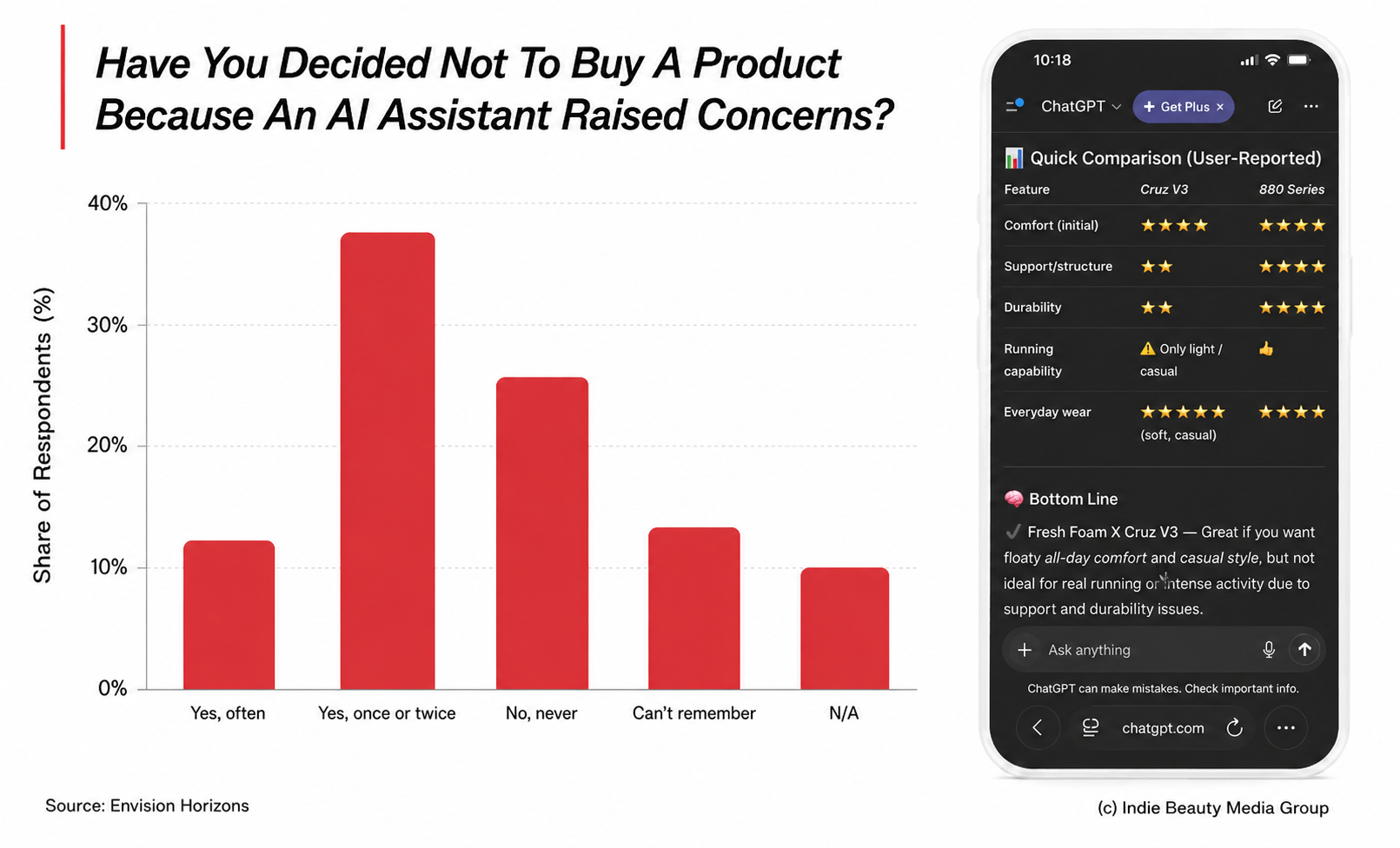
As consumers increasingly incorporate AI into their shopping research, it seems to be penalizing uncertainty. Products with strong ratings, for example, are still getting flagged if AI detects recurring complaints buried in reviews. Likewise, product claims that AI can’t validate through accessible information may raise concerns. The latter could be especially important in beauty, where brands often rely on ingredient claims, efficacy promises and educational content to differentiate themselves.
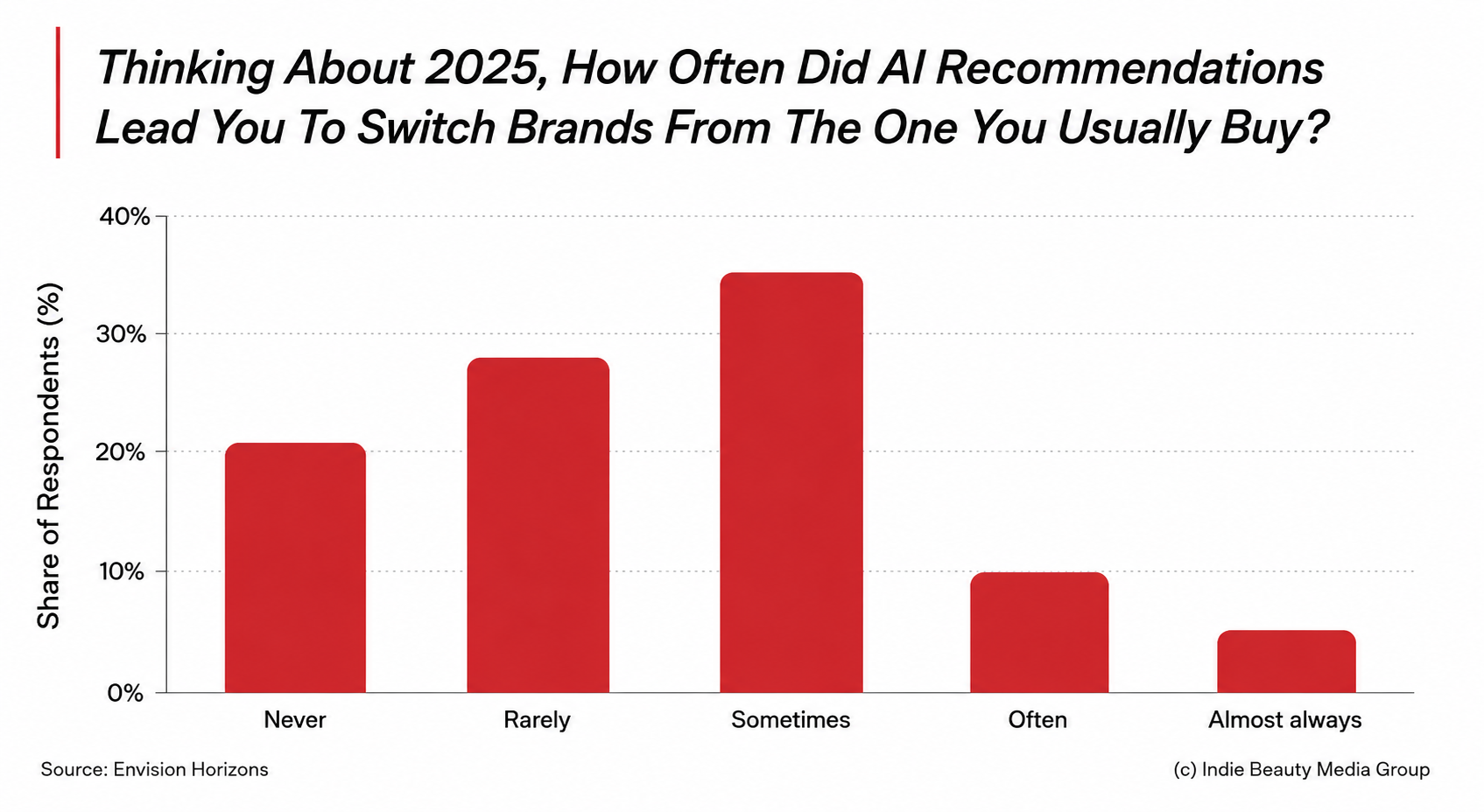
Beyond screening products, AI is helping consumers discover replacements. Nearly one-third of AI shoppers surveyed say they use AI to find alternatives to products they’re considering. Meanwhile, almost 80% report experiencing some degree of AI-driven brand switching. For beauty brands that have spent years building awareness, that statistic may be even more consequential than AI’s veto power. AI can now shift a consumer’s consideration set every time they ask a question.
According to the report, consumers prioritize price, ratings and familiarity ahead of brand name when making purchasing decisions. Only 9.8% of consumers surveyed said they would choose a product based solely on brand name when AI presents options side by side. The finding underscores that the brands most likely to benefit from AI-influenced shopping may not be the biggest legacy players, but those with the cleanest product data, strongest review profiles, clearest claims and most complete information across channels.
“Big budgets won’t matter if product quality and customer experience don’t live up to customer expectations, and AI is going to make sure of that,” says Meyer. “The real opportunity may belong to challenger brands. They can leverage AI recommendations to position themselves as better alternatives, capitalizing on the awareness larger brands create while winning on product performance, customer satisfaction and trust.”
Conversational commerce is expected to soar as the likes of OpenAI, Google, Amazon and Walmart are investing heavily in agentic experiences. Bain & Co. estimates that the agentic commerce market in the U.S. could reach $300 billion to $500 billion by 2030, making up roughly 15% to 25% of overall e-commerce. Brands spent the past two decades optimizing for Google search and Amazon rankings, and now they’re having to optimize for a new generation of e-commerce.
“The rise of agentic AI shopping is the single biggest disruption to e-commerce discovery since Google,” says Meyer. “But unlike SEO in its early days, the window to get ahead of this is still open.”
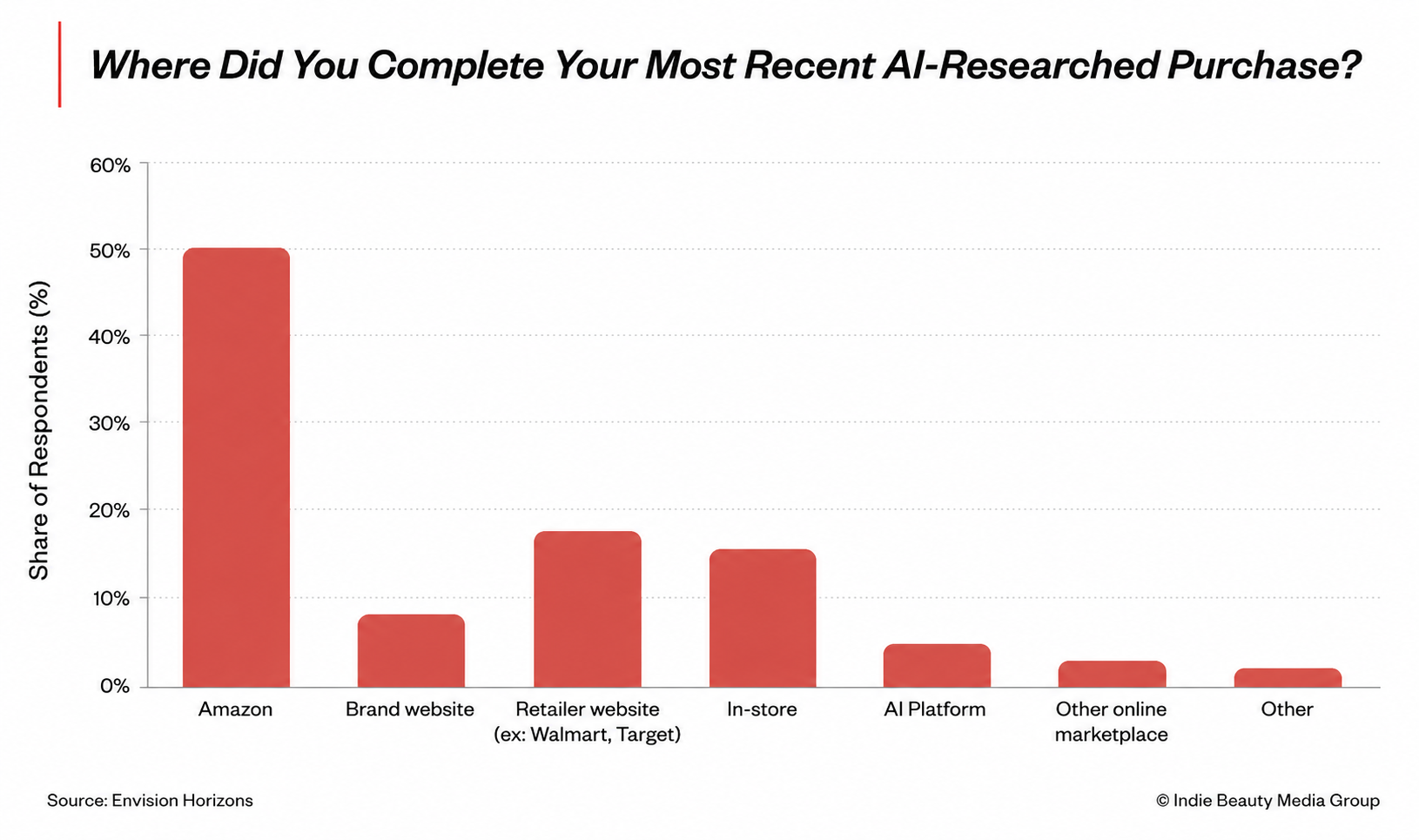
AI is disrupting discovery, but it hasn’t yet disrupted where purchases happen. Among consumers who have used AI for shopping, roughly half said their most recent AI-researched purchase occurred on Amazon, where scale, fast delivery and ingrained shopping habits keep customers sticky. Retailer websites such as Walmart and Target captured 17.6% of shoppers, while in-store accounted for 15.6% and brands’ sites 7.8%.
That dynamic may not last forever as technology companies close the gap between search and checkout. OpenAI recently pulled back from its standalone Instant Checkout initiative to focus on discovery and merchant-controlled transactions, but Google continues to push into commerce through shopping integrations and checkout capabilities embedded in search and AI experiences.
“The separation between ‘AI decides’ and ‘AI transacts’ is temporary,” cautions Envision Horizons’ report. “The question isn’t whether AI will own checkout, it’s when, and whether Amazon’s pull on consumer habit is strong enough to outlast it.”
Although relatively few AI-influenced purchases occur on brand sites, Envision Horizons found that 14.1% of consumers visit those sites after conducting AI research to validate claims, browse product lines and get acquainted with a brand they may never have heard of before. For beauty brands, sites need to function less like digital storefronts and more like educational hubs moving forward. Ingredient information, clinical results, FAQs, product specifications and educational content are valuable not only to consumers, but to the AI systems interpreting those pages, too.




Leave a Reply
You must be logged in to post a comment.