
While many beauty brands are backpedaling on sustainability, Sonsie is going full throttle.
Under the stewardship of Kailey Bradt, a chemical engineer who became CEO of the Pamela Anderson-owned direct-to-consumer skincare brand last month after starting supply chain platform Syndeo and Susteau, a now-shuttered eco-conscious haircare brand, Sonsie is foregrounding its commitment to the earth by housing its new multifunctional moisturizer, Adapt Cream, in a jar constructed from the company Shellworks’ compostable Vivomer material. The natural polymer material is made from microbes fermenting plant-based waste and designed to perform like plastic.
“I feel responsible to educate people that we do have a solution now that is the same quality as virgin plastic,” says Bradt. “You’ve got to touch and feel this thing. You wouldn’t believe it’s not plastic. I think we needed to show people that we can do better, and here’s proof.”
The decision to use Vivomer, which is also used by beauty brands such as People Care. Planet Care, Abel and Wildsmith, is part of a broader repertoire of sustainability actions Sonsie is taking. Certified plastic negative by Repurpose Global, the brand pledges to remove twice as much plastic as it uses, and Bradt is focused on transparency in the business to share with consumers—and competitors—the opportunities and challenges of sustainability from source to digital shelf.

“I don’t think you can have sustainability today without transparency because we as consumers have just been misled,” says Bradt. “It’s not always the brand’s fault, it’s lack of information and transparency from the vendors as well, but we’re going to be that brand that helps open that up, and we want other brands to follow us.”
Companies are running in the other direction lately, deeming the upfront costs of sustainability efforts not worth the payoff as consumer interest wanes. A 2025 The Conference Board survey reveals 80% of corporations are reworking their environmental, social and governance (ESG) strategies, signaling a pullback from earlier environmental and social initiatives. Bain & Co. surveys find that the percentage of Americans concerned about long-term environmental issues has declined from 90% in 2023 to 79% in 2025.
“I don’t want to see another plastic jar.”
Acknowledging the retreat, Bradt admits costs remain a hurdle, but she argues they’re not unreachable for brands, particularly for premium brands, and she says Sonsie’s customers value its eco stance. She estimates the Shellworks’ Vivomer jar is four to six times the price of a comparable container constructed from recycled plastic. To account for the higher cost of the compostable jar, Sonsie priced Adapt Cream at $4 higher than its original target price of $54. The price is still within Sonsie’s wider price range of $22 to $64.
“Do I think I’m going to get return on the investment? That’s not why I did it. It was the right thing to do,” says Bradt. “I don’t want to see another plastic jar. I don’t want to see another glass jar with a plastic lid. If we can set a new standard for sustainability in beauty, that’s what I want to do.”

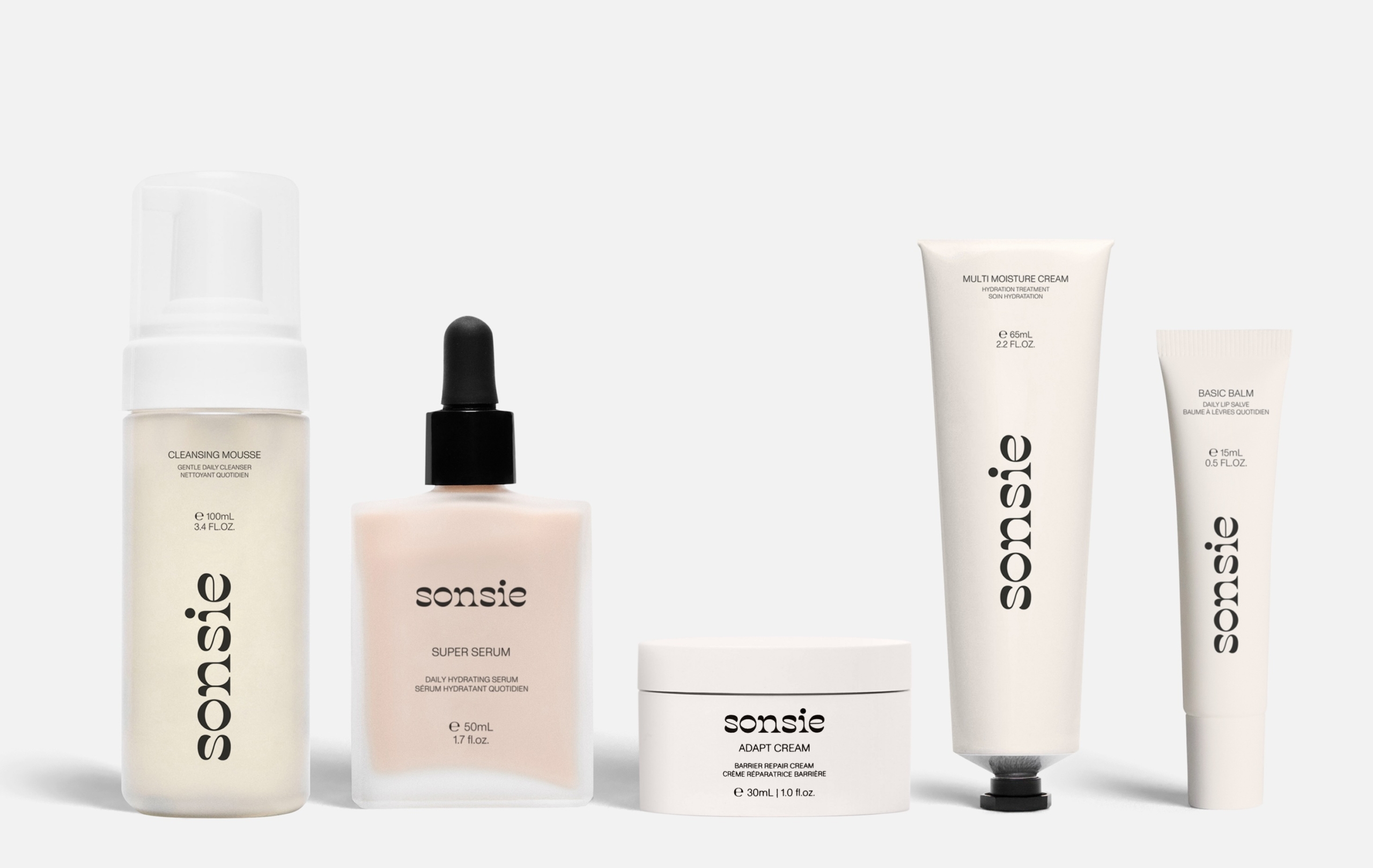
Bradt predicts Adapt Cream’s sales could surpass sales of Super Serum, Sonsie’s current bestseller. The brand’s complete assortment has five products, including Basic Balm, Cleansing Mousse and Multi Moisture Cream. “I really needed to show we could put a product out that would sell,” says Bradt. “The price point is super affordable for what the product does. It’s more than one product.”
In a statement, Anderson says, “We created Adapt Cream to support your skin, to just feel more you. There’s no wrong way to use it… it’s easy… under the eye, on a dry patch, I just use it all over my face and even noticed my sunspots are less noticeable. Then there’s this packaging. It’s not plastic, it’s made from plants. It’s home compostable! I can actually just throw it in my garden compost when I’m done.”
“I can actually just throw it in my garden compost when I’m done.”
Sonsie’s customers who overlap with Anderson’s fans are aware of the actress’s history of animal rights and environmental activism. She’s championed veganism as a way to reduce greenhouse gas emissions and protect animal welfare and is an honorary director of PETA, the animal rights organization. In a recent survey of 1,600 of Sonsie’s customers, factors influencing their skincare purchases are specific ingredients (60%), brand ethos (27%) and product claims (23%). Over half of the brand’s customers are aged 45 and above, giving them disposable income to support brands that comport with their ethics.
Formulated for sensitive skin, Adapt Cream responds to all those factors. The barrier cream features a green tint and contains 1% bacillus ferment blend and 2.5% adaptive tripeptide complex with palmitoyl tripeptide-5 and glycerin. The bacillus ferment is sourced from the river Río Tinto in Spain, where it thrives in a harsh setting.
In a four-week study of 25 people aged 36 to 50 applying the adaptive tripeptide blend two times daily, 100% reported their skin felt visibly smoother and firmer. The brand clarifies the clinical data is for individual ingredients and may not match combined results.
Model and influencer Marie von Behrens‑Felipe and her husband Roberto Felipe launched Sonsie in 2023. They raised an undisclosed amount of funding from friends and family to bring the brand to market. Last year, Anderson acquired a majority stake. The brand declined to specify sales, but noted, “2025 has been Sonsie’s strongest year yet, achieving record revenue and expanding its customer base.”
Bradt’s former brand, Susteau, broke into Sephora in 2021. She envisions beauty specialty retail in the future for Sonsie, though not immediately. The brand has dealt with stockouts, and it’s shoring up its inventory as it evolves its packaging for sustainability goals. Fundraising could be in the brand’s future, too.
Refills are on the horizon for Sonsie, beginning with the $32 3.4-oz. Cleansing Mousse. The brand is figuring out the pricing and sizing of the Cleaning Mousse refill, but it could be nearly triple the price and triple the size. “A lot of brands, they launch refills because there’s a refillable package for something, but they don’t even know people are going to rebuy it,” says Bradt. “We didn’t launch a cleanser and a cleanser refill at the same time. We waited to see if there was demand for it.”